



Bridging the Joint Thesis
Whether they’ve been shacked up in Lamont, Starbucks, or the back of your dining hall, they’ve undoubtedly been working away, huddled over laptops and poring over sticky-noted library books. With the final thesis deadline fast approaching, many are days away from the time when they’ll print, bind, and send a year’s worth of work, research, and sweat out into the universe (or at least university) for final judgment.
Perhaps the only undergraduate undertaking more challenging than writing a senior thesis for your concentration is writing an interdisciplinary thesis for both of your concentrations. Yet for some passionate thesis writers, this joint-concentration endeavor was just the challenge they’d been waiting for.
SEEKING APPROVAL
As demanding as the challenge of writing the interdisciplinary thesis may be, according to some joint-thesis writers, gaining permission to do so can be just as testing.
Alicia C. Beyer ’10, an Economics and History of Art and Architecture joint concentrator, wrote her senior thesis on the factors motivating corporate giving to the arts. Gaining approval for such a project, however, was no easy feat:
“It was challenging getting it approved, and a challenge convincing people that it wasn’t just that I had two very disparate interests and wasn’t willing to compromise, but that I was interested in their intersection,” explains Beyer.
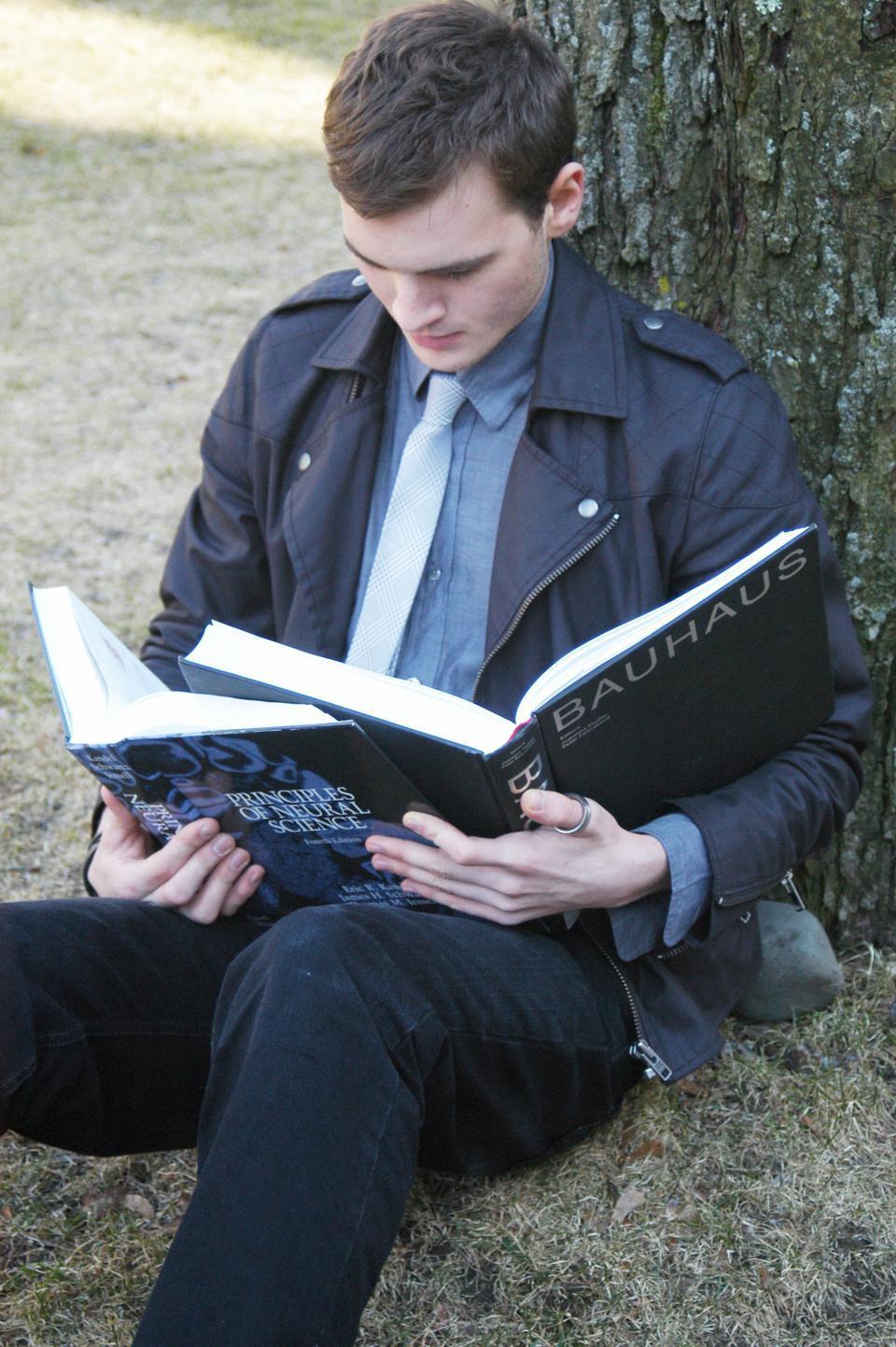
Roger C. Batt ’10, a History of Art and Architecture and Neurobiology joint concentrator, experienced a similar challenge in trying to identify a thesis topic that would fit with both his fields of interests.
“The most challenging part was just getting started and really finding a topic that both [departments] could work with because making a topic work for both a science and a humanities department was really difficult,” explains Batt. “At first they tried to encourage me to pursue a secondary in Art History, but I really wanted to do a joint concentration.”
THE STRUGGLE CONTINUES
Even after gaining approval from their departments, for some joint concentrators, one of their greatest challenges is just keeping both concentrations satisfied.
For Sarah A. Hinkfuss ’10, a joint Environmental Science and Public Policy (ESPP) and Economics concentrator writing her senior thesis on equity in informal water markets overseas, one of the greatest struggles was balancing the requirements and expectations of the two departments.
“Constantly, I was going back and forth. I was always writing and then figuring out what I needed to do and just making sure that what I wanted to do fit the stipulations of both departments,” Hinkfuss says. “It was very frustrating when I felt like I was attacked from both sides. Environmental would say I wasn’t being environmental enough, and economics would say I wasn’t being ‘economics-y’ enough...because I tried to mediate between different areas, it was like no area was satisfied.”
For Batt, finding the balance between Neuroscience and Art History has also been a challenge.
“Neuroscience is interested in methodology, the various scientifically rigorous aspects, whereas art history doesn’t care as much about the science. They care more about the theory. So it’s difficult to balance how much I’m going to give to each concentration.”
Of course, the challenges of undertaking such a massive project extend far beyond pleasing department heads.
For Natasa Kovacevic ’10, whose thesis combines Economics and Neurobiology, one of the greatest obstacles was fielding her own research, a process that was wrought with doubt.
“With a science thesis, especially an empirical one that’s so experiment heavy, you can never be sure of what you’re doing. You can never be sure that you’re going to get the results that you need,” explains Kovacevic.
According to Kovacevic, the threat of gathering potentially useless data loomed until the projects’s end.
“I’m not afraid of putting in a lot of work,” she says. “But it would sometimes be very daunting that no matter how much work I put in I couldn’t know for sure that my experiment would work.”
THE SPARK
So why was it worth it? Why go through the bureaucratic hassle of melding two fields? At the core, it was the writers’ passion that served as their primary motivation. Whether researching water supplies overseas or analyzing corporate giving to the arts, the genuine interest of these writers was what kept them typing.
For Hinkfuss, the challenge of combining two related fields with frequently opposing views was an interesting and novel experience.
“A lot of times, economists and environmentalists are on completely opposite sides of the table, so I was interested in studying them together in order to find the overlaps,” she says.
And beyond this challenge was the allure of producing useful research and data. Since Hinkfuss studied and proposed new policy for a real informal water market, her results have the potential to be put to use.
“I came up with policy suggestions and it’s neat because the people I worked with are the people who are in charge of actually monitoring [the water market], and they’re very interested in what I’ve been doing and my results,” she says. “I’ll have the opportunity to present this and potentially have it become policy.”
Kovacevic’s research results will also have real-life relevance.
“My research could actually yield useful new insights, so I felt like I wasn’t just doing it for the sake of me and my undergraduate thesis, but that it could actually be useful to future researchers in both fields.”
Overall, many joint-concentration thesis writers feel that focusing on two fields was an invaluable experience, one which allowed them to push their research and explore their topic at an even higher level.
“Definitely combining them forced me to bring their two methodologies into consideration and then to complement each other,” says Beyer of her experience writing on both Economics and Art History. “I definitely got things out of combining them that I wouldn’t have gotten from doing them separately.”
For Hinkfuss, the experience of combining Economics and ESPP allowed her to extend her research and analysis beyond what either department could have offered independently.
“If I had been an ESPP concentrator I could have written a thesis like the one I’m writing, but it wouldn’t have had the Economics support, and my thesis wouldn’t be what it is today,” Hinkfuss says.
Although the thesis writers have spent hours in the library pecking away at their computers, Beyer’s perspective of the value of her undertaking extends beyond the confines of the university.
“The real world is very interdisciplinary,” says Beyer. “Only in academia are there these weird, very defined environments, and so that was neat.”