

News
Summers Will Not Finish Semester of Teaching as Harvard Investigates Epstein Ties

News
Harvard College Students Report Favoring Divestment from Israel in HUA Survey

News
‘He Should Resign’: Harvard Undergrads Take Hard Line Against Summers Over Epstein Scandal

News
Harvard To Launch New Investigation Into Epstein’s Ties to Summers, Other University Affiliates

News
Harvard Students To Vote on Divestment From Israel in Inaugural HUA Election Survey
Simmons Discusses Doll Photography
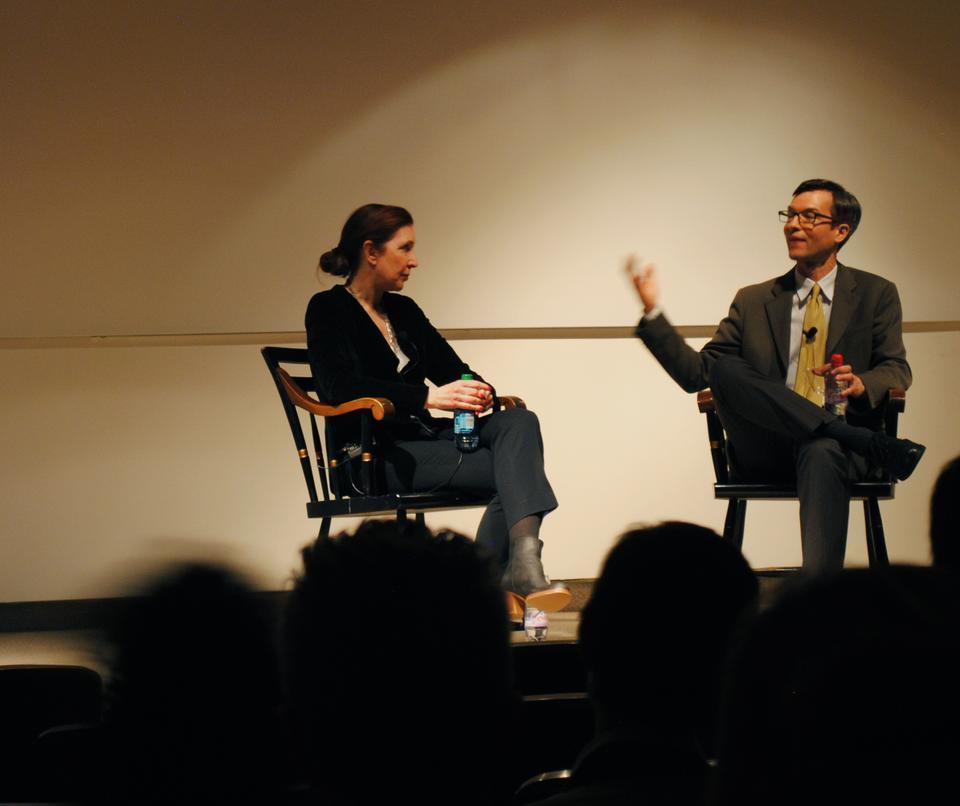
Laurie Simmons, an American contemporary photographer who captures photos of dolls, talked Tuesday at the Sackler Museum about the unique focus of her most recent photos—a life-sized Japanese sex doll.
Her newest series, called “The Love Doll,” features the doll in different scenes, including a nude photo of the doll playing on the floor with a puppy, a photo of the doll wearing twenty pounds of jewelry, and a few photos where the doll is dressed as an authentic geisha.
“By using dolls, inanimate objects, I can get more quickly to the core of emotions than when using other people,” Simmons said. “I keep having to say something about the subject of a woman as expressed through a photo.”
Simmons said she has always been drawn to photographing dolls. After coming to New York City in the 1970s and briefly shooting photographs for a toy catalogue, she started using dolls, dollhouses, and dummies in her work.
Although she has focused on female subjects during his entire career as a photographer, she said her earlier photos connote themes of nostalgia and memory in scenes of domestic, middle class life.
“I have always been drawn to a kind of nostalgia,” Simmons said.
One of her more recent projects was a 2006 musical film, The Music of Regret. The protagonist, played by Meryl Streep, begins the movie as a doll made in Simmons’ own image. Simmons said that—unlike photography, which captures a single moment—film moves with explicit linearity.
“I never think about the story,” Simmons said. “I always wanted it to feel like almost a daydreaming, natural moment where people didn’t think about what came before or what came after.”
History of Art and Architecture Professor Robin Kelsey, who led the Q&A section, said that the new series “brings out all the erotics of the earlier works.... There’s a movement towards a greater life-likeness.”
Avery W. Williamson ’13, a visual and environmental concentrator who attended the lecture, said “these art talks are a great opportunity to get a sense of what’s going on in the art world.”
Want to keep up with breaking news? Subscribe to our email newsletter.