
News
Summers Will Not Finish Semester of Teaching as Harvard Investigates Epstein Ties

News
Harvard College Students Report Favoring Divestment from Israel in HUA Survey

News
‘He Should Resign’: Harvard Undergrads Take Hard Line Against Summers Over Epstein Scandal
News
Harvard To Launch New Investigation Into Epstein’s Ties to Summers, Other University Affiliates

News
Harvard Students To Vote on Divestment From Israel in Inaugural HUA Election Survey
Clive Davis Talks Whitney Houston, Professional Journey

Legendary music industry executive Clive Davis described his transformation from Harvard Law School student to president of Columbia Records at a lecture in Wasserstein Hall on Friday afternoon. Answering questions from HLS Dean Martha L. Minow and audience members, Davis talked extensively about his work with Whitney Houston, Dionne Warwick, and other artists before a crowd of several hundred event attendees.
His talk came days after the release of “Whitney Houston Live: Her Greatest Performances,” a live album that celebrates some of Houston’s biggest hits, which Davis helped produce. Davis, who launched Houston’s career, remains one of the only non-performers to be inducted into the Rock and Roll Hall of Fame. He signed artists like Janis Joplin, Bruce Springsteen, Aretha Franklin, and Alicia Keys.
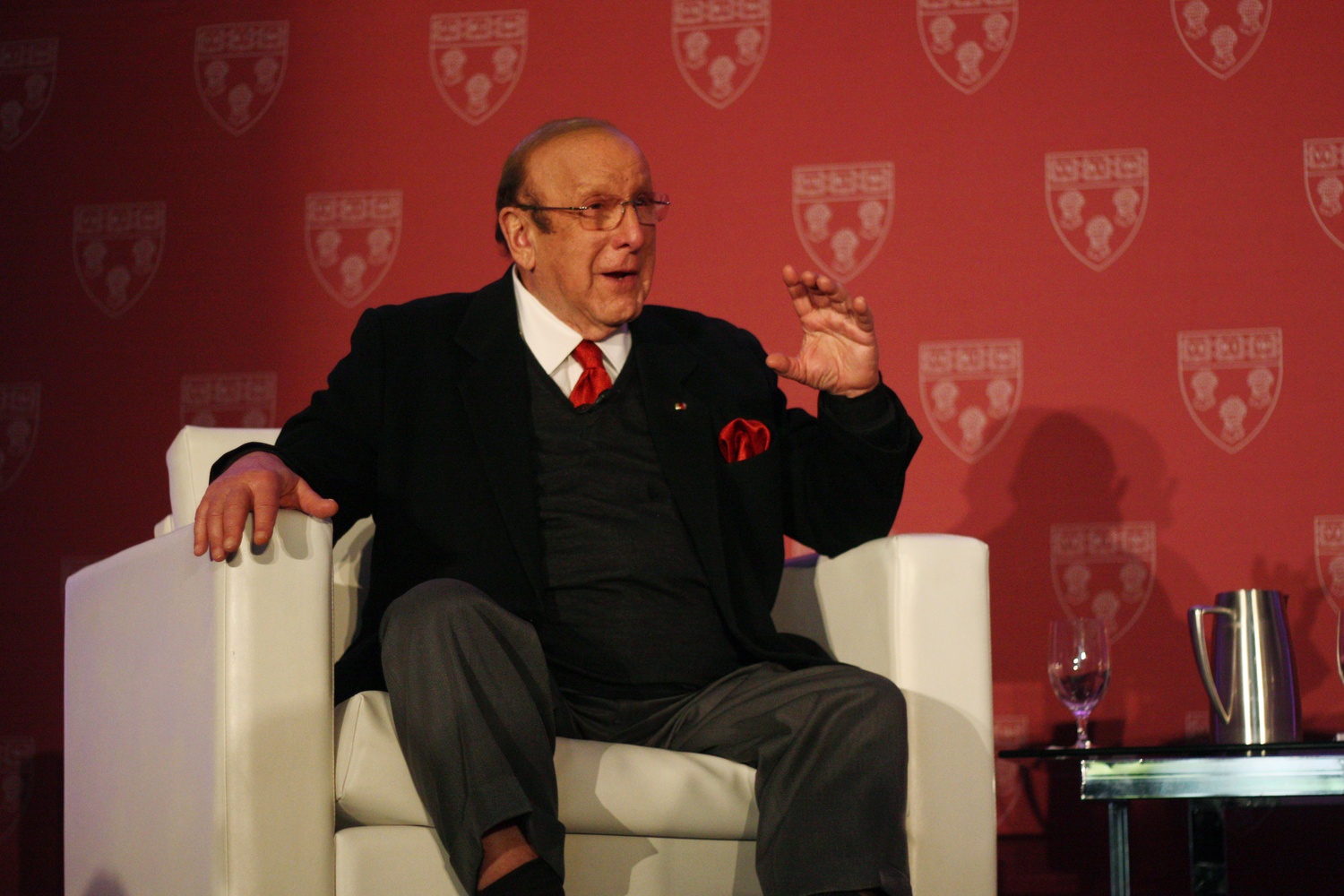
“I am so nervous,” said Minow after Davis received a standing ovation at the start of the event. “I have interviewed Supreme Court justices; I have been with presidents of countries; [but] I’m just so nervous. I am a fan.”
Davis’ college years, he said, were characterized by great anxiety over his financial situation: both of his parents died when he was a teenager and left him only $4,000, the balance of his father’s life insurance policy.
This precarious financial situation, coupled with the rigorous curriculum at HLS, motivated him to work hard, he said.
“The fear that if you don’t maintain a certain average you’ll lose your scholarship just creates the drive, the determination, the scared necessity,” Davis said, adding that such a necessity solidified his work ethic, which would prove instrumental in his career.
According to Davis, his entrance into the music world after law school was purely accidental: Columbia Records happened to be one of the clients of the law firm where he worked after graduating from Harvard in 1956. The record company, in search of a general counsel, hired Davis, and eventually offered him the role of president after a string of promotions left the position vacant.
“[That is] how I became head of Columbia Records,” Davis said. “It wasn’t my awareness, any ambition, any training. It really just happened.”
In his role as president, Davis brought fame to now well-known artists such as Houston, whom Davis discussed at length at Friday’s event.
According to Davis, after Houston heard consistent negative feedback from critics, she asked him if she should be writing her own songs.
Davis said that he reminded Houston of the record-setting sales of her first two albums, which sold around 50 million copies in total, and told her that her biggest asset was the “genius” of her voice and not necessarily her songwriting ability.
Prompted by Minow, Davis concluded the event by briefly addressing recent changes to the music industry that have led to decreased record sales.
“The concept of music being free is abhorrent, is wrong,” he said. “The idea that creativity should not be rewarded is so antithetical to our culture.”
Want to keep up with breaking news? Subscribe to our email newsletter.