

News
Summers Will Not Finish Semester of Teaching as Harvard Investigates Epstein Ties

News
Harvard College Students Report Favoring Divestment from Israel in HUA Survey

News
‘He Should Resign’: Harvard Undergrads Take Hard Line Against Summers Over Epstein Scandal

News
Harvard To Launch New Investigation Into Epstein’s Ties to Summers, Other University Affiliates

News
Harvard Students To Vote on Divestment From Israel in Inaugural HUA Election Survey
Astronomy Chair Breaks Down Search for Other Life Forms
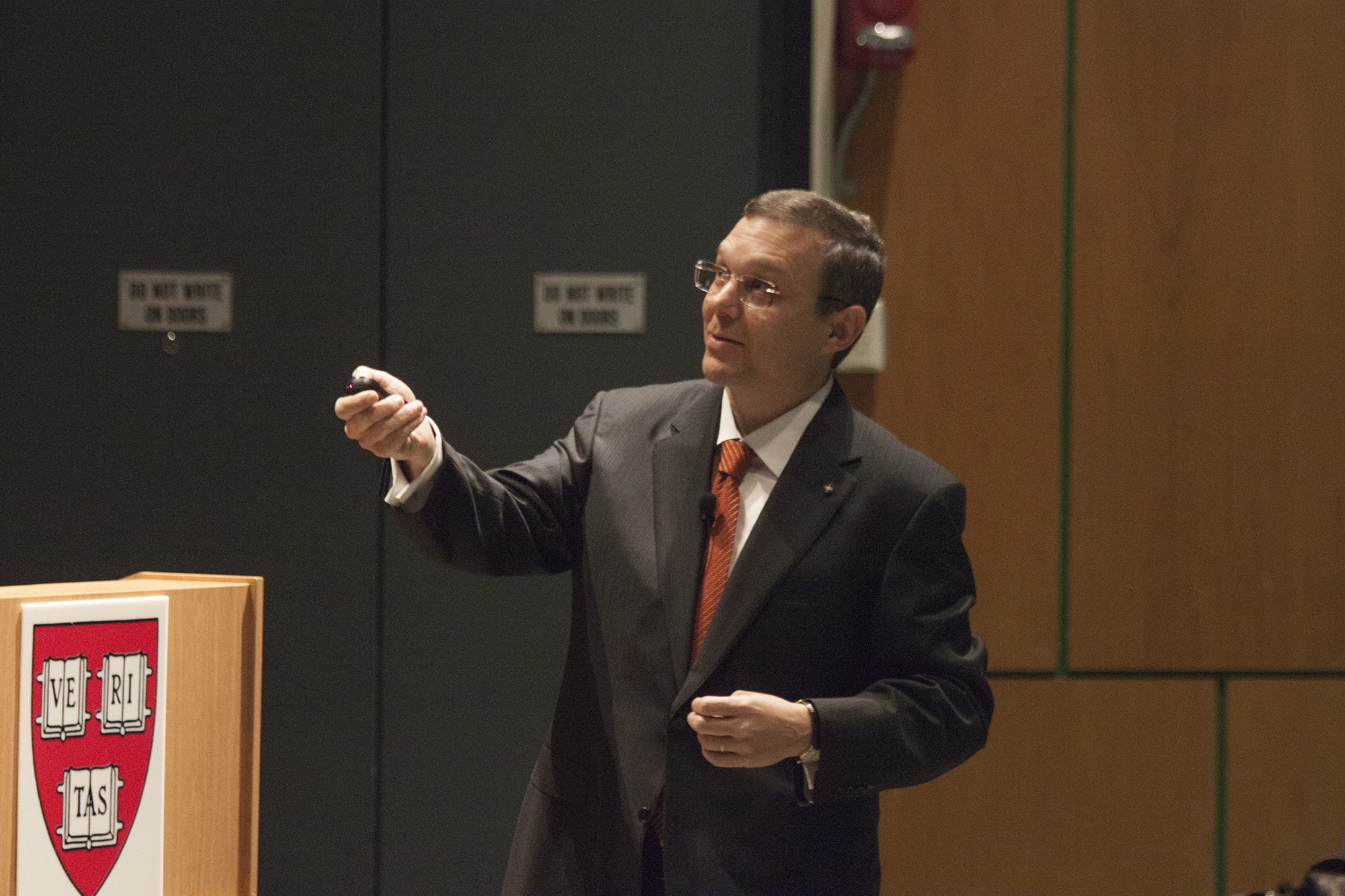
Harvard Astronomy department chair Abraham “Avi” Loeb presented cutting-edge techniques in the search for primitive and intelligent life Tuesday evening. Speaking to a room of about 200 people, Loeb introduced several methods used to answer the unsolved question of whether forms of life exist beyond Earth.
One way to answer that question is to locate extraterrestrial life by searching for artificial light on planets, Loeb said. However, as these planets are all orbiting stars, Loeb said, “you get blinded from the light that comes from a star."
This means that cosmologists must effectively block out the light from the neighboring sun in order to see artificial light, according to Loeb. In response, cosmologists have built starshades—large instruments that resemble tents—with specifically shaped apertures that block out light from stars while allowing light from the planet.

Another method discussed by Loeb is to search for biomarkers with large-scale telescopes, defined as those 24-39 meters in size. Harvard is sponsoring the construction of one such telescope, the Giant Magellan Telescope. Telescopes like the GMT have increased ability to detect biological particles on distant planets.
“The best instrument to use would be the James Webb Space Telescope," Loeb said. NASA's JWST is set to launch in October 2018 and is expected to be one of the most advanced telescopes in the current technological arsenal. As it is especially sensitive to infrared rays, Loeb expressed hope that the JWST will finally capture evidence of extraterrestrial life.
Another technique is to seek evidence of industrial pollution in the atmosphere of other planets, which Loeb said is a key characteristic unique to inhabited planets. Some may argue that pollution indicates the existence of an unintelligent life form because it shows that the species does not know how to take care of the planet. However, according to Loeb, industrial pollution may not be a negative characteristic because it may help the planet stay warm. Therefore, industrial pollution may still be indicative of a highly intelligent species.
Despite current technological progress, Loeb said, “there are some blank pages in the photo album of the universe." There is a rush to locate extraterrestrial life because as the universe begins to expand at an increasing speed, it will become more difficult to detect even the faintest traces of other galaxies, he said.
Want to keep up with breaking news? Subscribe to our email newsletter.