
An Ode To The Culture: Harvard’s ASL Program
I am two months into Harvard’s ASL 1 course, and I’ve finally racked up enough signs and confidence to clumsily string together a few complete sentences at our morning ASL coffee chat.
ne hour after Tatte Bakery and Cafe opens its doors for the morning, a small herd of students mark their spot in the corner of the top floor. Our laughter ripples through the bustling Tatte noise, and soft banging on the tables shakes our coffee orders. Yet not a single verbal word is uttered.
Instead, I bring my index and middle finger to gently brush my nose to say “funny,” my eyebrows furrow when asking a question, and my fellow American Sign Language students and I amateurly sign about our plans for the day. I am two months into Harvard’s ASL 1 course, and I’ve finally racked up enough signs and confidence to clumsily string together a few complete sentences at our morning ASL coffee chat.
After discontinuing its American Sign Language courses in 1994, Harvard reintroduced ASL on campus through tutorial courses offered in 2016. From then on, more ASL elective offerings have slowly appeared. In 2019, Harvard removed the “written language” necessity for its language requirement so ASL could fill the graduation requisite.
Still, it wasn’t until the 2024-25 academic year that the program could hire enough instructors to meet student interest. Now, with three deaf preceptors, the ASL program offers four beginning classes, two advanced tutorials, an ASL citation, and space for students to learn a new language and culture.
“There’s always been a community of people on campus who wanted to learn ASL and get involved with the Deaf community and learn more about Deaf culture,” Harvard Linguistics professor Kathryn Davidson says. Davidson, alongside the Phillips Brooks House Association’s Deaf Awareness Coalition, pioneered the start of the ASL program on campus.
“We offer all these languages, and having ASL represented among them then opens up this whole other cultural connection to people throughout campus,” Davidson adds.
The summer before my freshman fall, a sophomore friend at Harvard told me about her friend’s “amazing” experience with Harvard’s ASL program. Afterwards, I decided to enroll in ASL 1 to fulfill my language requirement, get to know a culture I was previously not familiar with, and dabble in a language not fundamentally rooted in speaking.
But my friend forgot to tell me one crucial piece of information about taking ASL: my professor would be deaf.
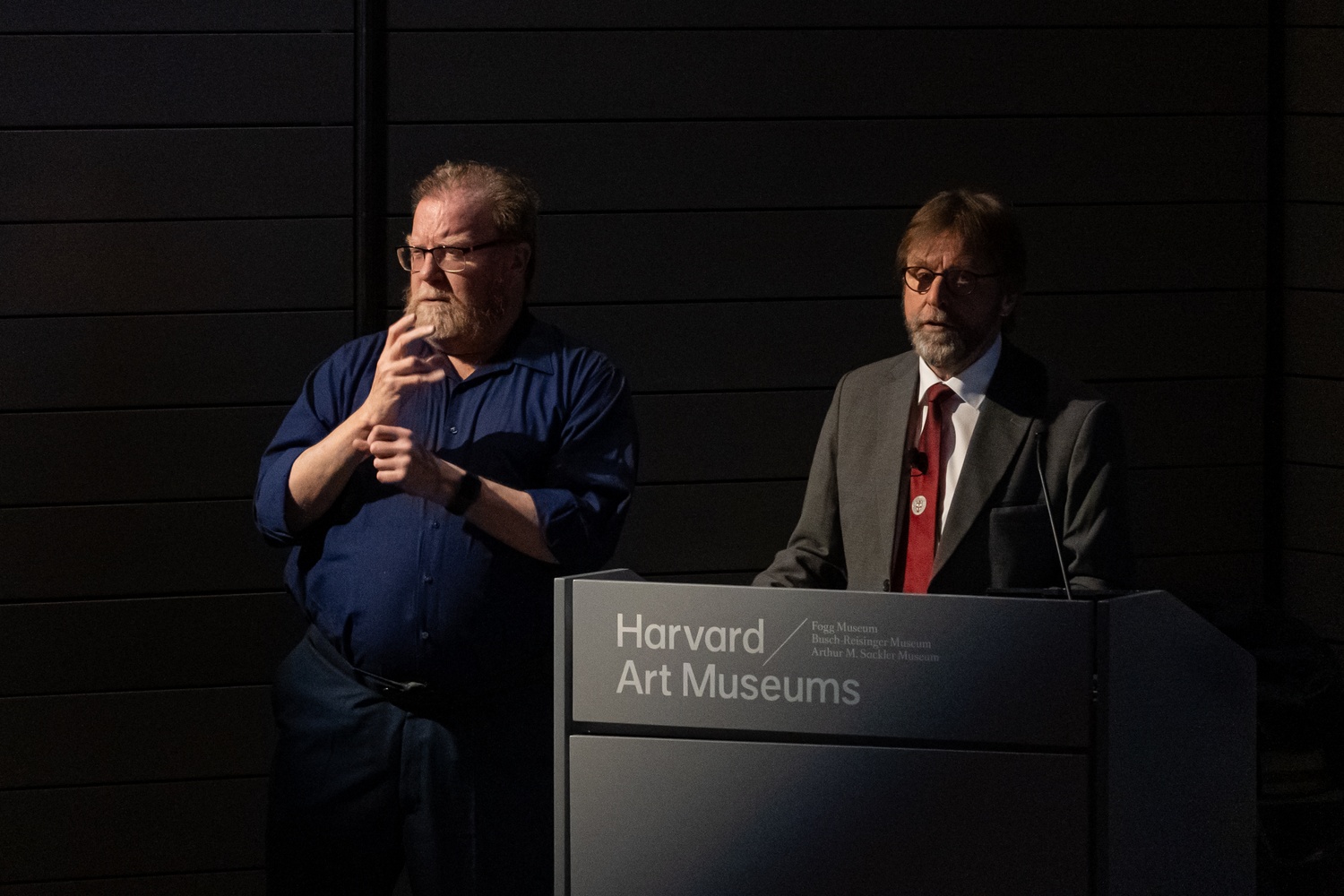
When I walk into my first 9 a.m. class of LING 73A: “Beginning American Sign Language I” with Professor Nozomi Tomita, I find an untraditional “U” shaped seating arrangement and an interpreter. Tomita immediately begins to sign words such as “welcome,” “deaf,” and “interpreter for only the first week of class” — which I can only understand because of the interpreter’s translation. Watching her hands quickly dancing from one shape to the next, I begin to worry I’ll fail to keep up with the class.
Luckily for me, this fear is baseless. During the next few weeks, we chip away at basic signs like “good morning,” and “how are you?” Tomita teaches lessons with understanding and patience, allowing me to make mistakes, laugh it off, and learn it once more.
I’m not the only one who has been intimidated by sign language at first. DAC co-director Jude Jamison ’28 initially took ASL 1 in his freshman fall to fulfill his language requirement. The course requires 10 hours of attending Deaf cultural events hosted by the ASL program or sometimes run by the DAC, and Jude recalls “dreading” his attendance.
“I was like ‘Wow, I’m an ASL 1 student and you want me to interact with a deaf individual who is obviously fully fluent?’” Jamison says. “I was so intimidated.”
But when he arrived at his first coffee chat, hosted in Boston, he was pleasantly surprised.“Everyone there was so unbelievably nice, and I learned so much so quickly,” he says. “It was such a welcoming community of people who genuinely wanted to help me learn, because they just loved how much I was involved.”
Mia Schenenga ’27 joined the program because she wanted to be able to communicate with a wider range of patients in her future career as a physician. Although Schenenga still carries this goal, she was soon drawn to the program’s uniquely strong culture and support. Last fall, she decided to foster more deaf community engagement in the Quad by initiating Pforzheimer House weekly ASL dinners.
“It has been a really cool experience to realize, first, how far I’ve done my ASL skills, and then also connect with students that are just starting and maybe teach them,” Schenenga says. “It’s definitely continued to be like a low stress, low stakes way to just practice and connect with the community.”
Tomita emphasizes this need for people to collaborate and engage with one another to learn ASL. “Acquiring the language without access to a community is incredibly difficult — you have to have signers to acquire sign language,” she explains. “It is entirely community based, and it’s a community grown language as well.”
Like Jamison and Schenenga, learning ASL at Harvard has opened a door to a world of Deaf culture and history previously unknown to me — both within and beyond the University. I keep close to me the proper manners when engaging with those in the Deaf community, the importance of being assigned a sign name, and even ASL slang.
When I meet Harvard ASL Director Frances Conlin on the third floor of Boylston Hall to ask her more about this culture, she brings along her interpreter Ruth Duke. Conlin sits across from me, and her interpreter takes the seat next to mine. My eyes stay fixed on Conlin while listening to Duke’s voice. I make an effort to read Conlin’s signs and pick up a few I remember learning from class, like “beautiful” and “motivated.”
To Conlin, the ASL program has an obligation to engage with Deaf culture broadly. “Learning ASL is a great thing, but at the same time, what are we giving back to the community? Because it is the language that belongs to deaf people, and we are responsible to give back,” she signs. “Meeting with deaf people” and “learning from the experience of others” are important elements of Harvard’s program, she tells me.
Tomita similarly compares teaching the language to “the circle of life.” Having learned ASL from deaf instructors herself after migrating to America from Japan, she has now taught at Harvard for two years.
“That passing on of language is so important, and it’s not just a teaching of a language, but it’s also a culture and this passing of an awareness,” Tomita signs, her interpreter Stetson Stanger verbally translating for me on our Zoom call. “It’s not always direct. You don’t always see the effects of it, but to know that it still happens is so enriching.”
As a current ASL 4 student, Jamison recognizes how his understanding of Deaf subcultures such as Deaf arts and Deaf studies has grown.
“I really had no perspective on what deaf culture was like at all,” Jamison explains. “I didn’t know any deaf individuals before coming to the department, so that was completely transformative.”
The same is true for me.
On a Thursday evening in November, I go to an ASL game night to fulfill my class social hours. Ditching my pack of Golden Oreos on a side table, I join a game of categories and am soon scrambling to sign “pizza” to my teammate before a timer runs out. In the otherwise silent Northwest Building, largely abandoned at this post-dinner hour, the game room roars with clapping and banging on the table.
Tomita once told my class that people have a predisposition to think deaf people are quiet or shy. ASL game nights say otherwise.
A central part of Deaf culture, I’m learning, is the nonverbal nature of signing and its subsequent reliance on visual elements. Signing offers ways for individuals to connect beyond what solely speaking provides — in more ways than simple translation.
In the first row of Sever Hall 102, I watch as Nozomi and Frances’ faces shift from amusement to confusion as our ASL program watches “La Famille Bélier” for a movie night event. Their eyebrows pull together, eyes wrinkle, and lips purse as they sign their reactions to the painfully awkward scene unfolding in the film. Settled in the row directly behind them, I watch them visually express their mutual distaste for the film; I sense their opinions even without understanding the meaning of most of the signs they use.
As I continue to immerse myself in Harvard’s Deaf culture, I discover that even trivial matters — like chatting in the middle of a movie — is one of many ways that signing’s nonverbalness expands the landscape for connection.
For Xavier Ayala-Vermont ’27, who was born deaf because of genetic hearing loss but has used hearing aids since elementary school, ASL has helped his sailing team collaborate. “We’re in big boats, so we’re far away from each other. So voices don’t carry, but signs do,” he says.
Ayala-Vermont says he enrolled in ASL 1 last fall to strengthen his foundation in the language and practice signing everyday, since the class meets Monday to Friday. He’s been utilizing it in the sport ever since discovering that many of his sailmates take ASL. Since then, he has worked to convince others to take the class as well.
While such practical use of the language is invigorating, my immersion in the culture has fostered equal curiosity. Where I used to think it was insensitive to ask deaf people personal questions, I now know Tomita’s watch vibrates to wake her up every morning and many do not perceive their deafness as a disability but an indispensable piece to their identity.
To Schenenga, the most significant takeaway from the program is learning not to be afraid to ask questions while also interacting with the Deaf community and navigating the “norms of Deaf culture.”
“As a hearing individual, I operate in the Deaf space differently than a deaf person might, but that doesn’t mean I can’t be a part of it or learn a language to connect with other people,” she says. “I think that’s something that’s really been important and impactful to me.”
—Christine Yoo ’29, a Crimson Editorial editor, can be reached at [email protected].