Artist Profile: Chika M. Munonye ’26 on Hope, Systems, and Storytelling
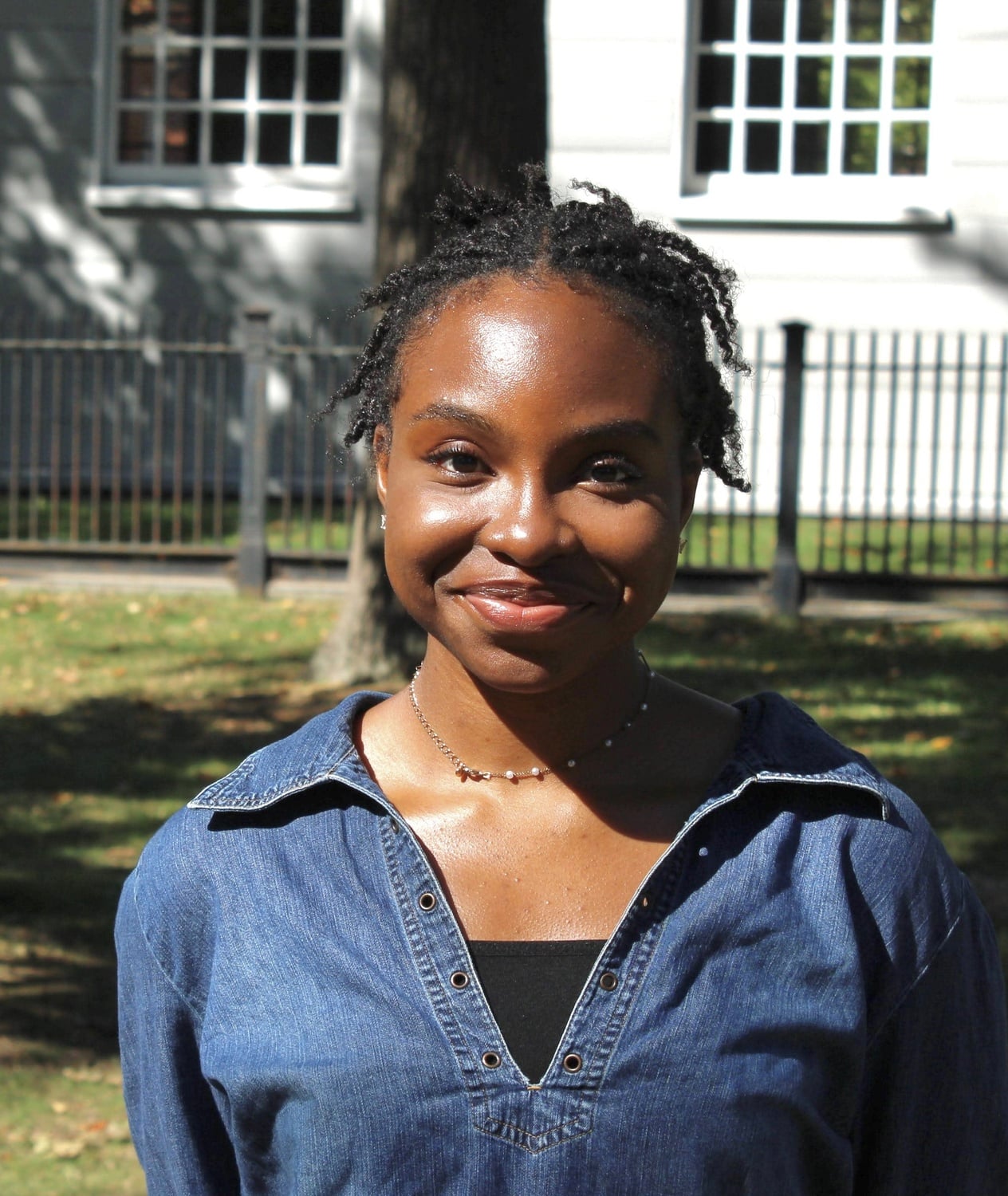
Ihechikarageme “Chika” M. Munonye ’26 takes on many roles — writer, director, creative producer, publicist, and student. Still, Munonye never hesitates to bear the weight of them all.
“Even though it feels like I’m wearing a lot of hats, sure,” Munyoye said in an interview with The Crimson. “I’m carrying a lot of heavy things, I’m putting the set together, I’m doing what needs to happen so the show can go on and be a special thing for everyone.”
Munonye’s creative flexibility was an integral part of the creation of “The Firm,” an original play Munonye wrote and executive produced that premiered on April 16 at The Loeb Drama Center. But beneath the logistics of mounting a campus production, “The Firm” dealt meaningfully with a persistent intellectual question: What happens when human life is measured, categorized, and ultimately treated as a resource?
“The main question is : What happens when human bodies become resources for the state?” Munonye said. “And then secondary questions are well-being, and who gets to decide that.”
Munonye — a senior concentrating in Sociology — did not always imagine herself as a playwright. Growing up in Washington, D.C., responsibility shaped her childhood early on — helping care for her father, navigating a quieter social life, and spending much of her time reading.
It was not until she encountered Kazuo Ishiguro’s 2005 novel “Never Let Me Go” and its unsettling exploration of the instrumentalization of human bodies, that the beginnings of her creative trajectory began to take shape.
“I think that if we continue down that path of commodifying our bodies and optimizing our bodies for a certain gain,” Munonye said. “I just wonder what that will look like, and this, I guess, is just one — one thought experiment of what it can look like.”
That “thought experiment” became the foundation of “The Firm.” Early drafts were shaped by questions about commodification, inequality, and the metrics used to define well-being, with Munonye repeatedly returning to how systems of classification structure both society and self-understanding.
For Munonye, classification shapes perception in small but revealing ways, such as how people tend to imagine “a pigeon, or a blue jay” when thinking of birds, rather than a penguin.
“It would make the penguin essentially feel a little bit strange from that category one, and it also makes it difficult — it shapes the way they interact with the category that they’re involved with,” Munonye said.
Munonye extended this logic to second-generation Nigerian Americans navigating layered racial and cultural identities in the United States in her senior thesis for her sociology degree. These idea — drawn from both her thesis work and lived experiences — influenced “The Firm,” where she uses dystopian storytelling to ponder hope and humanity in the modern age. Dystopian television like the 2022 television show “Severance” and “The Truman Show,” and real life stories like the life of Henrietta Lacks — whose cancer cells were used to create the first immortal human cell — heavily influenced the play.
“I think comedy and dystopians are good ways to highlight questions, and make you think about things without it being so in your face.” she said.
If writing is where Munonye builds worlds, directing is where she learns how fragile those worlds can be. “The Firm” marked her first experience directing her own work from “start to finish,” a process both exhilarating and disorienting.
“I think that it’s been fun. I think I’ve learned a lot about the theatrical process in general,” Munonye said.
To Munonye, the collaborative nature of experience — especially the role of her cast and creative team — was a highlight.
“I thought I was a good communicator, but I think that when you have to communicate an idea and have someone internalize it and have that method of internalization be different for every single person, that’s always interesting, and I think that my cast has given me so much grace, to get better at it. I think we’re all just kind of learning together,” Munonye said.
Outside of theater, Munonye was involved in nonprofit and development work, including with the Harvard Undergraduate African Development Group. While she has stepped back from consulting-oriented spaces, she continues to think about development as something shaped by inequality and global systems.
A recent trip to Nigeria sharpened these reflections, as meeting extended family and witnessing layered class structures pushed her to reconsider questions of privilege, access, and responsibility. At this point in Munonye’s life, giving back is about “intentional advocacy” and intentional awareness, not just posts on social media but active thought-provoking artistic engagement.
“If I can work with non-profit organizations in certain capacities — once I feel more developed — that would be the dream,” Munonye said.
Much of her work, both artistic and intellectual, is driven by questions of class, migration, and race, and how these social processes affect how people operate, display themselves, and interact with one another.
“I feel like I’m always writing about a question with theater,” Munonye said.
Still, Munonye resists the idea that “The Firm” is meant to provide answers. Instead, she frames it as a space of questioning. She hopes that audiences leave the theater thinking about bodies, systems, and the quiet ways institutions define human worth — and perhaps laughing, too.
“You can’t not be hopeful, you know what I mean? Because it’s just like, if you’re going through X, all of these things, and you’re still smiling, and you’re still laughing, I too can laugh,” Munonye said.
That idea of humanity — fragile, contradictory, persistent — ultimately anchors her work. That same sense of inherited resilience runs through her understanding of life. It is something she associates with her mother, her sister, and others she has encountered whose joy persists alongside difficulty.
“And it’s not just my mother,” Munonye said. “I think a lot of the people who I’ve talked to who experienced a lot of intense moments in life, are some of the most beautiful, most joyful, most happy people, most optimistic people I’ve ever met.”
After graduation, Munonye plans to step back from the intensity of campus life and return to writing, possibly developing a full-length book. She imagines a slower life in Washington, D.C., focused on reading, revision, and time with family. That support system has been central to her process.
“I also do want to thank my sister for reading all of the drafts of my plays and everything I write. She’s a real one, she’s also my graphic designer for the posters, so she’s really talented, and she’s my favorite person,” she said.
Even as she looks toward a quieter future, Munonye remains committed to storytelling as a form of engagement with communities, institutions, and the questions they raise. She hopes to one day bridge nonprofit work and the arts, as interconnected ways of understanding and changing the world.
“You can live your life pessimistic, of course, there’s a lot of reasons to be pessimistic in this life, but I think if you do — if you do that, then you will run the very great risk of not being able to change anything,” she said.
For Munonye, that tension between uncertainty and possibility circles back to the same impulse that drives her work: the insistence on continuing to ask, build, and imagine anyway.
Want to keep up with breaking news? Subscribe to our email newsletter
Have a tip for The Crimson? Share it confidentially