
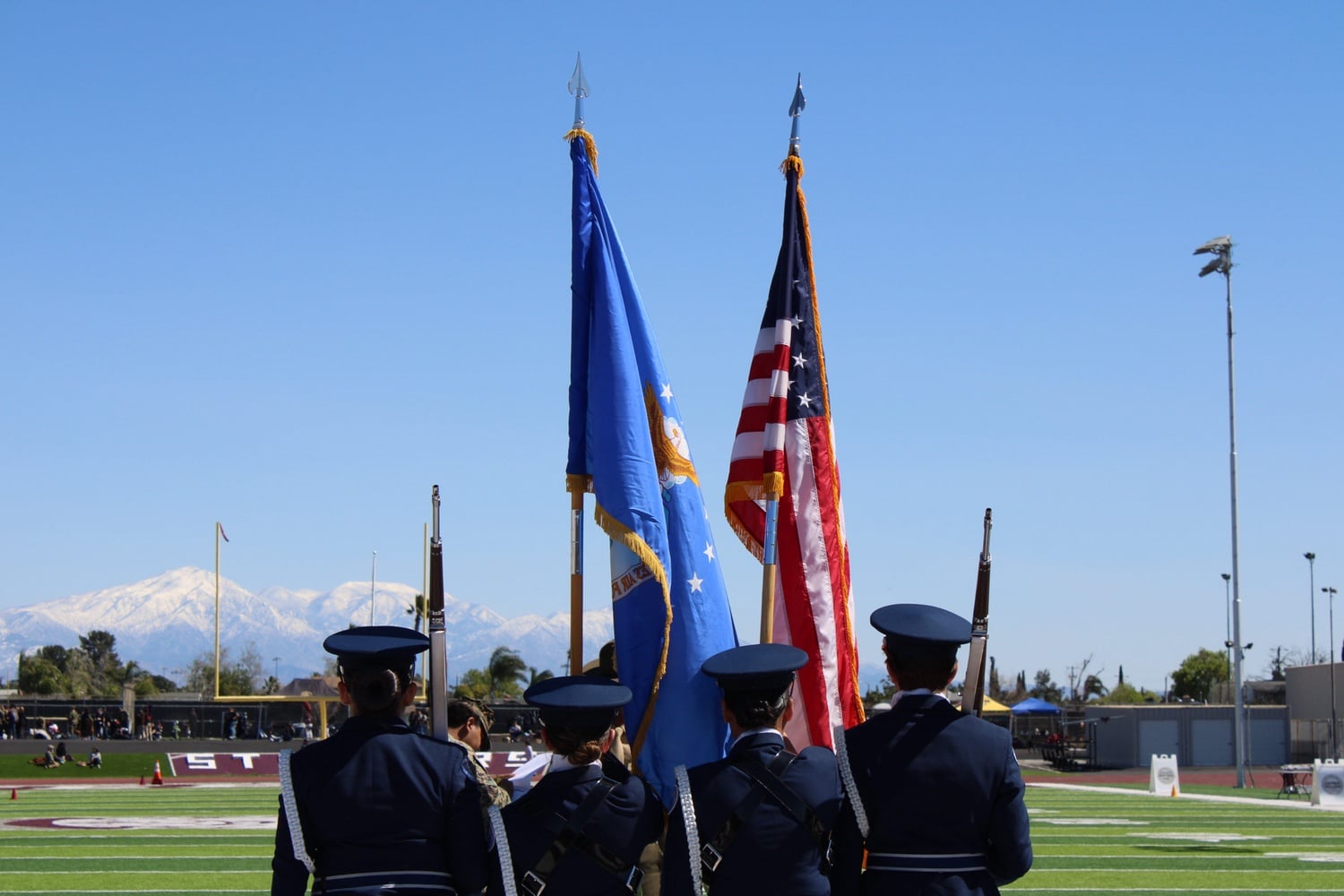
Grey, White, and Blue
America was a Leviathan that encircled the borders of my thoughts, living as a separate entity above the flesh and blood of this country. I simply took her benevolence for granted, as a fixed variable in this equation.
hy are you patriotic?” my friend Anna asked me.
I was in the Air Force Reserve Officer Training Corps and preparing to serve as an intelligence officer in the U.S. Air Force. I took immense pride in my identity as an airman, but her question stunned me. Many people had questioned my decision to join the military, yet no one ever questioned my motivation, my love of country.
On the steep steps boarding the bus to Budapest, I began explaining to her my parents’ immigration and how I was a product of American generosity. Lush sprawling green hills rolled behind us as the wheels of the bus turned. Anna peppered me with follow-up questions.
I felt I owed service to my country because America was kind to me. I loved America, I told Anna with a soul-deep conviction. I meant every one of those words. Still, the unconvinced look in her eyes never left. At the time, I couldn’t fathom how one could live in the country and stand as testament to its benevolence, but not reciprocate its love. Little did I know, just eight weeks later, my eyes would shine with those same reservations.
y parents, shortly after marrying in China, immigrated first to Quebec, Canada, where I was born.
Many of my early memories spotlight federal immigration bureaus that taught me I was not an American — I was an alien, a foreigner. Shortly after I was born, we moved to California, where I grew up hearing tales of how my parents once picked green onions in Canadian fields on the weekend to make a little extra cash. And yet, marveling at the life we had built for ourselves in the States, I began to conceive of this bigger entity, a benevolent one called “America.” In the coming years, this “gung-ho” sense of patriotism crystallized in my mind.
Since I can remember, I’ve always wanted to be something bigger than myself — to be grand, to make a crater in this world. I had a distinctly American sense of optimism, believing that through hard work and a little bit of luck, I could accomplish anything.
I was naïve enough to feel defiant in the face of failure. I was reckless enough to be brave. I was filled with enough conviction to take every leap of faith. From this cacophony of traits emerged my unwavering belief in American exceptionalism.
t the start of high school, I enrolled in AFJROTC — before then, I didn’t know what those seven letters stood for. Little did I know, it would prove to be the best decision of my life thus far.
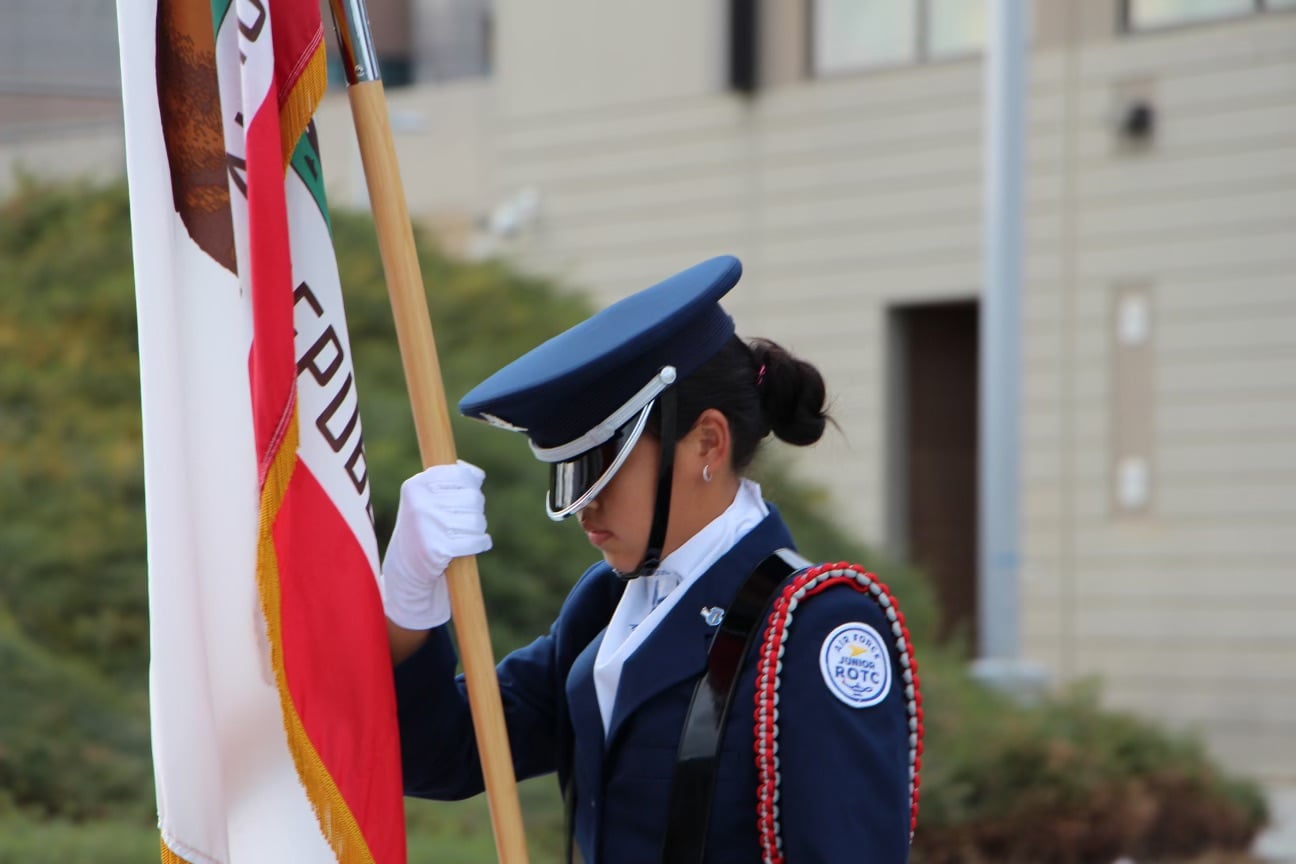
On the very first day of class, I was taught how to stand at the position of attention and render a proper salute. Although the experience was jarring, within minutes, a deep-seated pride bloomed in my chest as I held my first ever salute through the national anthem. Soon, I was given a pair of dress blues and a silver nameplate — I was now Cadet Sun, a title I would begin to define myself through.
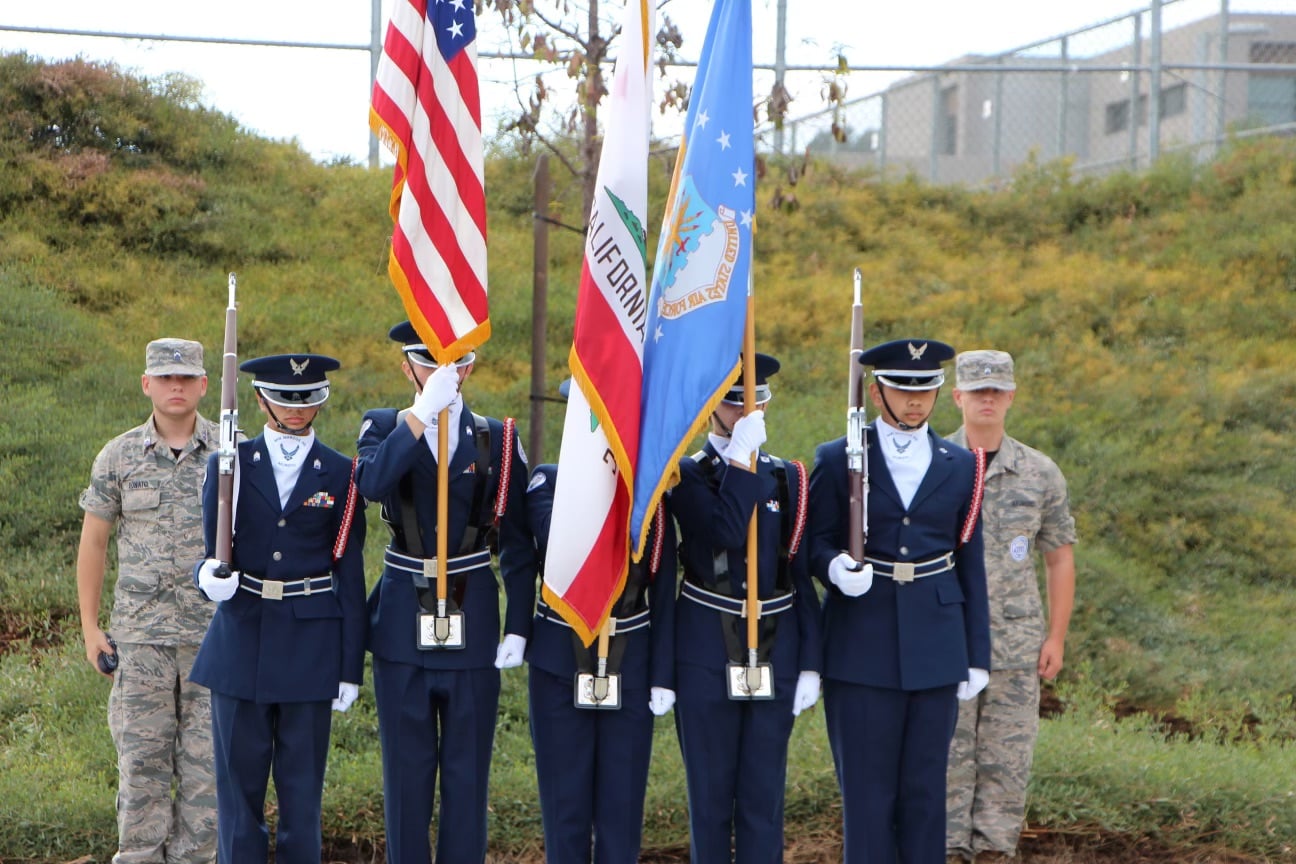
Presenting the colors at football games in front of hundreds of onlookers, I swore I could feel my heart beat to the rhythm of the national anthem. When I raised the American flag on mornings before class, I felt an inexplicable sense of honor watching it billow underneath the Californian sun. My need to be something more finally felt fulfilled.
As an airman, I would be something more for this country.
hile riding in the car during my sophomore year of high school, my mother asked me if I would join the military. I said yes without hesitation. From the passenger seat, I saw the concern look on her face.
“But what if you die? What if you get deployed?” she countered in Chinese.
“Then I’ll die a hero,” I replied in English.
When senior year came around, there wasn’t a doubt in my mind that I would pursue ROTC in college and graduate as a commissioned officer. The day I was presented with my Air Force Scholarship, the Lieutenant Colonel that commanded my Junior ROTC unit — a close mentor of mine — left a white envelope on my desk. I opened it to see a scrawled congratulations note and a pair of second lieutenant ranks pinned to the paper.
My hands shook as I took them out. These were the same ranks that his mother had pinned on him at his college graduation. Now, they were mine. Tears filled my eyes.
I imagined myself standing in Harvard Yard in dress blues with my mentor’s ranks pinned to my lapels as I gave my first salute to him. At the time, I couldn’t imagine anything else. There could be nothing else.
n the fall of my senior year of high school, after the results of the 2024 election, through tears, I wrote the following in my diary:
America seems to lose to its own narcissism. The same narcissism that fueled our belief in justice and liberty are now the shackles that bind our country to a seemingly fascist regime. To a leader who believes in tyranny, who wants to perpetuate the cycles that we have just begun to break from. Maybe the world doesn’t bend towards justice, maybe this is the fall.
I couldn’t reconcile this America with the one that I was planning to serve. Over the course of senior year in high school, I threw myself into recovering my sense of faith. I had an unbreakable belief that America was good — greater than the sum of its parts. It had to be.
I read all 85 of the Federalist Papers, scouring for any clue that our founders had anticipated the current state of America. In those few months, I wrote a series of essays to my government teacher that documented the tumultuous waves of despair and hope I felt. When spring arrived, in my last letter to my teacher, I said:
When I walked into your class on the first day of school, the question at the forefront of my mind was, “What defined America?”
I can tell you my answer to that question: the belief in American exceptionalism.
From Manifest Destiny to the North winning the Civil War to electing the first Black president, we’ve been fueled by the belief that we will be on the right side of history. In the end, it has always come down to individual Americans asking themselves what is right — and because we believe we are unique, that we can make an imprint on this world, we’ve had the courage to stand up and fight.
fter starting at Harvard, I began to question my role in history. I had come to college as pre-med, ready to swear to “do no harm.” In a matter of months, I pivoted to wanting to pursue military intelligence, and the fear of weaponization descended on my mind.
When I returned home for winter break, my sister and I sped down the I-15, the bright lights of the UCSD campus passing in a blur behind us.
“Why do you keep faith in America?” she asked me. I tightened my hold on the steering wheel. The extensive changes the military had undergone and what I saw as the unconstitutional actions it had taken in the past few months had left me with a sense of helplessness.
I knew she wouldn’t believe the answer I gave everyone else — she was raised by the same parents, under the same roof, and yet, had a bone-deep apathy toward America. I considered my words carefully.
There wasn’t another option. In this country, trust and faith were analogous to money, I told her. If everyone suddenly stopped believing in money and began to withdraw it from banks, we’d end up with an economic collapse. Regardless of whether I always agreed with the actions that this country or the military took, if it was within the confines of the law under a democratically-elected president, I had an obligation to keep faith. She nodded her head slowly, seemingly convinced, and we continued driving down the highway in the dark.
tanding on the glossy faux wooden tiles of the Air Force Detachment 365 in front of the large American flag, I had expected to feel more.
I raised my right hand and swore my oath — to protect my country from enemies foreign and domestic. Instead of an overwhelming sense of unity, I felt hesitancy at the commitment I had just made. Would that mean I’d have to fight my fellow Americans?
What is duty?
Just a few weeks later, I would pose this question at Harvard’s JFK, Jr. Forum to the former Joint Chief of Staff Charles Q. Brown Jr, once the highest ranking officer in the U.S. military. His answer was that my job as an airman was to serve. Once a decision was made by higher ranking officers, my job was to follow. Duty demanded more than an individual’s wants. Duty was to the larger institution.
I felt satisfied with that answer and resolute in my goals. Fears that had laid dormant through the winter reared in early March as the war with Iran broke out, yet, I clung to General Brown’s words.
Service was sacrifice. Thus, service was inextricably good.
An ocean away, on foreign soil, my fears found a new habitat to sink roots into.
On the Fourth of July, the 250th anniversary of the United States of America, I found myself floating down the canals of Amsterdam in a low-basin boat, engaged in an argument about whether the core institutions upon which the American government rests should be preserved, and found I was actively losing.
I stared at the hazy Amsterdam sky with the weight of not being in the United States for an undeniably important event. There has always been a naïvely optimistic part of my soul that hoped that by our 250th anniversary, America would stitch its own wounds shut. That we would stop bleeding red. And yet, as the holiday passed across the world in a different country, I couldn’t muster any feeling but apathy.
“Can you tell me what you, as an American soldier, does for the average Iowian?” my travel companion asked.
I found myself at a loss for a response. I had already exhausted all my points. How could I not answer this simple question?
America was a Leviathan that encircled the borders of my thoughts, living as a separate entity above the flesh and blood of this country. I simply took her benevolence for granted, as a fixed variable in this equation. I could have never conceived of the idea that she could be anything else — or that she might not have existed at all.
I would replay this conversation over and over on my train ride from Amsterdam back to Cologne. Piercing rays of sunshine filtered into the cabin as we crossed over the Rhine and I knew that my world view had been scrambled. The pride that had glittered in my chest months ago was nothing more than a dull light fading with the sunset. The name America had tarnished. And yet, I felt tethered to my duty to her.
his new image of America grew like ivy in my mind, crawling into every crack of doubt, completely consuming my conception of patriotism. For weeks, in every conversation I had with co-workers, friends, and strangers, I desperately wished for someone to convince me that I was wrong.
On a Saturday afternoon, I called the Lieutenant Colonel, hoping that he could restore my faith. The distinctive click when the phone hangs up fills my small apartment. Sitting alone over the tiny strip of counter that had served as my dining table over the last 6 weeks, I felt a penetrating sense of loss. I felt like I was peering down on America through a kaleidoscope, fragmented pieces of a country I thought I knew. One whose image changed moment from moment, turn to turn.
I had never before thought of my patriotism as something external to myself, and yet when that part was taken out, I found myself staring at disappointment.
The strongest tie I had to service — the sense of duty that I had felt without question, the enjoyment of feeling like my purpose was tied to something undeniably valorant — that last tie was shimmering, slowly disappearing.
I realized that bonds of duty could be broken. Duty could change.
I realized the vision of America that I had stitched back together after the 2024 election could not be fully mended. For the first time in my life, I entertained the thought of letting go.
n Aug. 26, under the dappled sunlight of one of the printing rooms in Lowell, I watched the ink dry on that dotted blue line. This was it. I just signed my disenrollment papers.
I didn’t feel the sense of finality or righteousness I was expecting. Yet, the reality was, I would no longer be an ROTC cadet. I wouldn’t be commissioned as a second lieutenant in the U.S. Air Force in 2029. And would never salute the American flag in uniform again.
I was officially discharged on Sep. 15, 2026.
had taken my flame of patriotism for granted. I hadn’t realized how much tending it took to keep that patriotism alive. Every time I recited the Airman’s Creed, another gust of pride stoked the coals. The name “SUN” embroidered on my uniform elicited a sense of something larger than myself. When there wasn’t a warm environment to nurse the flames anymore, they smothered out.
A new apathy now haunts me. It’s hard to believe that my individual actions will be anything more than pebbles in the grand scheme of life. I used to do my makeup every morning while listening to CNN on 2x speed, cataloging every detail of events unfolding on Capitol Hill in the back of my mind. Now, I find myself observing American partisan politics believing it useless to root for any side (though I do care deeply for democratic institutions). I used to play audiobooks on American politics during my runs. Now, I blast music and try to outrun my thoughts.
But as the weeks go by, another seed of patriotism begins to grow in the emptiness that was left behind. I feel myself melting back into the easy embrace that tells me America is exceptional, that we will correct our course. The alarm bells still ring in the back of my mind, but in the cacophony of all my other thoughts, it becomes easier to ignore them every day. It scares me that this is the case.
Now, when I hear of the military, see the billowing American flag, or meet a veteran, I still feel that shared sense of identity. I still want to pipe up and scream that I spent 5 years of my life in those institutions and a lifetime loving this country. I don’t think this love will ever truly escape me. Even if it’s been excised from me, the scar tissue will always remain, and I’ll always feel its phantom pain.
I will always be someone who believes in ideals. Even though they might never be realized, they are always something that will fill me with hope. In the emptiness that remains, I find myself looking for something to fill its place — for a new vision to compel me.
—Magazine writer Anne Sun can be reached at [email protected].