
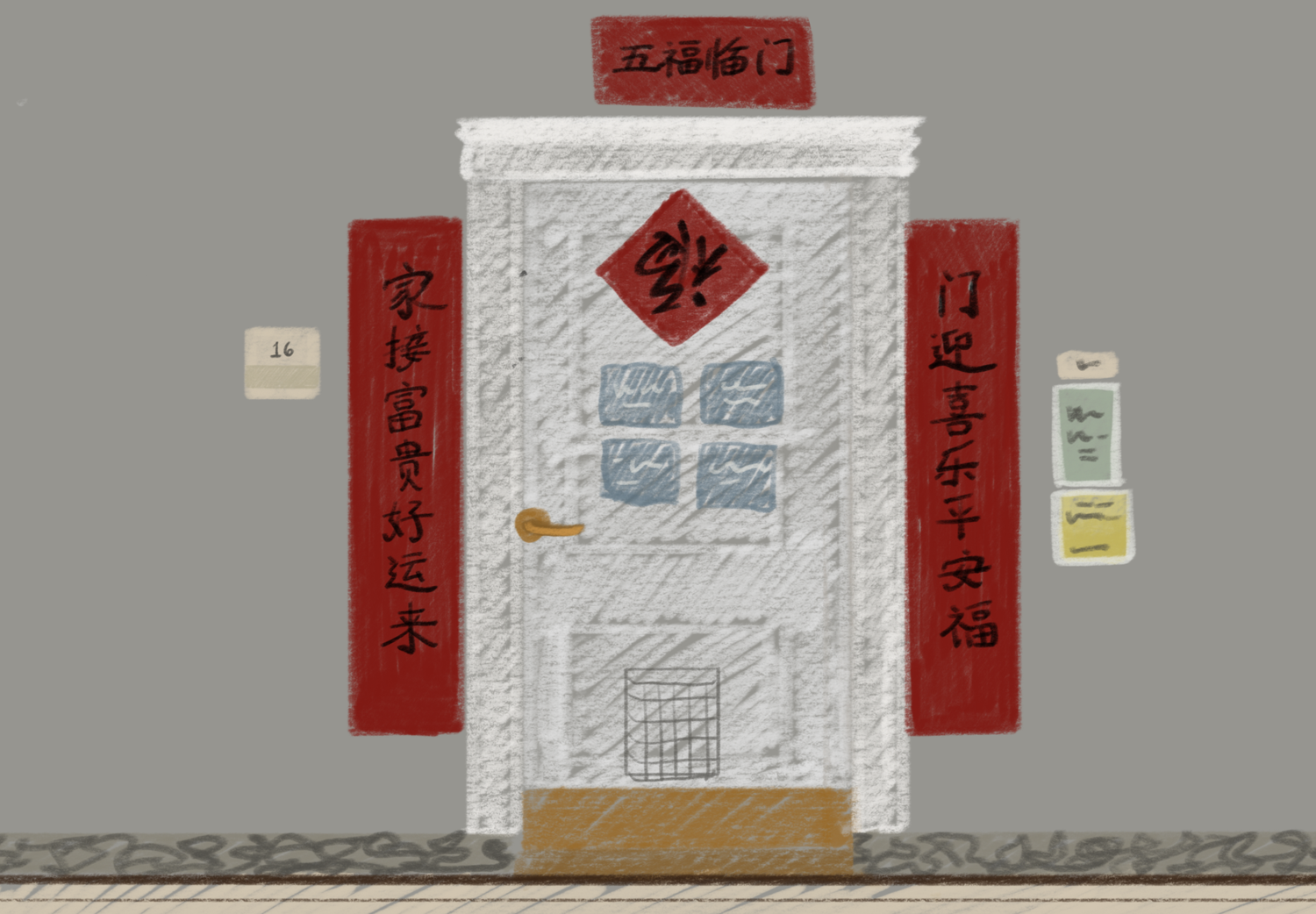
Door Decor
The transition from accustomed conventions of home to unfamiliar college life was not as discernible as I had anticipated. It was only when cultural idiosyncrasies were missing that the pangs of homesickness rippled over me at last.
ith abandon, I ripped open the crunchy manila parcel and drew out two scarlet ribbon-like decorations. I pressed the signs against the muted blue walls surrounding the door to my Pennypacker Hall dorm room.
The week before, I idly scrolled on Amazon, procrastinating my Economics 10B problem set and stumbled across the listing. Everyone at home would be making the same order, why not me, even while I’m here at Harvard? I laughed at the idea, clicked out of the tab, and resumed calculating the impact of a policy on nominal wages.
But seconds later, I found my finger hovering over the “Add to Cart” button. Afterwards, I couldn’t help but anxiously open my phone every couple of hours to track the UPS delivery status. As soon as the notification declared the package’s arrival the next day, I took off, sprinted towards the mailroom, and collected my impulsive purchase.
***
Hanging chunlian, strips of red paper inscribed with Chinese poetic verses, around entrance doors — homes, corporations, and buildings alike — is a Chinese New Year tradition, a symbol of beckoning in the new year and renewed fortune.
It is difficult for me to articulate what feeling this custom evokes for me. The term “beloved” seems suitable, but I never really loved chunlian — they just existed universally and silently.
On a seemingly random wintry day every year growing up, I would return home from school and the red chunlian would hang beside our door, our neighbor’s door, and even the shopping mall’s glass doors. I never contemplated what the invisible ornaments symbolized, never considered the holiday’s precise relationship to the moon cycle, never took the time to translate each Chinese character in staccato. I just wrapped my hand around the knob and pushed open the doors — red flashing in my periphery.
Chinese New Year typically falls on the second new moon after the winter solstice, with celebrations spanning two weeks. Each day in that period, from New Year’s Eve to the fifteenth day, has particular rituals.
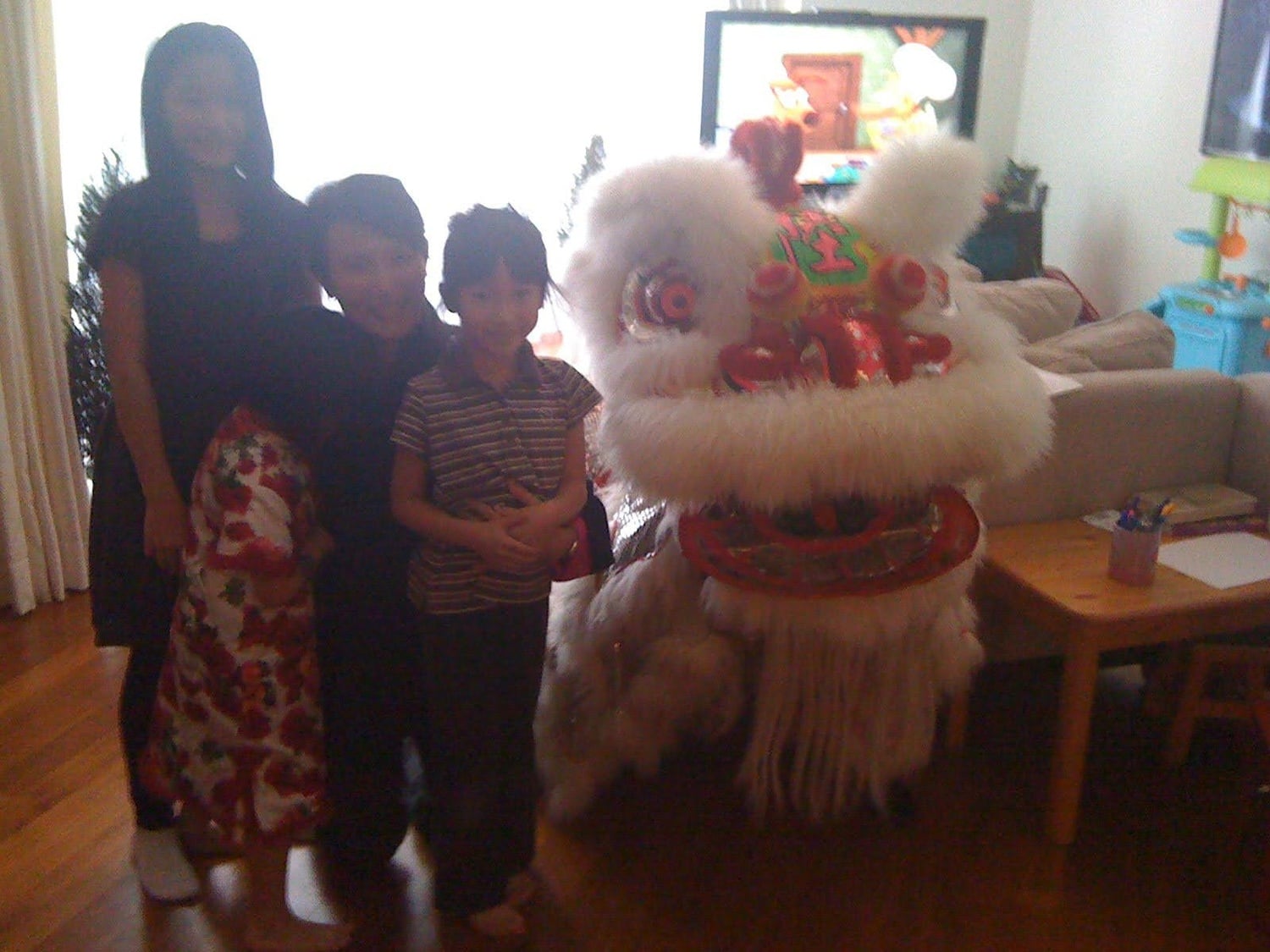
The chunlian is the first of such Chinese New Year rituals, heralding in the rest of the festivities — Cookie Monster lion dancers chowing down on lettuce hung from door frames, flames racing up a firecracker tail behind a plume of gray, crimson-clad businessmen flooding the subway, and family huddling around a table of fragrant food — until they all disappeared inexplicably in the same unison which they arrived.
Surrounded by other, more striking rites, the newly hung chunlian instantly dissolved into imperceptibility, like a teaspoon of salt in a glass of water. It is hard for me to ascribe emotion to the tradition. I barely noticed its existence.
***
I never kept track of the lunar calendar before — for me, the holiday season was ushered in like Mondays. But, on the morning of New Year’s Day in my freshman year, I inadvertently woke early, giving me extra time to pick out my outfit before my 9 a.m. class, a Mandarin language course for heritage speakers.
Whereas chunlian were unremarkable in my memory, the tradition of wearing red is sharply imprinted on my mind. Red is generally considered to be a lucky color in Chinese culture. Strictly speaking, clothing worn during Chinese New Year is most auspicious if purchased new for the festivities.
My outfit — a red fleece and a graphic T-shirt with a red 8-ball design — was hand-me-down and well-worn, but I figured the effort must win me some points from my classmates. Remembering that once in elementary school, a girl wore a qipao — a traditional Chinese dress — to school on New Year’s Day, I wondered what my audacious college classmates would wear today.
Charged with eagerness, I finally made it on time to my class. I watched my classmates file in, yawning groggily as they slid into their seats. Taking off their puffers, they each revealed a rainbow of jewel tones.
My knee ceased bouncing under the chair’s attached plastic desk. I had projected my excitement upon my Mandarin speaking classmates, though they hadn’t given me any reason to do so. I forgot that I had only recently unearthed such a buzz myself and my uncommunicated expectation for unanimity was unfair.
“Today is New Year’s Day!” our preceptor said in Mandarin. She pointed to another student and then to me. “Did you two wear red because of this?”
Her supine hand motioned towards the boy, encouraging him to respond (and to incorporate the recently reviewed sentence structures, please). The boy said he didn’t, while shaking his head. The teacher cracked a joke and then launched into a review of yesterday’s material. As she breezed past me, I thumbed the zipper on my red jacket.
***
After refreshing the tape under the chunlian, I sat on my Pennypacker dorm stairs and ripped a piece of paper from an untouched notebook. I zealously tapped away on my computer, pulling up a few articles describing the significance of chunlian. New and familiar facts blended together as I researched. I’m sure my teachers throughout the years tried to instill most of this information in me, but for the first time, I really internalized it.
I summarized the articles on the sheet of paper in neat handwriting and closing the paragraph, I rhythmically translated each character of the chunlian’s poetic couplet. Satisfied, I hung the explanatory paper beside the chunlian and stepped back to admire my handiwork.
But finally drinking in what I had done, all the excitement drained from my body.
To start, the decorations were huge, too visible. The strips covered almost the entire wall, even obstructing the “Quiet Hours” infographic my proctor had put up. And Pennypacker Hall’s central staircase’s second-floor landing fed directly to my door, forcing everyone traveling up the dorm to be face-to-face with my red display. Worst of all, it was the only adorned door — atypical and attention-seeking.
I surveyed the rest of my floor. A vision of all the other doors suddenly furnished with chunlian, like the ones I was accustomed to, flickered by. When the mirage dissipated, the blank walls were even more striking than before.
Over the next two weeks, through my fish-eye peephole, I saw students stopping and reading my museum exhibit. I felt simultaneously appreciated and surveilled. Part of me wanted to swing the door open and thrust a bowl of traditional glutinous rice balls at them, but the other half of me wanted to run my nails down the decorations and rip them from the walls.
When I was filled with this partial fury, I couldn’t help but direct it at my peers. Why aren’t they adorning decorations from their hometown cultures? Why aren’t they intentionally displaying themselves?
***
The transition from accustomed conventions of home to unfamiliar college life was not as discernible as I had anticipated. It was only when cultural idiosyncrasies were missing that the pangs of homesickness rippled over me at last.
The following year, I didn’t hang up chunlian. I didn’t wear red.
To be honest, I forgot about it, and by the time I remembered, it felt excessive to order a next-day delivery of red decorations.
—Staff writer Darcy G Lin can be reached at [email protected].