
Free Range Kids, Grown Up
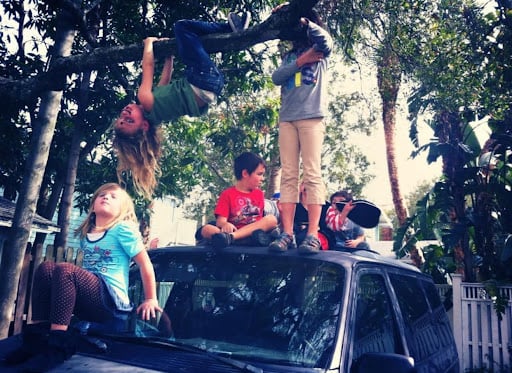
The children of Old Seminole Heights were frequently picked up from school together, often spending evenings and late nights together as a neighborhood family of sorts. We spent time eating buttered rice, black beans, or packages of oreos, but mostly playing Kick the Can.
ell after midnight on this most recent New Year’s Day, my childhood friends and I left the abandoned river house where my dad docks his house boat and made our way to a nearby park to play an old favorite game of ours: Kick the Can.
It began with me, the oldest of the bunch, volunteering to be “it” first, just to get the game going as I always do. I had captured nearly everyone before someone who had strategically remained hidden ran out from behind a tree and knocked the can over, freeing everyone. I was left to start my search from the beginning again.
But it was okay — more than okay, actually. I felt awash with an old wild and competitive energy drawn out by this tribute to our shared childhood.
e call ourselves “captains’ spawn,” because our three respective fathers share ownership of a pontoon boat they bought a decade ago for $3,000 each. The seven of us perceive ourselves as the core of an oscillating number of kids that all lived within about a mile radius of one another in a Tampa, Florida neighborhood called Old Seminole Heights from the ages of around four to 14.
Maybe by luck — or with a slight coordinated effort by our moms — our parents found one another and committed (or maybe resigned) to a communal type of parenting. Children were free to roam wherever, as long as we required minimal help in doing so.
The children of Old Seminole Heights were frequently picked up from school together, often spending evenings and late nights together as a neighborhood family of sorts. We spent time eating buttered rice, black beans, or packages of Oreos, but mostly playing Kick the Can.
We spent so much time together that when one of the six of us had lice, you could bet we all had lice.
While the houses of each family served as bases for food and security, the streets and spaces between the homes were where we felt fully and freely responsible for ourselves and our own safety.
We could climb whatever we wanted as high as we could as long as we got ourselves down. We could walk or bike anywhere we wanted to visit as long as we could get ourselves back. We would climb through the storm drains under the streets, set up forts underneath abandoned houses, and drag old roadside furniture to the forested region of a nearby park to create our own secret jungle gym. With our parents’ knowledge and encouragement, we removed the screens from the windows of our room so we could climb out on the slanted roof and wriggle down the fence into the backyard.
We, too, would eventually contribute to the neighborhood caretaking network ourselves. From age 11 onwards, I was babysitting for multiple families, including the newborn baby across the street.
The lack of surveillance gave us freedom that seemed greater than many others in our generation. More influential than simply freedom, though, was the opportunity to adhere to our own sense of what was fun and interesting. The only constraint to our adventuring was the need to convince the other kids that whatever ploy one of us had in mind was worth pursuing.
he weekends and afternoons of our childhood were mostly unprogrammed. The same thought of self-reliance applied to our organized extracurriculars — freedom to join and participate in whatever we wanted as long as we could generally get ourselves there by walking, busing, or carpooling.
On a trip to the beach, a few of the captains’ spawn wanted a soda from the vending machine. We started singing on the side of the street with a hat turned over and set in front of us to see what money we could make — after 30 minutes, we finally earned enough. Permission wasn’t necessary, expected, or desired. If we could acquire the tools on our own, the project was ours for the making. I remember that day; it was the best eighth-of-a-can-of-Coke of my life.
We knew our parents’ relaxed approach was unique, even for Florida. I wouldn’t disagree if someone called it dangerous, but traveling together allowed us to learn about the world in the safety of numbers. Danger was only ever apparent when we found ourselves alone.
When I was eight years old, I thought I knew how to make my way back to a friend’s house three quarters of a mile from the beach. I crossed eight lanes of Florida traffic that I didn’t recognize before realising I was completely lost. Seeing me crying on the side of the road, an older man pulled over next to me, instructing me to get in his car. The potential disaster of that situation was averted by an older woman who helped me call my mom.
Despite the fear of wandering alone the near abduction instilled in me, my mom’s calm reassured me. She remained confident in my ability to fend for myself — nothing changed about my freedom.
Getting lost is a part of life.
here is much to appreciate and critique about the ways in which the captains’ spawn were raised. I sometimes wonder how our parents possibly let us do any of the things we did or lived with the possibility of all that could have happened. Like all the time we spent in the shipyard down the street from our house with a man on a boat we later learned had robbed a bank. But I now see our parents’ triangulation of care and relaxation as essential to both our character developments and their own ability to live full lives.
Like throwing your hands up to the wind and allowing the breeze to move your arms at its will, our parents let the world teach us in its own individualized way.
Certainly our parents have shown fine examples of the places free-spiritedness can take you. A few years after our dads bought the old pontoon boat together, our moms quit their day jobs and opened a shuffleboard bar and restaurant. Unexpected, unplanned and with many obstacles, but achieved all the same — a refreshing view of success that gives us trust in the future and its ability to be ever evolving.
Maybe we encountered some of the sad and horrible things that exist in the world a bit earlier than a lot of kids. Maybe our across-the-street neighbor nearly succeeded in convincing us that the moon was fake for several years. But in the process, we became adaptable and resilient in a world that’s always changing, a world that is impossible to prepare for anyway.
For the captains’ spawn, the experiences established in us ambition, confidence, and a relative coolness. Though sometimes we talk about feeling like we grew up a little quickly, we’ve all maintained the beautiful childlike belief that the world is a place we can shape into whatever we want it to be — where we can roam free.
—Staff writer Asher J. Montgomery can be reached at [email protected].