
7 Harvard Affiliates on How AI Has Changed the Meaning of Their Work
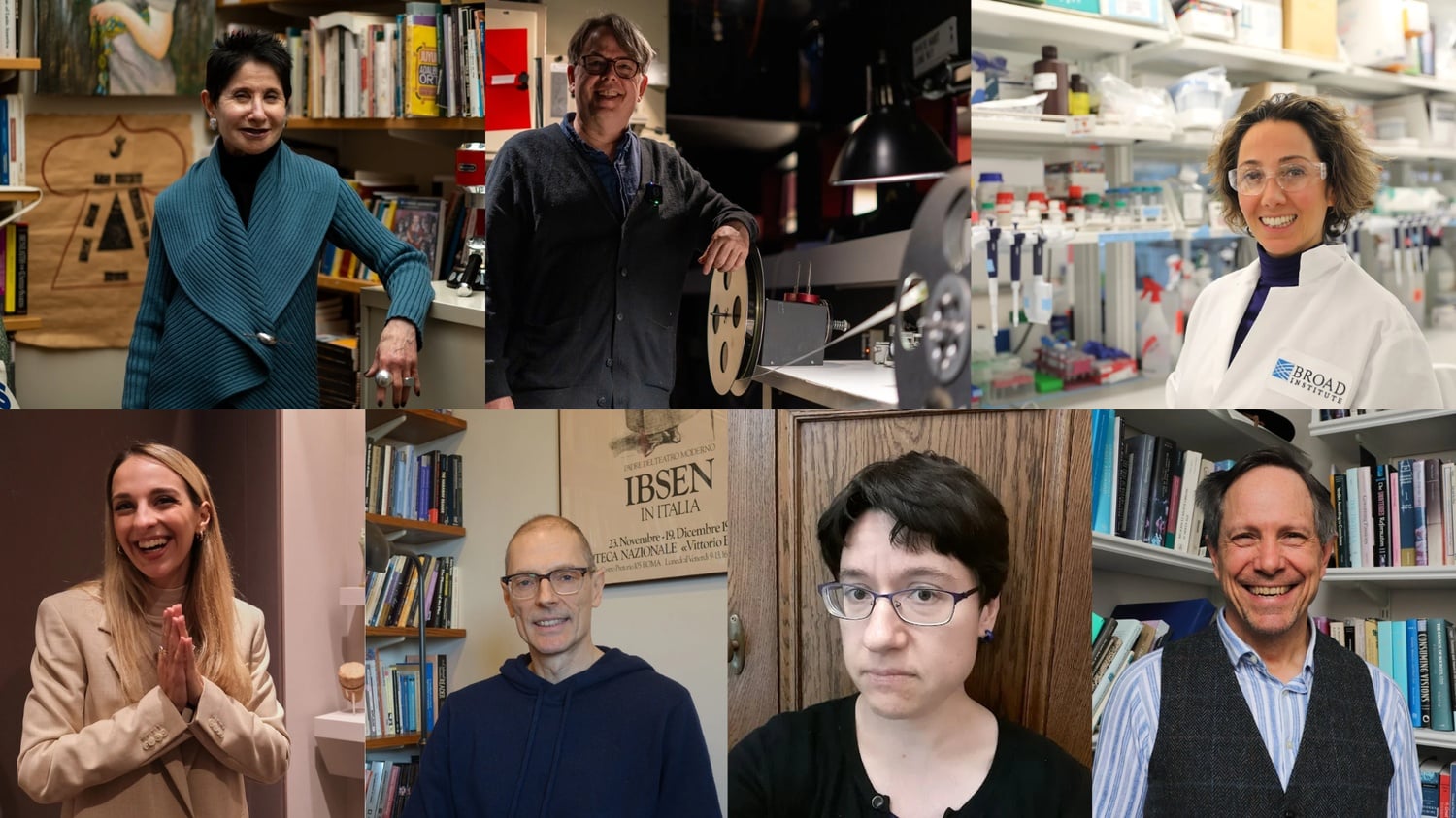
Seven Harvard affiliates told Fifteen Minutes their answer to the same question: “How does AI change the meaning of your work?”
If I think about my work in pandemic response, it has just really amplified the stakes.
There’s both unprecedented opportunities for bad actors to create bioweapons that could put the entire human population at risk and yet, at the same time, it can really accelerate the response.
It’s a crucible, a lot of things swirling and you are trying to move through it, to use artificial intelligence to find solutions as quickly as possible, while recognizing that at every moment bad actors could be using it to create risk. So how do we stay ahead of that curve? There’s just real stakes there. There truly are likely individuals out there already thinking about how to accelerate creating weapons, and we have to move really carefully and thoughtfully in generating data to mount a response — putting ourselves in this position where we might be moving as quickly as possible to set up capabilities to respond while making sure that we don’t unwittingly help accelerate our demise. It’s a wild time.
— Pardis C. Sabeti, professor in the Department of Organismic and Evolutionary Biology at Harvard University and in the Department of Immunology and Infectious Disease at Harvard School of Public Health
The fact that large language model text AIs can generate something that looks like a story by processing large bodies of data is an interesting extension of the ways scholars have been using neural network learning machine tools for a while, and it can make it useful to see things like genre at scale.
As far as I can tell, the fact that AI machines can now generate sort of very generic texts is an interesting toy, but I haven’t seen any real cases for major positive impact yet.
We’re in a moment where AI as a story generator is a sort of tool in search of a purpose in the world of literature. It’s clear that text AI can be used to generate generic writing, and that’s obviously been a big source of anxiety for people who teach writing. I think that we’re in a moment where people who teach writing are readjusting around the use of this new tool, just the way math teachers did with calculators, and I think that that adjustment period is going to take another few years.
— Anna Wilson, assistant professor of English
I’m optimistic that people will always see films in the theater and always want to see the original format. That’s something AI can’t do.
I could see AI helping in access and accessibility as it develops — like films that don’t have subtitles, we’ll be able to do live translations. I know it’s been experimented in various ways at Sundance already. No matter what language you speak, you’ll be able to hear or see a translation on a tiny screen that you know is in your language. Right now, when you see a film that’s subtitled here, it’s only in one language, you know, it’s in English. So I think AI will grant more access.
— John R. Quackenbush, projectionist for the Art, Film, and Visual Studies Department
AI is starting to have an impact on Egyptology, although there are some important challenges that distinguish it from other fields and have to be taken in consideration.
First, we’re confronted with an extremely small and highly specialized dataset for Egyptology. For Middle Egyptian or Demotic, we simply do not possess the volume of standardized, digitalized text that is available for other languages.
Another important configuration in our field would be technological privilege. Despite the growing spread of AI — everyone has access to ChatGPT, and this is used in Egypt as well — now that I’m here working in Egypt itself with Egyptologists from here, I still find professional tools are costly and mostly inaccessible to foreign universities, which creates a strong imbalance.
— Gaia Bencini, PhD candidate in Near Eastern Languages and Civilizations studying Egyptology
It hasn’t changed the meaning even remotely. So the methods, I would say, absolutely. But the meaning hasn’t changed.
I’ve been using AI-equivalent software to transcribe some records. This was totally impossible two or three years ago; I work with documents in Latin and in very difficult handwriting. This is material that I and graduate students can do on our own, but when you can get an AI-equivalent thing to do it for you, it just really rapidly increases it.
The people who go into medieval European history typically already have Latin and they typically are drawn to the period because of some interest they have in the Middle Ages. There’s a lot of people who could be really interesting additions to the scholarly community who are put off by the problem of language access.
Something that would allow a student to really dive into a research project or senior thesis — their Latin might not be great, but this would allow them to get into it — that might really help the community, bring in new voices into the community, and change the community in interesting ways.
— Daniel L. Smail, professor of History
AI has changed my work a lot. When ChatGPT came out, I very quickly started to experiment with it. I got invited to this tech conference and there I learned I could use it to recreate some of the philosophical historical figures I had been studying — especially Socrates, Confucius and others, philosophers who themselves didn’t write but developed their philosophy in a form of dialogue.
It partially motivated me to embark on a book project about dialogue — it’s about the great dialogic traditions, Confucian dialogues, Buddhists, debating monasteries, Socratic dialogues, and how they are used today. As I’m developing this book, I’m also vibe coding this app where I try out different dialogues with different philosophers.
I’ve also been thinking a lot about the implications of AI. I study literature and language and a large corpora of texts. And now there are agents that speak, that use language. Yes, they use language differently from us, but as a literary critic and someone who studies language, it’s fascinating for me to realize we humans are no longer the only language users in a certain sense.
— Martin Puchner, professor of Drama, English, and Comparative Literature
AI is a challenge for our work as humanists, because we need to learn how to use it rather than be guided by it. It’s very important, too. It saves many hours and much frustration in finding information, but it can be a shortcut to thinking, and that’s the danger of it. So making sure that we don’t fall into that trap. And finding ways for students not to fall into that trap is the way it has changed our work.
— Doris Sommer, founder of the Cultural Agents initiative and professor of Romance Languages and Literatures and of African and African American Studies
—A number of FM staff members contributed reporting to this story.
—Magazine associate editor Jona P. Liu can be reached at [email protected].