

News
Summers Will Not Finish Semester of Teaching as Harvard Investigates Epstein Ties

News
Harvard College Students Report Favoring Divestment from Israel in HUA Survey

News
‘He Should Resign’: Harvard Undergrads Take Hard Line Against Summers Over Epstein Scandal

News
Harvard To Launch New Investigation Into Epstein’s Ties to Summers, Other University Affiliates

News
Harvard Students To Vote on Divestment From Israel in Inaugural HUA Election Survey
Panel Discusses Foreclosure
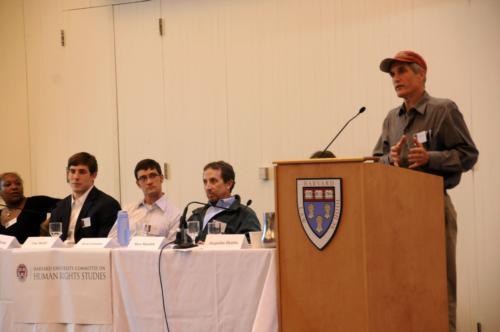
The panel discussion “Protecting the Right to a Home: the Anti-foreclosure Movement in Boston and Beyond” examined Boston foreclosures from a human rights perspective yesterday evening at the Law School.
The discussion mainly served to celebrate the achievements of two grassroots organizations—City Life/Vida Urbana and the Harvard Law School student-run organization, No One Leaves. Jacqueline Bhabha, the executive director of Harvard’s Committee on Human Rights Studies, moderated the event.
Bhabha began by briefly discussing the issue of home foreclosure and eviction with respect to American law.
“The notion that individuals have a right to a home is somehow strangely absent,” she said.
According to Bhabha, lacking a home violates a number of human rights.
In Boston, the rate of home foreclosure has risen dramatically in the past three years. Faced with what seemed like no alternatives, many tenants who were foreclosed upon accepted “cash for keys” deals, in which the bank paid the occupant a small sum in return for the occupant signing away the legal right to remain in the home.
City Life/Vida Urbana and No One Leaves have been raising awareness about other alternatives by canvassing from door to door. In the past two years, no tenant working with City Life has been evicted.
“If we can get enough people to stay in their homes, eventually someone is going to pay attention” said Nicholas Hartigan, a co-founder of No One Leaves.
Melonie Griffiths-Evans, a CityLife/Vida Urbana organizer, recounted her personal experience with foreclosure. Before receiving help from CityLife/Vida Urbana, Griffiths-Evans said that she felt that she had no other option but to enter a homeless shelter. But CityLife/Vida Urbana barricaded her home to prevent the bank from evicting her and her family. Ultimately the bank entered into negotiations with Griffiths-Evans.
“It was huge for me, seeing that my voice could be used in non-traditonal ways to effect traditional ways of doing things,” Griffiths-Evans said.
Want to keep up with breaking news? Subscribe to our email newsletter.