
Class Clown: Avery Pratt
Avery’s comedy focuses on the absurd.
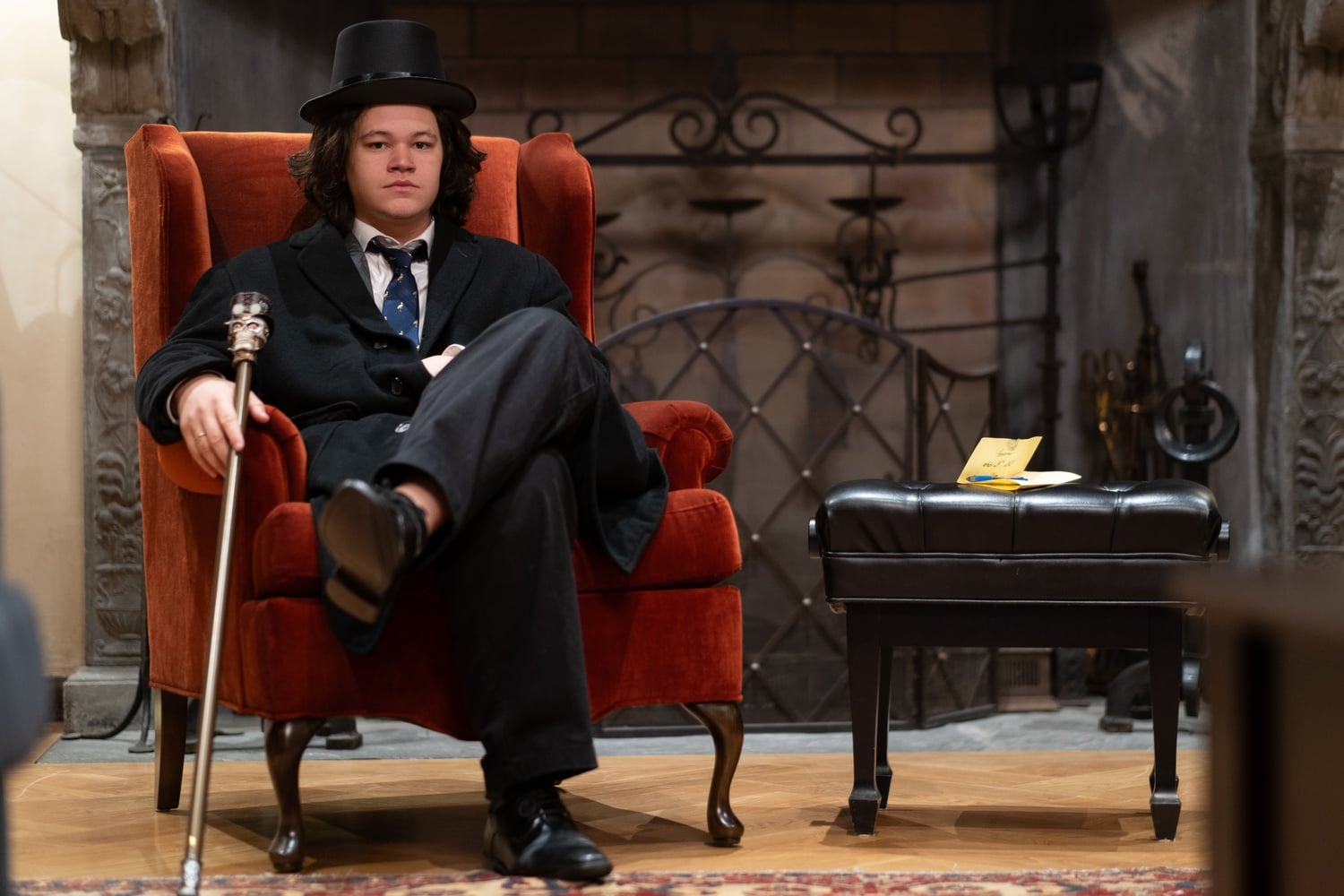
very G.D. Pratt ’26 meets me in the Adams House dining hall wearing a suit and overcoat. After exchanging introductions, he leads me to two red wingback chairs in Adams’ gold room.
Lying on one chair is a top hat, a cane with a skull handle, a mysterious piece of yellow parchment scrawled upon in cursive, and a rather modern looking blue pen which feels conspicuously anachronistic given the apparent Victorian theme.
Avery is a member of the Harvard Undergraduate Stand Up Comedy Society and the Harvard Lampoon, a semi-secret Sorrento Square social organization that used to occasionally publish a so-called humor magazine. He studies Social Studies, and his family is from Antigua, which inspired him to write his thesis about how humor manifests in Caribbean languages and how that humor can be seen as a “resistance form to the colonial project.”
Avery’s own comedy focuses on the absurd.
“I think some of my favorite humor magnifies things that are inherently a little bit strange or random, but we don’t really understand that absurdity because we take it for granted,” he says.
In an at-times absurd run for Harvard Undergraduate Association co-president alongside his friend Hamza T. Masoud ’26, Avery proposed banning homework, quicker laundry, free ice cream, more weekends, better weather, and bigger food. Avery says that their final promise came from a feeling that critiques of Harvard University Dining Service’s quality had become “trite,” and that a different tact was necessary to “ameliorate” dining concerns.
I ask Avery how many votes he earned.
“Oh, just, just about none of them,” he says.
Still, Avery and Hamza earned a dignified second to last in the race.
“I remember when we were at our campaign offices and seeing the penultimate position,” Avery says. “Our ties were kind of loose to our necks and all that sort of thing. But it was a big win.”
Avery is quick to credit his running mate Hamza and, as in a wholesome Oscar’s speech, he asks me to include his gratitude to various people.
He talks about how, while growing up, his parents called people they admired “life enhancers” and says he’s found a lot of those at Harvard. In addition to his brother and parents, he asks that I credit his other life enhancers: Hamza, Matt Sakiyama ’25, Sterling E. Hoyte ’26, Charlotte Y. Levy ’26, J. Garner Currie ’26, Elio G. Torres ’26, and his girlfriend Lauren M. Teichholtz ’26.
Freshman year, Avery and his roommates realized that Harvard did not limit the number of students a dorm could host for Visitas. Emboldened by the oversight, Avery and his roommates hosted 11 Visitas students in what he described as a “sardine trap house of high schoolers.”
When the weekend arrived, high schoolers slowly started arriving at Avery's common room. But one prospective student was running late.
“One of them was texting me super strangely. He was like, ‘I have just landed on the tarmac. Period. ETA, approximately 3:57 p.m. Period,’” Avery says.
Then he and his roommates heard a knock at the door.
“We open the door, and we’re like, ‘Hey, can we help you?’ And he was like, ‘Hey, probably weren’t expecting me to be older than your dad, huh?’” Avery says. “One of our Visitas kids was a 50-year-old veteran.”
Not really knowing what to do, Avery and his roommates offered to pool money to get their 50-year-old pre-frosh a hotel room, but he turned them down.
“I’ve slept in a closet in Fallujah, I can handle a boys dorm,” Avery recalls him saying.
That was good enough for Avery, his roommates, and the 10 other sardines bundled up in sleeping bags on the floor of his common room.
“And we were like, ‘Say less. Welcome!’” Avery tells me.
The rest of the night was spent with the veteran “telling war stories” to the eager audience of high schoolers. What started as a joke became a memory Avery speaks about with fondness.
“It was both hilarious and quite wholesome, which I think is a fun combination,” Avery says.
As our interview winds down, I ask Avery, still holding his skull topped cane, why he chose to meet me in the gold room. He tells me about his freshman year, about walking into Adams for the first time and feeling “immediately enamored” with the space.
When Adam’s House renovations were complete, Avery worried that the room might have been “sanitized” – that modernity had stripped away the beauty he recognized freshman year. Remarkably, though, renovations hadn’t dampened its grandeur.
“When I saw this room again as a senior in Adams House my heart was filled with joy that this very strange, idiosyncratic room had the same charm,” Avery says.
When Avery came to Harvard, before an ill-fated HUA campaign, before the Lampoon, before HUSUCS, and before he stuffed 11 pre-frosh in his dorm room for Visitas, he knew he loved writing. He just hadn’t quite defined his genre.
“I don’t think that I knew that it was expressly humorous as much as it was strange and absurd,” Avery says. “I really like the way that there’s an implied humor to abstract and absurd forms that vaguely resemble images and objects that we interact with in our game lives — and a real sincerity that you’re able to portray without defaulting to known stories.”
Avery went on a journey of comedic self-discovery at Harvard influenced by famous writers he admires.
“I think that for, dare I say, the vast majority of my Harvard experience, I have sort of tortured myself trying to create something that, at times, wasn’t very authentically me,” Avery says.
Within the last year, though, Avery says that he has “reconnected” with his own comedy, an experience driven by the friends he’s made at Harvard. Working through the creative process with them has brought him back to the joy of crafting art that feels “whimsical or fun or fresh or absurd.”
—Magazine writer Jack B. Reardon can be reached at [email protected]. Follow him on X @JackBReardon.