
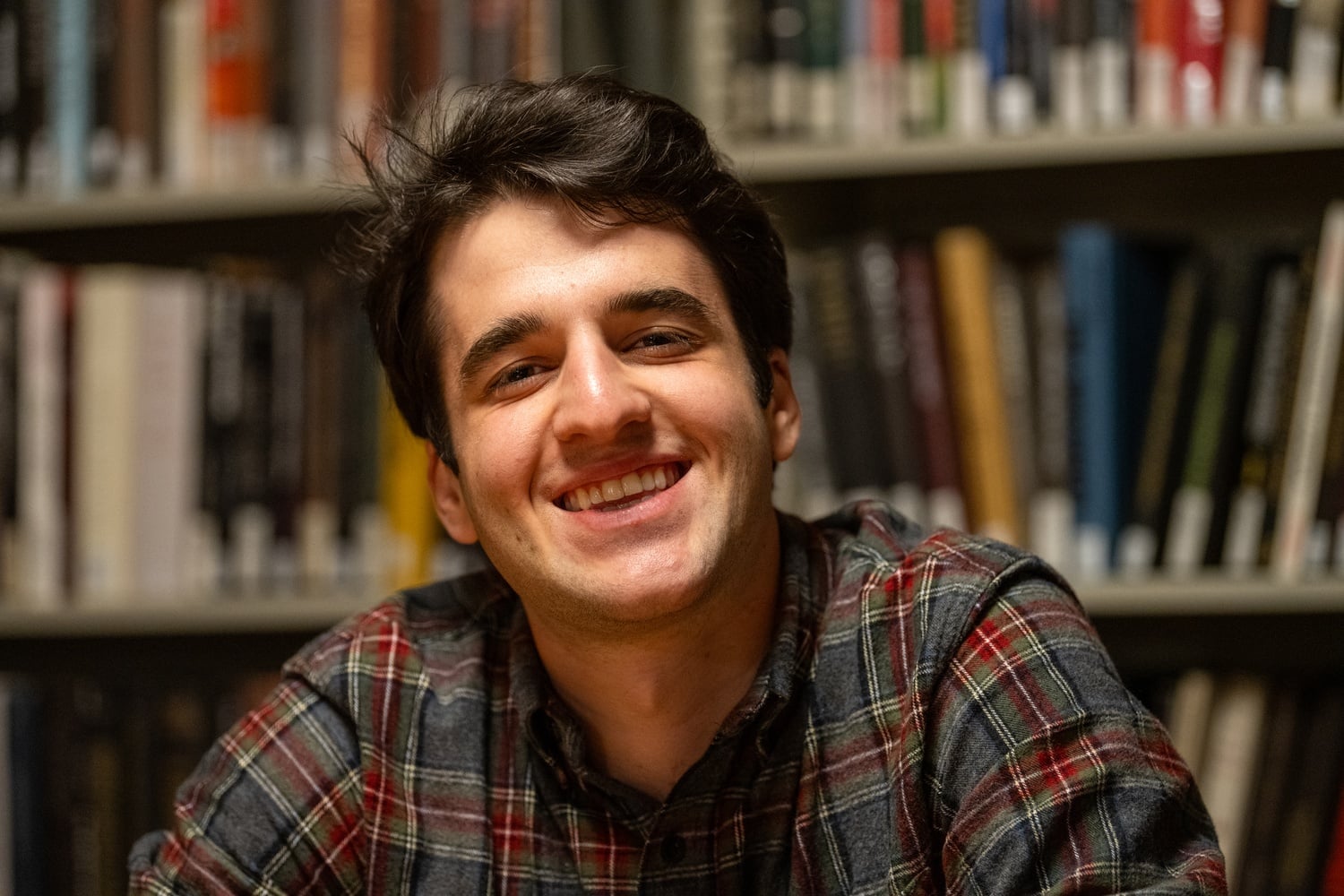
Most Likely to Be President: Necati Unsal
When Necati first came onto campus and was rejected by selective government groups, he took it as an opportunity to find more meaningful forms of advocacy and service on campus.
his year’s most likely future president (a serious title at a school that’s churned out eight of them), Necati O. Unsal ’26, didn’t spend his summer interning in Washington D.C. or lobbying alongside a federal agency. Instead, Necati was knee-deep in the rural outbacks of southern Colorado and Montana, working as a cattle rancher and horse outfitter, preparing horses for use in outdoor expeditions.
Though Necati had initially planned to work with his congressman, Virginia District 11’s Gerry Connolly, his plans fell through when Connolly suddenly passed away in May.
Instead of changing his LinkedIn to the green #Opentowork banner and seeking out another government job, Necati looked to unusual venues for employment — agricultural & animal husbandry Facebook Groups.
“At that point, I feel like the universe was telling me that I had to get away,” he tells me.
Necati shows me pictures of himself wearing a typical work getup, cowboy boots and all, while telling me about his difficulties adjusting to farmhand life. He says it was a culture shock, especially because there was no service, electricity or running water. He also struggled with a variety of new tasks, like digging stumps, pulling weeds, and tending to horses.

“The whole summer was kind of a humiliation ritual. I was bad at every single thing I did,” Necati says.
Still, he says he’s grateful that he had a chance to try something new.
“We are limited by our small exposure to other kinds of life,” Necati says. “I wanted to do something radically different.”
Life, for Necati, seems to be shaped by this desire to try different things. When he first came onto campus and was rejected by selective government groups, he took it as an opportunity to find more meaningful forms of advocacy and service on campus.
“I’m so grateful for my losses and awkward moments and my fails because they create a richer person,” Necati says.
Necati’s work at Harvard spans across a wide array of programs and leadership roles. He has taught with the CIVICS program, worked as a Peer Advising Fellow, served as HoCo chair for Currier house his sophomore year, and even acted as president of the Franklin Fellowship his junior year. According to Necati, however, the role he has the deepest attachment to is his work as a director of the Y2Y Harvard Square homeless shelter.
“I found such a great community working at the shelter,” Necati says. “I could make more of a direct impact on people’s lives and genuinely contribute to making the community I wanted to be a part of.”
Necati had also entered Harvard as a government concentrator, only to find his first government class “formulaic.” Studying government, according to Necati, only gave him the tools to look at the world as it was. “I wanted something more than that,” Necati says.
While exploring different options, Necati found a home in the Social Studies department. “Through it, I saw a different view on change making, which was more based on different theories of what the world could be like,” Necati says.
Currently, Necati is writing his senior thesis in social studies on the views and beliefs of left-wing students on Harvard’s campus. “There’s a lot of emphasis on right wing youth, especially after 2024,” Necati says.
“But also being in a very elite school there is something interesting about the fact a lot of people here are left-wing,” he later adds.
Necati says his thesis was initially more archival, but changed his mind when listening to a speaker in his methods class say the daily work of his thesis should be something he loved doing. Now, he’s collecting data for his thesis based on student interviews.
“If I did historical stuff, it would probably be me in Houghton,” Necati says. “Not the worst, but not my thing. I just love talking to people.”
Necati keeps the specifics of his work under wraps, noting that he’s already gotten in trouble with his advisor for sharing too many of his views with interviewees.
Despite his spontaneity in some areas of life, Necati grounds himself in his identity and community. One of the first things he mentions is that he is a proud North Virginian, hailing from his hometown of Lorton, VA. Necati finds something distinctive about Virginia, and speaks proudly about the state’s strip mall culture, Peruvian Chicken, and distinctive character.
“It’s a blend of southern hospitality with the diversity of the area,” Necati says. “People are just really excited to meet people.”
Last May, Necati ventured on a weeklong trip across Virginia with his friend and suitmate Ashwin H. Sivakumar ’26. Not only did they visit a variety of places across the state, they also had a chance to converse with its people, from actors in Colonial Williamsburg to a person who claimed to run the largest Black-owned farm in Virginia.
“Just love meeting people, talking to them, hearing their perspective on the world,” Necati says, “It’s usually my highlight of traveling.”
Necati takes pride in his Turkish and American identity. It was something that took time to grapple with — he is Turkish on his dad’s side and half Turkish on his mom’s, but didn’t know of any Turkish students until coming to Harvard. According to Necati, he spent time in freshman year trying to map himself onto a Turkish or American identity and spent the winter and summer break of his freshman year working and living in Turkey.
“When I came back to Virginia, I was like, I think I’m just from here,” Necati says. “I’m still proud to be Turkish, but I think I’m Turkish American,” he adds.
Much of Necati’s interest in public service and politics also comes from his family. He is a first generation student, and says that despite his parents experiencing a difficult upbringing, they also made an effort to raise him with unconditional love (his dad even got a tattoo of Necati’s face on his shoulder, much to Necati’s dismay). His parents have also brought him into a shared community — Necati jokes that he has “peak only child syndrome,” since his parents made an effort to incorporate so many people into his upbringing. “I was the only child of 20 parents.”
Being raised by his parents and their village of people taught Necati the value of community building.
“The reason I want to go into public service in the future is because I feel like I got to see people at their best,” Necati says. “Genuinely like what happens when people start to imagine themselves as part of a shared community, not tied together by blood, but something deeper than that, a shared commitment to one another.”
It’s this commitment to community that Necati brings forth not just in his advocacy work, but in his personal life as well. “My greatest accomplishment at Harvard is introducing my block mates to each other and facilitating a really good blocking group community,” Necati says. Together, they’ve spent late nights in Currier Dhall or chatting in the Currier Bingham Living room. They even do massage circles — something which Necati admits is one of his more “vulnerable facts,” but is still keen to share pictures of.
“The perfect form of reciprocity is a massage circle, which just goes on and on, and everyone’s giving each other a massage,” Necati says.
The pictures, however, show Necati at the front of a massage congo line. “I feel like this looks bad too, because I’m benefiting,” Necati says. “Honestly between you and me, that’s my ideal state.”
Whether or not this politically minded senior will fulfill his peers’ prophecy is yet to be decided. In the meantime, Necati is looking forward to learning and discovering more about the country he loves.
“I really like this country, and I would like to be in a position to make a lot of change,” says Necati. “But who knows where life will lead me.”
—Magazine writer Jona P. Liu can be reached at [email protected].