
Most Interesting Thesis: Rosie Couture
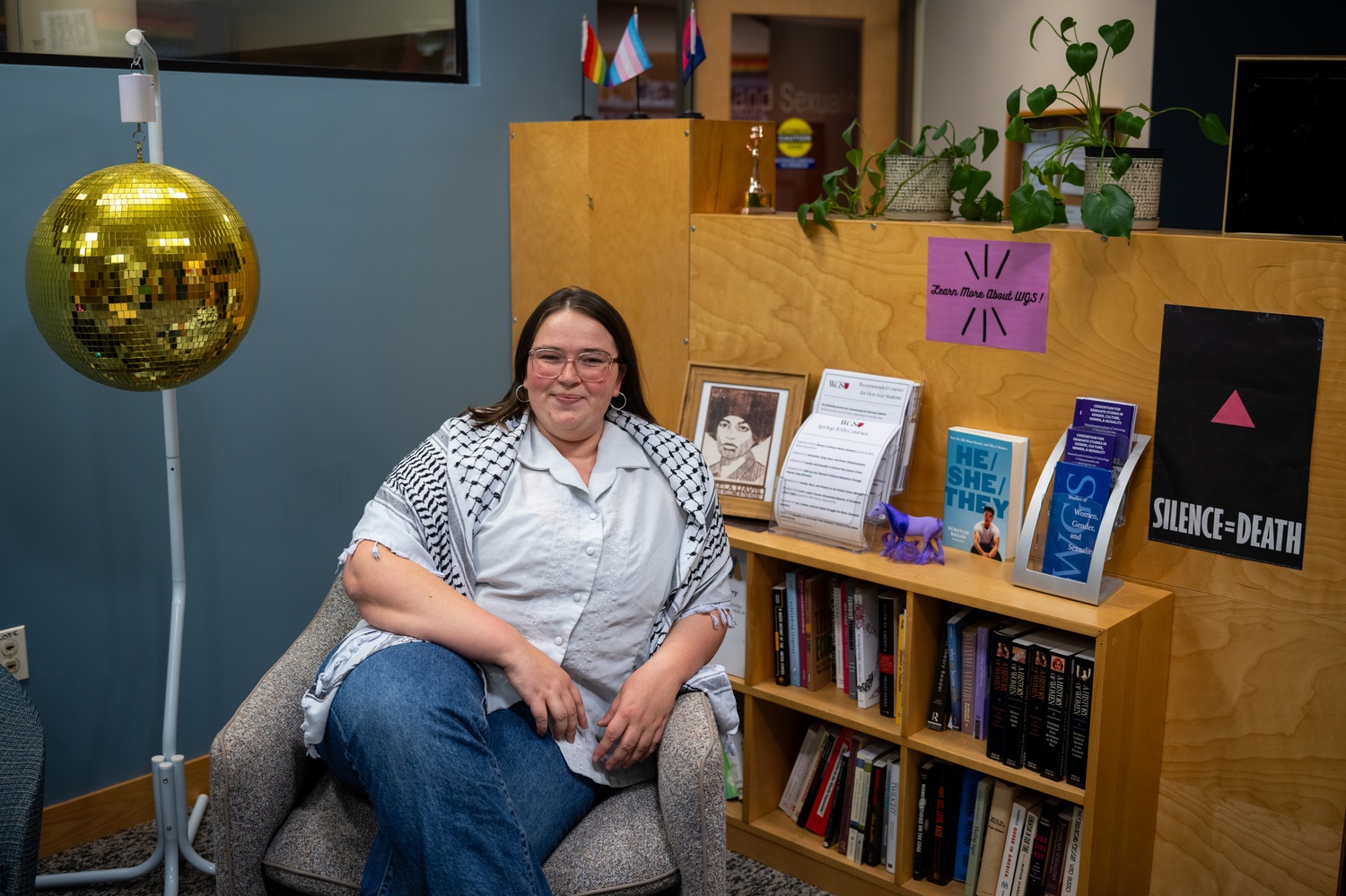
This summer, Rosalie “Rosie” P. Couture ’26 went on a road trip to lesbian bars across the American South as part of her thesis research.
his summer, Rosalie “Rosie” P. Couture ’26 and her high-school best friend went on a Harvard-funded road trip to lesbian bars across the American South. In between dancing and drinking, she was taking notes. After all, the expedition was a central part of her thesis research.
“We talked to the owners, we talked with the workers, and we just hung out,” says Rosie, who went to high school in Arlington, Virginia. “And we’re trying to understand — what role do these bars play in their communities?”
Her research has taken her from the depths of Harvard Radcliffe Institute’s Schlesinger Library to archives and interviews around the country. Through her studies of lesbian bars in the U.S., Couture hopes to understand their evolving popularity and their significance to lesbian and queer communities.
“In the 1980s, during the peak of lesbian bars, there were over 200 bars. And today that number is less than 40,” she explains. Many of the bookstores, communes, and organizations that arose during the women’s liberation movement of the 1960s and ’70s have since shuttered, which means that these bars are now among the only physical institutions by and for lesbians.
Rosie argues that lesbian bars have long served as important hubs of community-building and activism. Three major chapters of her thesis explore what it means for these institutions to succeed. The first examines how they mediate belonging within the lesbian community, pointing out that many were not utopian spaces and had histories of racism and transphobia.
She also catalogues how these bars have responded to political attacks, from a long legacy of police raids to modern legislation targeting drag queens and trans youth.
“I’m theorizing that with these attacks bars become more important because people need a space to come together and feel safe and loved,” she says, “and come figure out how they’re going to fight back.” In the final part of her paper, Rosie measures the economic factors that have affected the longevity of these institutions as well as who has access to them.
More broadly, Rosie says she’s also interested in lesbian bars as unique spaces for serving and uplifting women, something that’s been a defining aspect of her college education. “The whole theme of my time at Harvard is I just want to love and support and empower women,” she says.
Indeed, Rosie is no stranger to coalition-building and political organizing herself. Off-campus, Rosie has worked in state and national Congressional offices. She is co-founder and executive director of Feminist Generation, a national youth advocacy group that has organized around improving youth voter engagement, access to family planning, and gender-affirming care.
Meanwhile, at Harvard, the social studies and women, gender, and sexuality double-concentrator has campaigned to raise awareness around topics such as justice for survivors of sexual abuse and, recently, Harvard’s ties to convicted child sex offender Jeffrey E. Epstein.
“Harvard has taken $9 million from Epstein to end donations,” she adds, “and I would love to see Harvard repair the harm of that by donating $9 million to Women, Gender and Sexuality Studies so that we can continue writing theses like this one.”
During a time when the WGS department has been facing challenges — including funding cuts and a recent denial of tenure for one of its only full-time faculty members — Rosie hopes that her senior thesis will help highlight the significance of the field.
While she says she’s unsure what form her passions will take after graduation, Rosie is grateful for all that the thesis process has taught her. “You get to meet and learn about so many people today and in the past who care about the same questions you’re asking.”
By combining her longstanding interest in feminist scholarship with the political theory — and funding — of the Social Studies department, Couture has been able to research something she cares deeply about while also having a lot of fun.
“Follow your heart and gut about the people and places you love,” she advises other students trying to chart a path through their studies. “And do something with your Harvard education and platform.”
—Magazine writer Megha Khemka can be reached at [email protected].