
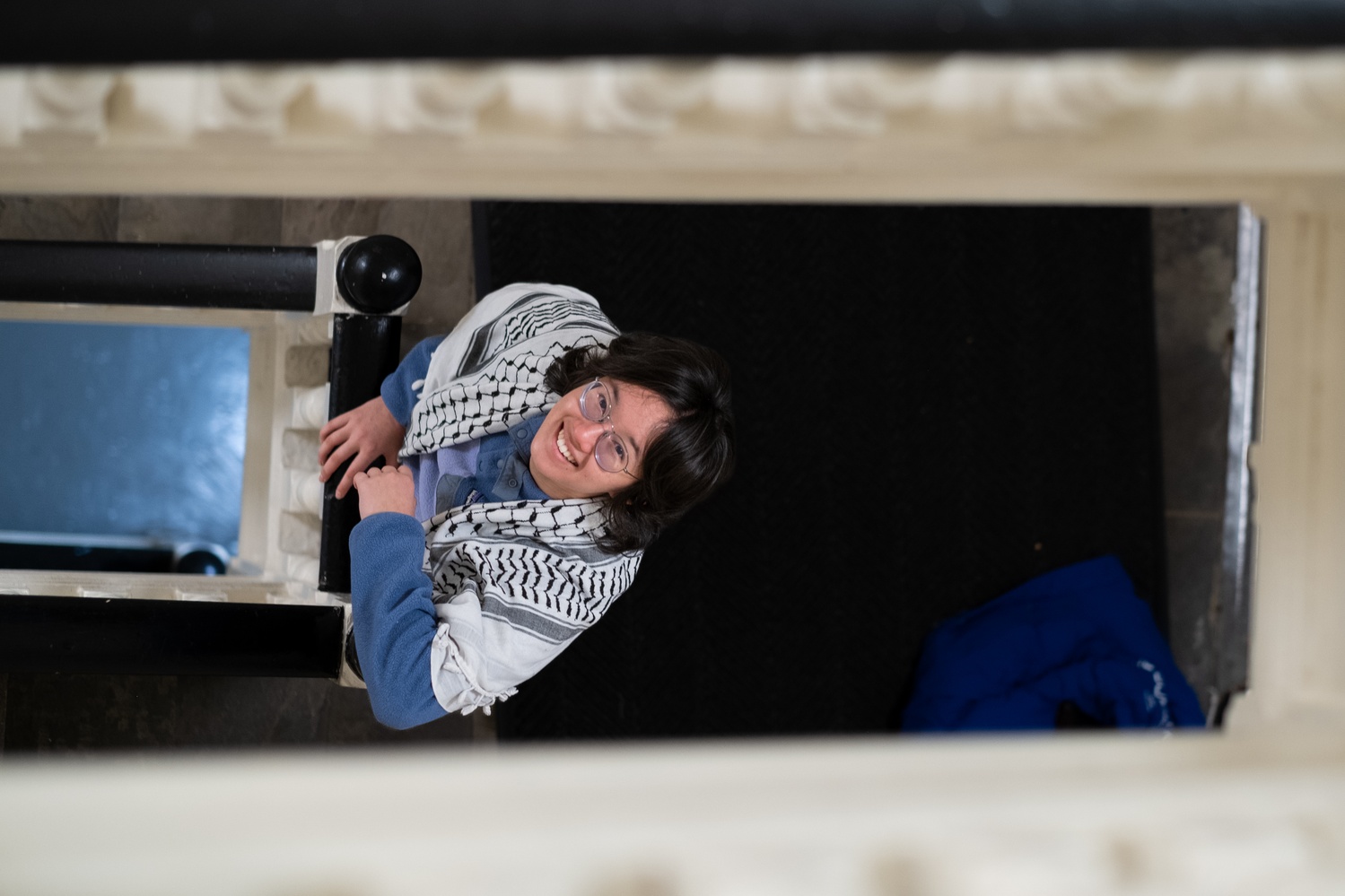
Most Changed Since Freshman Year: Violet Barron
Before this experience, Violet had never imagined herself an activist.
t was October of 2023, and Violet T.M. Barron ’26 was standing on Brattle St., watching in shock as a billboard truck cycled the full names and faces of students who were part of the more than 30 student organizations that had co-signed a statement declaring Israel “entirely responsible” for Hamas’s deadly Oct. 7 attack.
The truck circled Harvard Square for several days, flashing the names of students under the heading “Harvard’s Leading Antisemites.” Some were people Violet had sat beside in section, some were friends. Standing there, face-to-face with photos of her classmates rendered larger than life, she couldn’t shake the feeling that something was profoundly wrong.
At the time, Violet had regarded the student statement as insensitive and considered her classmates who had signed it to be “misguided” and “naive.” Yet the students whose faces now loomed above the Square were not, in her view, the caricatures the truck suggested.
“I knew they weren’t hateful,” she says. “I knew they weren’t bigoted. I knew they weren’t antisemitic.”
Violet herself is Jewish. She grew up going to Hebrew school twice a week, has visited Israel twice, and celebrated her bat mitzvah at the Western Wall. “For the vast majority of my life, including freshman year, I was a liberal Zionist,” she says.
“More or less, I felt neutral-to-good about Israel,” Violet adds. Her misgivings about Israeli Prime Minister Benjamin Netanyahu felt unremarkable to her, simply part of the skepticism she assumed most mainstream Democrats felt toward him. On the whole, though, Violet didn’t give much thought to Zionist politics. Israel existed in her mind, she says, as “this place where I had gone, where I had fond memories — which was certainly a complicated place, but not one that shouldn’t exist.”
In the days following Oct. 7, Violet called home and reached out to friends from Hebrew school, crying daily and longing for the Jewish community she never felt she found at Harvard. She mourned for Israel and for the family friends she had there, but once Israel “retaliated nearly immediately, and very disproportionately,” she understood that her grief had to extend to Palestinians in Gaza, too.
Her disillusionment with the nation she once felt connected to was only deepened by the October doxxing trucks. Confused by what she describes as the aggression of pro-Israel activism on campus, Violet embarked on an “investigation of sorts,” and began to read the work of Palestinian authors.
“For the first time, I read the anti-Zionist perspective, and learned of the storyline that had been missing my entire life,” she says. Hebrew school, she adds, had given her a “one-sided narrative” of Israel. Reading that 1948 marked not only Israeli independence but also the beginning of what Palestinians refer to as the Nakba — the mass displacement of Palestinians during the Arab-Israeli war — helped her, she says, “fill in this other half of the story.”
Before this experience, Violet had never imagined herself an activist. During her first year at Harvard, her political energy went into mainstream campus institutions — the Institute of Politics and the Harvard-Radcliffe Asian American Association — where she worked on voter-encouragement and civic education initiatives. She was especially drawn to the Asian American Association after its support for Harvard in the Students for Fair Admissions Supreme Court case, a position that aligned with her liberal instincts. “I was interested in thinking about politics in a way that I think a lot of people at this school are — which is, frankly, pretty uncritically,” she says.
But just a month after she first saw the doxxing truck, Violet found herself camped out in University Hall with eight other members of Harvard Jews for Palestine — an unrecognized student group she founded — urging Harvard to call for a ceasefire and formally distinguish anti-Zionism from antisemitism. The 24-hour occupation brought Violet before the Harvard College Administrative Board, her first brush with University discipline.
Violet recalls that she had always been “afraid of authority,” and was disinclined to “make a lot of noise.” The war in Gaza, though, altered her sense of what she was comfortable with — and what she felt was required. “When one thing kind of falls or breaks open, then everything does,” she says. Activism no longer felt peripheral — it became, in her words, “something that I feel that I have to do.”
The University Hall occupation was only the beginning. In the months that followed, Violet moved further from the quiet freshman she had once been and deeper into the public, and often demanding, work of campus organizing. She quickly joined the Harvard Undergraduate Palestine Solidarity Committee and Harvard Out of Occupied Palestine, an unrecognized student group, and founded Harvard Undergraduate Jews for Peace in addition to Jews for Palestine. Soon, nearly all her time outside of class was consumed by meetings and steady organizing. (Violet is also a former Associate Editorial editor at The Crimson.)
Those tense months of Violet’s sophomore spring culminated in the encampment — an experience she describes as among the most formative of her life, and one that she says “bifurcates” her time at Harvard.
For nearly three weeks, Violet and other pro-Palestinian student activists slept in tents in front of University Hall, protesting the suspension of the PSC and urging Harvard to divest from Israel. Under the constant eye of University security, they formed a makeshift community that held teach-ins and group prayers in spite of repeated warnings about disciplinary action. For Violet, it was a rare space on campus where her identity as a Jewish anti-Zionist felt comprehensible — even welcomed.
“That was a point along the way when I saw the potential for what Harvard could be, and what I want Harvard to be,” she says. “It really posed an alternative way of being on this campus.”
But the encampment also marked the beginning of a new reality for Violet — one defined not only by her newfound sense of purpose, but also by consequences. In the weeks that followed the encampment, she was summoned before the Ad Board for a second time, at one point facing the possibility of a year-long suspension — a ruling that was overturned the following summer.
“If you had told me that that would happen to me freshman year, I would have cried,” Violet says. “I probably did cry the first time I was Ad-Boarded,” she adds. But what had once seemed unimaginable gradually came to feel like an unavoidable extension of the work she had committed herself to.
Alongside the attendance credits forfeited for protests and the uncertainty of whether she would finish her degree on time, Violet found that her pro-Palestinian visibility carried social costs as well. “I have lost a lot of friends over my political commitments and being vocal about them, especially friends from home,” she says. “There are some people who don’t talk to me at all anymore, who I used to be very close with.”
That distance surfaced on campus too. Violet says the shifts in her social sphere were felt most acutely in the Jewish spaces she had once hoped would anchor her when she arrived in Cambridge freshman year. Even before she became involved in activism, Violet recalls that she had “never really felt welcome at Hillel,” largely because, being half-Asian, she didn’t “look stereotypically Jewish.” But as she became more engaged in pro-Palestinian organizing, she says the atmosphere sharpened. “I’ve been yelled at in Hillel and called a terrorist just for wearing my keffiyeh,” she recalls.
Harvard Hillel — one of the University’s two Jewish student organizations — states on its website that it welcomes students of all races and ethnicities, which Hillel Executive Director Jason B. Rubenstein ’04 affirmed in a statement.
This sense of isolation, Violet notes, predated her politics but was intensified by them, reinforcing the feeling that the communities she once expected to sustain her at Harvard did not — or perhaps could not — make space for the kind of Judaism she was trying to inhabit.
The questions she was confronting in Hillel echoed in her conversations at home. Violet describes difficult discussions with her grandparents, whom she describes as “ardent supporters of Israel,” as she worked to define a version of Judaism that diverged from the one she grew up with.
Violet recalls a conversation with her father in which, after a long argument about Israel, he offered a quiet verdict: “You’ve changed.” The comment, she says, stayed with her.
“I’m still the same person who he raised me to be,” Violet says, “which is someone who tries to be unconditionally empathetic and a critical thinker.” What looked sudden from the outside felt, to her, like the natural unfolding of traits she had carried all along.
She remains ambivalent about the idea that she has changed as dramatically as others believe. Her politics are different, the risks she accepts are higher, and even the communities she turns to for belonging have shifted. But Violet insists she is still the same person who walked through Johnston Gate almost four years ago.
“I think that what really just happened was, I got some clarity,” she says. What changed, in her view, was her willingness to follow her core tenets to what she saw as their logical end. “I see more clearly now what it means to really stand by and stand up for values that I think I’ve always had,” Violet adds.
And when she thinks back to that afternoon on Brattle St., watching her classmates’ faces flash across the doxxing truck, she sees not the beginning of a break, but the first moment she understood what her values would ask of her.
—Magazine writer Caroline G. Hennigan can be reached at [email protected]. Follow her on X @cghennigan.