
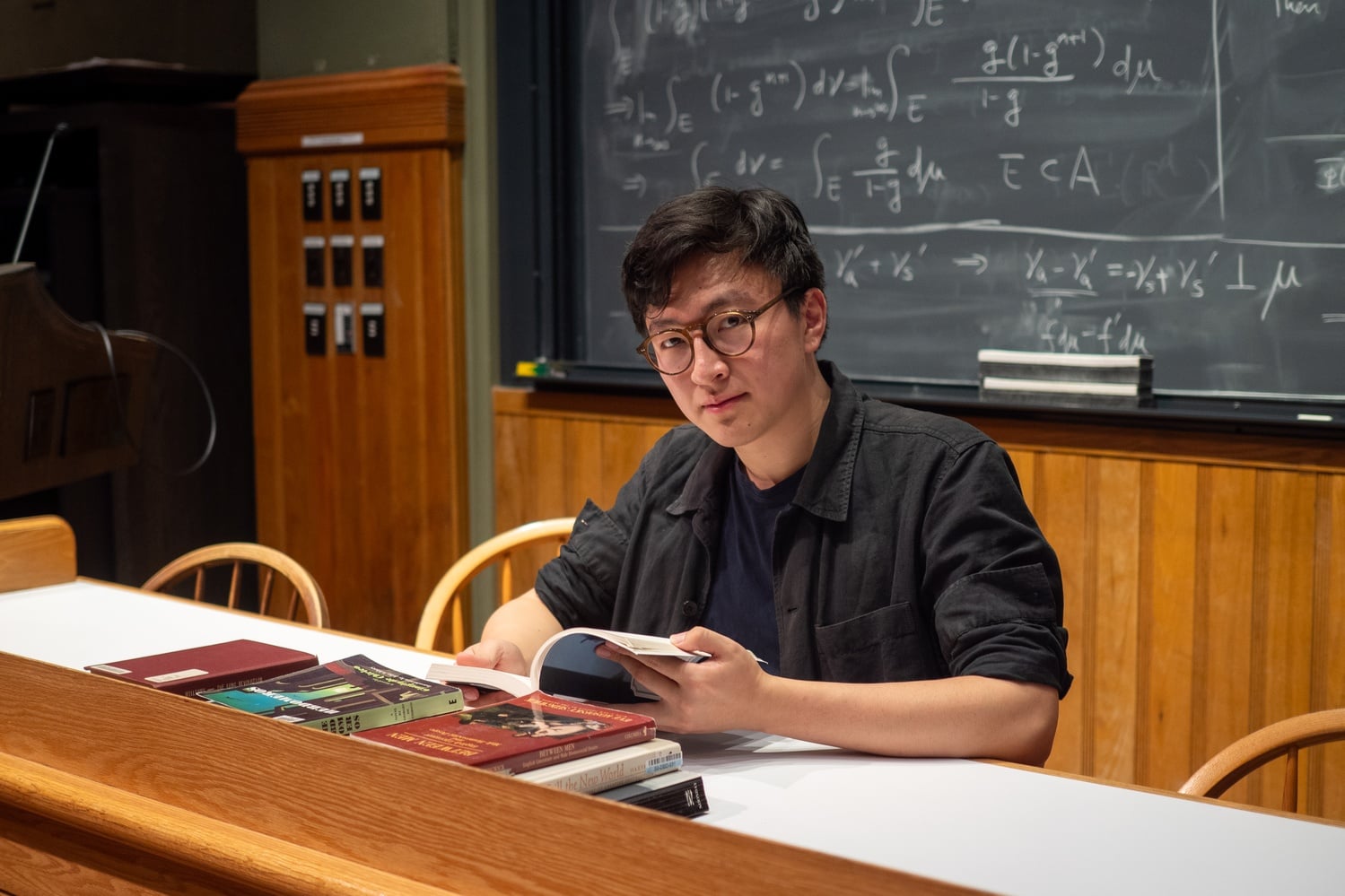
Renaissance Person: Max Fan
Max says he sees the lights of Shanghai, the stacks in Widener, the classrooms in Botswana, and the sight of the ocean for the first time as lessons in a kind of intellectual vastness.
. Max Fan ’26 vividly remembers the first time he saw the ocean.
“I remember watching the waves crash over these rocks, on the southern coast of Victoria, and feeling the immensity of that, and thinking there’s a billion times more ocean than I can see,” he recalls.
Born in China, Max moved with his family to Australia at four years old. Those early encounters with scale and awe have since become a recurring motif. He remembers the first time he flew into Shanghai and saw the bustling metropolis from the air. Now a senior studying Math and English, Max says each moment reminded him of how much there is to learn.
He says that he hopes to inspire similar feelings and become a high school teacher after graduation. So far, he has spent his sophomore and junior summers in Botswana, teaching subjects like physics and math.
“Mathematics is a way that a lot of developing countries get on their feet by having strong groups of engineers that return after foreign study to build up the country,” he says. Max coached the Botswana International Mathematics Olympiad Team and helped establish one of the first further mathematics programs in the country.
While math has always been a practical subject for Max, he has also delved into the study of the subject’s pedagogy. Learning the strange, unpredictable way people learn — what sticks and what doesn’t.
He finds this unpredictability when he teaches English classes, too. He is constantly surprised by what his students write and express, from pondering the physicality of ghosts in Shakespeare plays to the unexpected intersection of pop stars and T.S. Eliot.
Once, he gave a harsh grade to a student who compared “The Waste Land” to a pop musician. Later, he couldn’t stop thinking about it and now says he wishes he could retract the grade. The experiences have taught him how to “read things generously” and to meet students “where they are.”
But don’t think Max only confines himself to Math and English. Ask him about his years as a cadet officer in high school, his stint on the national Australian Schools Debate Team, coastal rock formations, Caribbean history, evolutionary biology, or architecture, and he’ll give you some interesting tidbits to nibble on.
The easiest empirical proof of this passion is a quick glance in Max’s backpack, which contains nothing but a hefty set of tomes: “Silent Spring Revolution,” “Risk and Morality,” “The Centenary History of Rossall School,” and many books related to his thesis on British writer J.R. Ackerley and post-colonial queer theory. Max finds inspiration in Ackereley’s work, which he says spans an “astounding range” from travelogues to romance plays.
“I’m interested in people that seem out of place, or out of time — as in unhitched from the era that they’re writing in or reading in,” he tells us before citing a long list of authors including William Faulkner, John Wilmot, and Aphra Behn.
Reading is one of the key pillars of his life. Max recalls learning that bookshelves themselves functioned as structural supports in Widener From the outside, he says, libraries are “beautiful facades of things, but on the inside it’s literally the books holding up the institution — and that’s heartening,” he says.
He says he sees these moments — the lights of Shanghai, the stacks in Widener, the classrooms in Botswana, and the sight of the ocean for the first time — as lessons in a kind of intellectual vastness.
He tells us his favorite quote from the author of the “Little Prince”: “If you want to build a ship, don’t drum up the men to gather wood, divide the work, and give orders. Instead, teach them to yearn for the vast and endless sea.”
He explains that “that’s the way I, in a very idealistic sense, see the role of education in people’s lives. That the things that you learn aren’t important so much as the feeling that you learn, of what learning feels like, and those things that make you realize the immensity of something — nature, people.”
But not all of his interests are grand and sweeping. One of the books on his bookshelf is called “Raising Milk Goats The Modern Way.”
“Raising milk goats seems like one of those singular goals that’s worth pursuing. It is challenging, admittedly, to raise milk goats in Cambridge as such,” he chuckles. “But if I could, I would.”
Correction: December 20, 2025
A previous version of this article incorrectly stated that a quoted passage was from The Little Prince. In fact, the quote is from the book’s author.
—Associate Magazine Editor Sunshine Chen can be reached at [email protected]. Follow her on X@sunshine_cxn.