
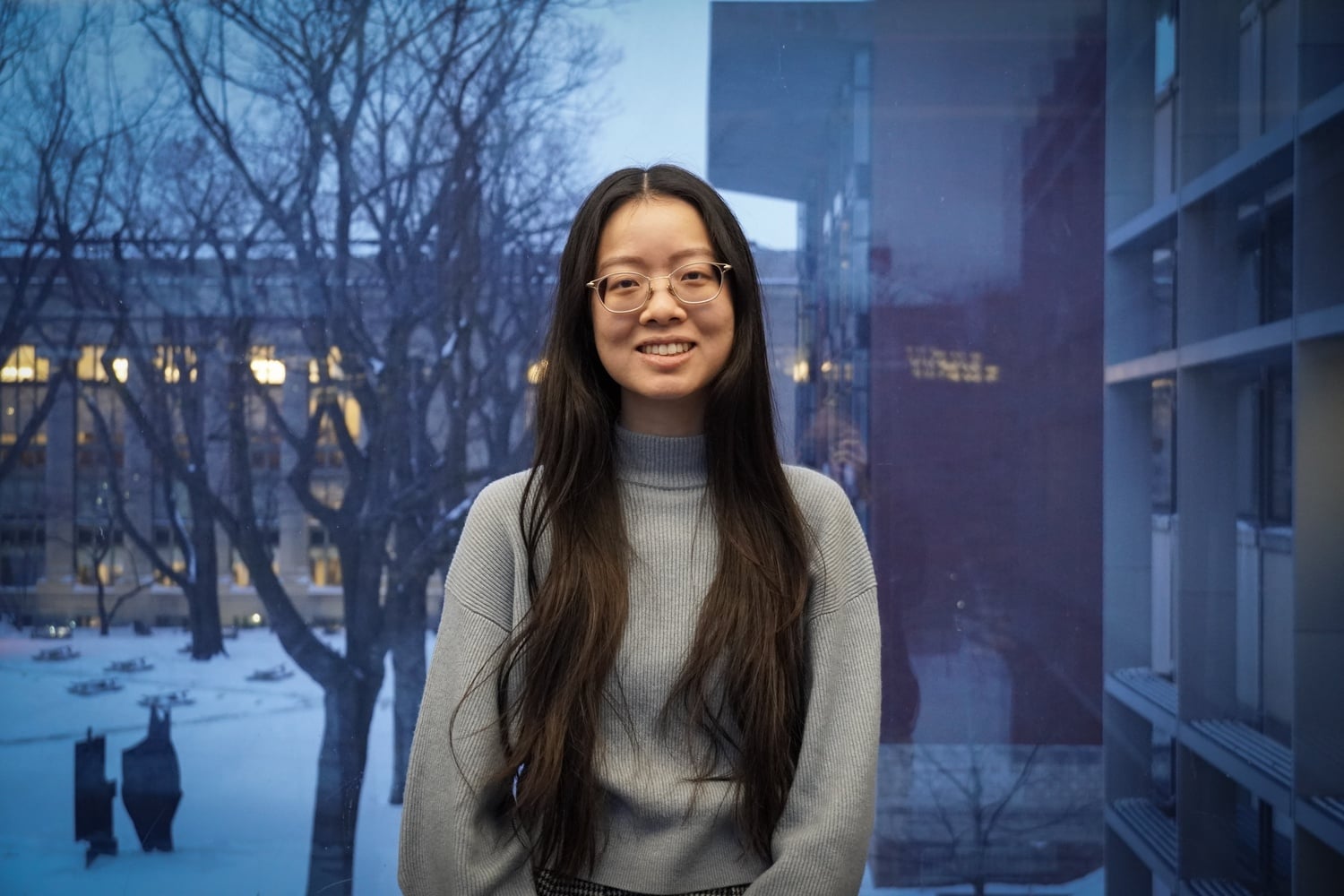
Fifteen Questions: Julie Vu on Human Judgment, Teaching Philosophies, and Why Good Data Matters
The lauded Preceptor and Curriculum/Pedagogy Specialist in Statistics sat down with Fifteen Minutes to talk about her long-held love of teaching, the importance of good data in an increasingly polarized world, and student culture at Harvard.
Julie P. Vu ’15 is the course instructor for Statistics 102: “Introduction to Statistics for Life Sciences” and the preceptor for Statistics 100: “Introduction to Statistics and Data Science.” This interview has been edited for length and clarity.
FM: You recently won a pedagogy award for your work in the Harvard Statistics Department. But you’ve also been famous for your teaching skills since high school, when you made online study guides. What got you interested in teaching?
JPV: I just really like that process of helping other people see that they can do something that they didn’t really think they were capable of doing. And I love being able to work on different ways to explain a topic.
I found it a very rewarding thing to be able to provide, from back then in high school, a way to help people get through something that was very difficult for them.
FM: What has it been like to be a teacher at the same place that you were a student?
JPV: I think it’s very fun. A lot of the faculty that I talk to feel like they don’t know anything about the undergrad culture.
But I think it’s a different view to have been a student here and be very familiar with the dorms and what students prioritize in their life. You know, maybe it’s not always classes.
FM: How would you describe your teaching philosophy?
JPV: The main thing is that learning happens when you try to do things, rather than just listening to a lecture.
I really remember sitting in lectures and feeling like, “This is okay. I think everything makes sense.” And then getting to the pset and seeing, like, “I don’t think we cover this or I don’t have any idea how to start this problem.” So I think my teaching philosophy is centered around, “How do we help students bridge that gap between things that they’ve heard and seen and what they need to do?”
FM: You interned at a restaurant in Harvard Square when you were a student here, and you’re known to bring homemade baked goods to class. When did your baking journey start?
JPV: I think I probably started baking in college. In the middle of college, I lived in DeWolfe after my first summer because I was doing research in my lab, and so having my own kitchen was a good nudge to start cooking and baking.
FM: Did you ever consider baking professionally?
JPV: I did consider that after graduating. But it’s a lot of work, and I think it would be the case of, “Oh, it’s suddenly not my hobby anymore.” And I’d also have to make the same thing every day, I’d have to get up at like 3am. There were a lot of hurdles, but I still get a lot of people telling me that I need to open a bakery.
FM: Do you have a signature dish?
JPV: What are the TFs most excited about? I guess they all have pretty different preferences. Nut bars. They love nut bars. Frangipan bars with pistachios and apricots, and I’ve also done that with different versions, like strawberry matcha, or fig and hazelnut.
FM: Would you consider baking an art or a science?
JPV: Something that people really noticed when I was hanging out in my lab in undergrad a lot is that biologists love baking. It’s the same procedure for them as being in a wet lab — just measuring out lots of things, and then combining them in a specific way, and then getting a predictable result.
I guess some people would say art because maybe they want to do more of the improvisational part. But I really enjoy making the same recipe repeatedly, regularly, and then learning more about it every time I do it.
FM: You concentrated in OEB [Organismic and Evolutionary Biology] at Harvard. What made you pursue statistics?
JPV: I did research in plant genetics for my senior thesis, and I, up until that point, definitely avoided math. I took calculus in high school and said, “Okay, that’s enough of that.”
When I started my senior thesis, I was collecting data, and then I realized I didn’t really know how to analyze the data. So that was actually the first year that Stat 102 was brought back after a very long time. That was my junior spring, so I’d signed up for Stat 102 not really knowing what to expect.
But I really liked it.
I became a TF for the course my senior year, and that’s what really made me change my direction. I realized I didn’t want to be doing wet lab all the time.
I realized I was a lot more interested in what happens afterwards, once you have the data, and telling stories about the data.
FM: What is a fact about statistics that you would share at a party?
JPV: Suddenly, a lot of bad statistics jokes that I’ve heard come to mind.
If somebody was asking me what I do, they probably want to talk about AI.
A group of students I once worked with for [Stat] 139 on their final project when they submitted it wrote “trash in, trash out” on the last page of their paper, because that was the main takeaway they took from all of our meetings leading up to the project. So I would probably want to tell somebody “trash in, trash out” still applies when we talk about AI.
So often people confuse data quantity for data quality. They’re not the same thing. Data quality is much more important, and when we build these AI models without being careful about what’s in the training data, we’re going to make a lot of mistakes.
FM: What is the role of human judgment in statistics?
JPV: If you are the analyst, you get to make choices about what population you study, what variables you choose that you believe are a good proxy for what you’re trying to measure. Another important thing that I try to tell students is that data isn’t like “real.” Data is just something that we collect in a format that computers can work with. For things like race, we collapse that into a variable with a limited amount of categories because we can’t have an infinite amount of categories on a form. That’s a very rough sketch.
So it’s very incomplete, this process. You have to make some choices, and some choices will lead you to be more biased in one way or the other.
Another example I talk about with students is that statisticians have a responsibility to present results in a responsible way.
There can be negative interpretations of data that you originally thought were neutral. But it’s up to you to be ahead of the story and say, “Okay, this is what we cannot draw from it. This is what we can draw from it.” So that’s definitely an issue of human judgment.
FM: Do you consider grade inflation to be a major problem at Harvard? And what do you think is the role of grades when you’re designing a course?
JPV: I think grade inflation is always going to be a thing, because what are grades, even?
I think the problem is that the grades always get used for something. I’m very aware that a 4.0 versus a 3.98 is significant for certain things that students might apply for, and so that’s why they’re worried about the difference between an A and A-minus. I think grades should be a marker for students of how much they’ve learned or what they take away from a course.
Just like when students get evaluated or applicants get evaluated for school or for jobs or internships, there have to be ways to assess fit that aren’t just about grades or just aren’t about any kind of quantitative score. We’re going back to this theme of imperfect data again, and I don’t think there’s any way that one letter is going to really fully summarize a student’s experience in the course.
FM: How do you balance having a rigorous course with the realities of the Q Guide?
JPV: It’s tough, right? Very few people have managed to do it consistently, like Joe for Stat 110. Famously, a very difficult course that students love. But I think it’s all to do with expectations. If students go in thinking that the course is going to kill them, they will work hard and they will survive, and they won’t be angry about it. But if students go into a course thinking it’s going to be super easy, they won’t ever have to do any work, and they realize it’s a lot of work, they get very angry actually. And it comes out in the Q.
You’ve also probably heard of the research that teaching evaluations are still very biased for gender bias, age bias, so that comes out in the Q, too. I think some people are surprised to hear that it happens at Harvard, but bias is everywhere. It’s really hard to escape social conditioning. I’ve seen that women are more punished in the teaching evaluations, especially when expectations aren’t met. And I think people unfortunately also feel way more comfortable admitting a course is difficult if it’s taught by someone male rather than female.
So evaluations are tough.
FM: You talked about this idea that data isn’t real. Do you think that data or perceptions around data have a big impact on our current political climate?
JPV: I think that’s exactly the point. People can see the same data or the same study and come away with vastly different conclusions for what that means or what we should do in our society. And also, we’re not living in a world where people agree on the truth. One side might say this is what we think is important. These are the facts, and the other side will just say, those are not the right facts to be looking at, look at these facts instead.
I think scientists, especially with the recent election, were very discouraged with the anti-scientific sort of beliefs, right? Like punishing people who are in academia or who do research, and also doing things like changing public data sets like the CDC. Things like that, taking those things down—that was very jarring to a lot of people who spend their entire lives researching this very rich source of public data. And attacks on things like the Census Bureau—very worrying for statisticians.
FM: In your weekly flipped classroom instructional videos, I’m told you always take a few minutes to recommend a local restaurant or event. What’s your rationale for including these recommendations, and do you have one for the magazine’s readers?
JPV: I think it’s good for students to get outside of Harvard Square and just what they’re used to.
Some students have never been to Boston or seen anything outside. Which is a shame, because, you know, we’re not in New Haven. There is stuff to see.
I would recommend going to Mountain House in Allston — which is a Szechuan restaurant — because spicy hot food sounds very good in the cold weather. I’ve recommended students go to restaurants in Allston before. It’s just like a super different vibe than Harvard Square, and the restaurants are less expensive and there are better options.
FM: Okay, well, thank you so much again!
JPV: Feel free to take a scone.
— Associate Magazine Editor Megha Khemka can be reached at [email protected]