
Fifteen Questions: Ambrogio Pistoja on Satire, Cultural Heritage, and Bruce Springsteen
The Romance Languages and Literatures Associate Professor sat down with Fifteen Minutes to discuss satire as verbal violence — and whether it can still be funny.
Ambrogio C. Pistoja is an associate professor of Italian in the Romance Languages and Literatures Department. This interview has been edited for length and clarity.
FM: You conduct research on, among other topics, satire in pre-modern Italy, which I’ve seen described as both verbal violence and a language of injury. What does it mean to you to think of satire as a form of violence or attack?
ACP: We are, as human beings, symbolic creatures. We create narratives to understand ourselves, our relations with others, our relations with the world out there. And these narratives are so important to us, almost as our own physical bodies. Satire is a way of employing language and other forms of artistic expression — of non-physical expression, or at least non-physical touch — that is able to infringe, to cause injury into these narratives, even to rewrite them, to alter them. And the consequences can be profoundly destructive, can unravel narratives that we use to really understand and be who we are, to understand, also, our communities.
So yes, satire is this space where language is discovered as a tool to unravel these very precious narratives, but like any technology, it can be used for the good and for the worse, for good and for bad reasons. There’s a way in which a process of unraveling or dismantling can be healthy, beneficial. Sometimes we become trapped into some pieties and ideologies of ourselves and our fellow human beings. Satire as an act of violence against these narratives can be beneficial.
FM: For many people today, satire can be an outlet for processing stress, finding connection — especially online. Do you think there’s a place for satire in this context?
ACP: Of course, absolutely. Yes, it’s true that it also has this effect of generating community because we might enjoy seeing our inconsistencies, our miseries being exposed and ridiculed. And there is definitely something primordial in laughter itself. It’s such a mysterious thing. Why do we laugh? What is laughter? In some of the classes I teach, we really ponder on the origin of laughter. This outburst of energy that our brain, our body — without us even being fully conscious, without us being fully aware — our bodies respond, our minds respond to the presence of certain incongruities in the world. Once again, we realize that the world is greater than our own categories.
FM: Do you often find yourself laughing at the things you read for your work?
ACP: I laugh at myself for things that I write about, about the objects of my research, sometimes, yes. And yes, definitely. I really enjoy working on satirical traditions of our modern world because yes, so much is still recognizable.
I do laugh across centuries, and I invite my students to do the same, to be able to do the same, so to still laugh at some ingenuities of Classical authors, or authors that come from another side of the planet and another side of history.
FM: Who is the funniest Classical author?
ACP: I can go with an erudite answer, which is Archilochus. Archilochus is this founding figure of the satirical genre, and there are some ways in which he ridicules his targets that is so exaggerated, so absurd, too, it sounds like all nature is conspiring to destroy his enemies. And we just wonder whether he enjoyed these kinds of exaggerations.
But another Classical author that is just so fine and so precise, so you keep finding different levels every time that you read, so different nuances or chromatism in laughter, is Horace.
FM: A little over a year ago, you posted on X: “Can one successfully pursue the core mission of any academic institution — scientific inquiry, the search for truth — without being good?” How would you answer this question?
ACP: I was trying to point out that — there was a faculty meeting at that point, and during this faculty meeting, I realized that even us members of the faculty at Harvard, we would so much benefit from more conversation on the nature of knowledge, what is knowledge, why we’re pursuing knowledge, and possibly rediscover that the relationship between knowledge, between truth and goodness, exists.
Knowing is also an ethical process. Let’s say that. And there is, I think, a gate here at Harvard that says something about only the good can enter, as if you can access knowledge only if you are morally, ethically sound. And I know this sounds a bit old school, or worse, it sounds a bit bigoted because there are so many different ethical systems. But can you really understand something unless there is some kind of humility in your approach to that thing?
FM: When you’re teaching courses on, say, pre-modern satire, other forms, do you ask your students to think about the moral impact of the works that they’re reading?
ACP: Yes, that’s lesson number one, in the first class, what we really try to look at together.
What we call satirical, if we look at it from the perspective of the target or the victim, changes and takes a very different name: abuse, psychological violence, bullying.
FM: In addition to the topics we’ve already spoken about, I know you also study mythoalchemy, which I understand to be a subdiscipline that treats mythology as a source of early alchemical and scientific knowledge. How did you first discover that subject?
ACP: This is a bit of a joke, but we are in Boylston Hall, and Boylston Hall was a chemistry lab — I don’t know if you knew that — initially. Just above our heads, there was the chemistry warehouse, and my office was up there, and there was not a lot of air exchange, and so maybe it was under the fumes of the older chemistry warehouse that started to combine chemistry and literature.
The idea that fascinates me is how the imagination leads the scientific and technological development. Alchemists, since at least the third century of the common era, sought a method to transform lead into gold. We ended up doing it only 50 years ago, 60 years ago, but they already understood that it was technically possible. Or maybe they set the path for the following generations to transform that imagination, that dream into a viable process. They were right, they just didn’t have the right source of energy to do it.
FM: I think many people view religion, mythology, spirituality, and hard science as very distinct things, but it seems like this is a discipline that explicitly blends them. Do you think that degree of overlap is particular to the pre-modern era, or is it still possible today?
ACP: I have the same question myself. I wonder whether we need to encourage those scholars — for example, someone here, Jacob Barandes — who are working towards bringing back together, for example, philosophy and physics. And I wonder whether in this system there is also space for poetry. And this is where mythoalchemy comes back into the game. So, whether poetry — with its ability to create stories that defy or resist or push against the limitations, the boundaries of logics and language and grammar — might contribute something to this interdisciplinary conversation that is already taking place. So yes, maybe in the future there will be a way of adding a third element, maybe in the margin, to this ongoing attempt at reconnecting and rediscovering the vitality of this interdisciplinary discourse between the hard sciences and the soft ones, between the humanities and the sciences.
FM: The cultures you study are centuries removed from our own. Do you often think about your work’s relevance to the modern day, or even your own life?
ACP: If I was a better philosopher, I would say that there is not really a present time. There’s always the result of a past, of which we become aware. So, in the work I do and the courses I teach, I try to open up these paths into seven, eight, 10 centuries, maybe even more centuries of human activity — of human voicing, of human aspirations, of human violence, also — to enrich, to make this thing that we call present, deeper, more intense, more meaningful. Sorry, meaningful is not right, but even more in need of meaning.
FM: You also wrote in your faculty bio that you grew up near Milan. How did you end up in Cambridge? And how do you think living in the U.S. but continuing to study Italy has shaped your perspective on your home country?
ACP: I felt always attracted by cultures that were not exactly my own. I was exposed to a lot of Russian literature in my house because of my family, and I watched a lot of movies and listened to a lot of music coming from England, again a bit of Russia, and America. Indeed, I always felt an enormous fascination for the American project and specifically for the American culture of the 20th century, and so I just started to possibly move in that direction.
I’m bringing an expertise that I have accumulated over the years in Italian cultural history, but that I have refined very much into an Anglo-American context.
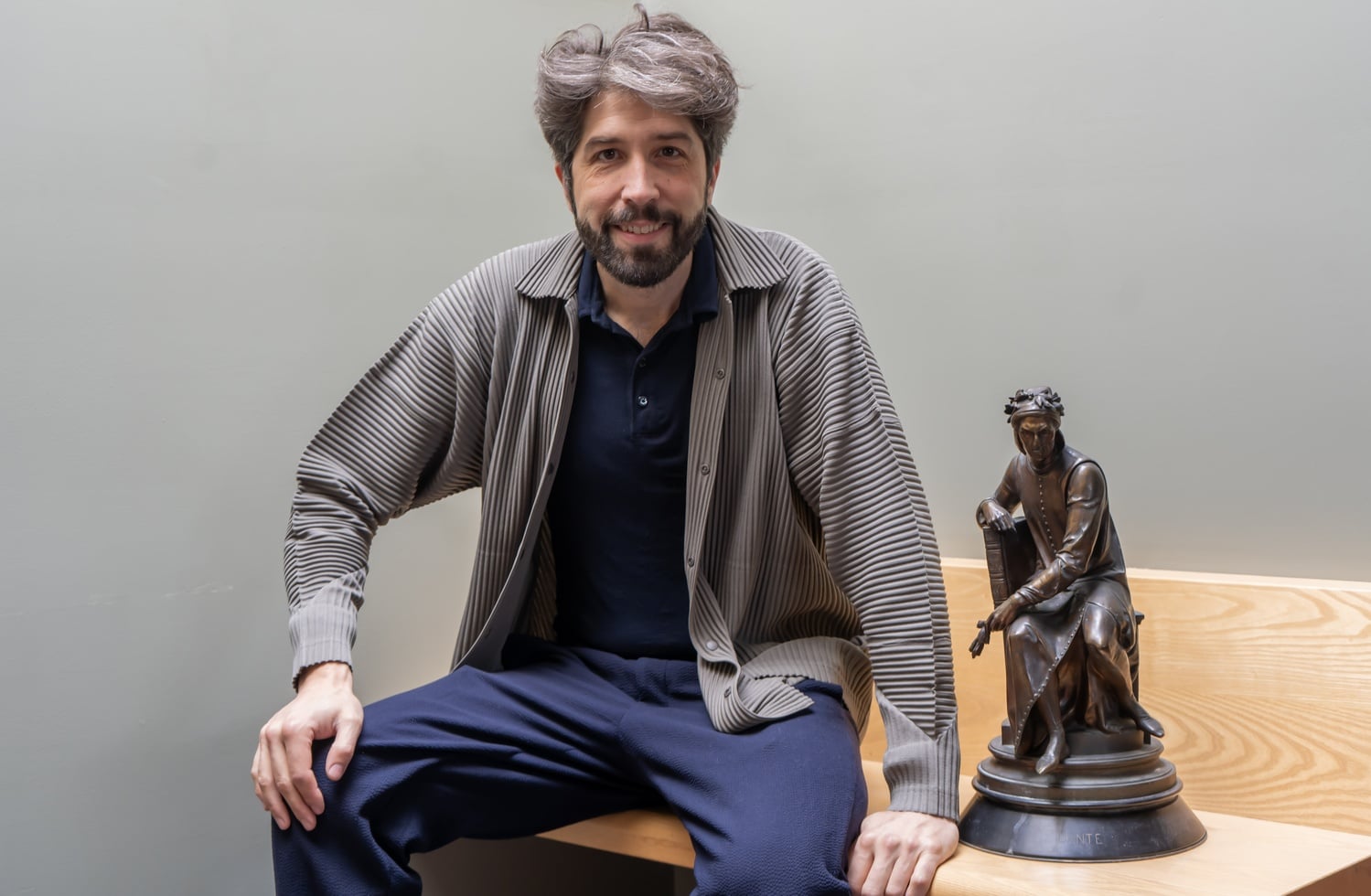
And I find it moving that there is a Dante here at Harvard.
I find it moving because these figures, Dante, in particular, was there to welcome these immigrants as a point of reference. So Longfellow here at Harvard and the Dante club here at Harvard cultivated an interest in non-American authors, so that when Italian immigrants came and contributed to the creation and the construction of this society, of this nation, they found a familiar face.
FM: You also wrote that part of your family is from Odessa. Do you still have family in Odessa today?
ACP: No, my close relatives have all left by now, and as I was planning to go and visit — for the first time in my life, I have to say I’d never been as a young kid — and then when I was planning to go, things precipitated, and since then I’ve not been able to visit the city. But it’s very close to my attention what’s happening there, and what’s happening to the community in Crimea.
FM: When you included that detail in your faculty biography, were you hoping people would ask you about it? And has it helped you find other people at Harvard with connections to the region?
ACP: Yes, absolutely. Yes, I’ve been involved in — I don’t know if it’s that relevant — some dinners with local families and some students, too. But yes, my hope after this Dante phase, this Italian phase, is to give more time and energy to the study and the understanding of this other part of my heritage. Whether that is going then to shape a bit of my academic profile, that’s something I still don’t know.
FM: Do you know where your starting point would be?
ACP: For the study of this part of my heritage? Yes, definitely. I would like to go back and study the anarchists of the 19th century, the Russian anarchists of the 19th century. I have a few notes there that keep growing, and one day — starting with Herzen — I would like to be able to see if there is something for me, something to be said, or something to be found.
FM: You study comedic forms. What is the last thing you read that made you laugh?
ACP: That’s a tough question for someone as the semester is in full swing, where you’re actually reading, and only things that you have to read — and that’s what I’ve been doing probably for the past now three, four months. I don’t remember really sitting down and looking for something that really gave me that kind of pleasure in reading.
I’m sorry, It’s not a great example. I went back to read this story in Boccaccio, and I was presenting this story to an audience in Oxford, and as I was retelling the story — that is really meant to be laughable and comedic — because of how I retold the story, no one laughed. And actually, together we realized in that moment that, if that story is told from the perspective of this young boy, there’s nothing to laugh about.
Maybe I’m not very good at preserving the comedic energy in some of these stories. I read them in a way that’s too scientific.
FM: When you are reading for pleasure, or listening to music for pleasure, or consuming media for pleasure, are there things you’re particularly drawn to?
ACP: I’m very fond of Bruce Springsteen. I grew up listening to a lot of his music. My English started with Bruce and these books I had with all the lyrics and Italian translations. And yes, Bruce is still a good companion throughout the days.
FM: Do you have a favorite Bruce Springsteen song?
ACP: I’ll tell you the two songs: “New York City Serenade” and “Incident on 57th Street.”
—Magazine writer Sebastian B. Connolly can be reached at [email protected] or on Signal at sbc.23. Follow him on X @SebastianC4784