
Making Its Mark
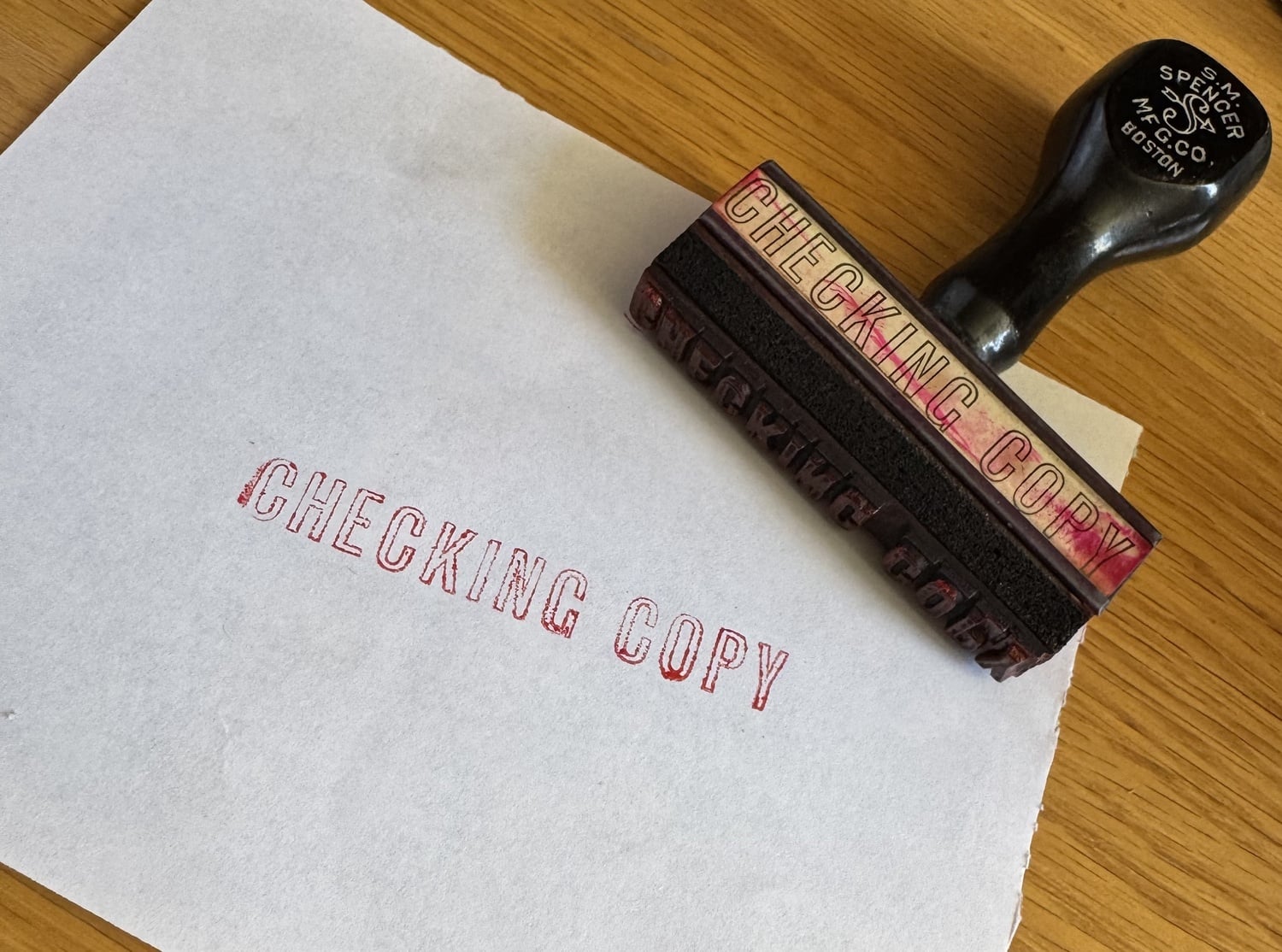
What compelled me, in the herculean mass of things, was a wooden stamp: smaller than the size of my palm, with a knobbed, black lacquered handle and a cherry-red stained body.
found the stamp atop a dresser in a side room of the little house on 21 South Street. It was there the day the Harvard Advocate sorted through the building’s clutter and decided what to do with it: keep, discard, keep, keep, discard. I knew the origin of some things — the dirty Swiffers and their headless rods (discard), beer cans nestled around the house like forgotten easter eggs (ew! discard). Even a dead megaphone and DIVEST banners from the encampments (those, we kept). Other items had more nebulous origins, things and places I didn’t know about: clumps of wires from unknown technologies or the body-sized plastic bag full of small flowerpots (who was planting flowers out here?).
What compelled me, in the herculean mass of things, was a wooden stamp: smaller than the size of my palm, with a knobbed, black lacquered handle and a cherry-red stained body. The stamp would’ve printed the words, CHECKING COPY, a phrase I didn’t understand, but was sure I could look up later. I was told I could keep it since it seemed like the building had no use for it. I slipped the stamp into my pocket, forgetting about it entirely.
When I rediscovered it between the couch cushions hours later, I threw it on my desk, a new shelf-top ornament. It felt funny having it there, out of place next to my books and coffee mugs, so far from its printing heyday. I plucked the stamp off my desk and observed it from all angles. What could I do with this object whose function was now defunct, whose history and memory I could not trace?
When you want to remember something, you’re told to write it down. But writing isn’t the only method of keeping memories. Socrates, most notably, complained about this kind of mnemonics as a substitute for oral thinking: “You have invented an elixir not of memory, but of reminding.” He worried that by transferring the active work of remembering from our brains to the page, memories would not be truly preserved — only superficially understood.
Yet time has shown us that the best memorykeepers are not orators, but writers. Take journalist Joan Didion, for example. In her essay “On Keeping a Notebook,” she reveals that her entries are not purely factual records but reflections of personal memory. What mattered was “how it felt to me,” she wrote. Writers like Virginia Woolf and Franz Kafka penned their diaries just as diligently as they wrote their literary masterpieces.
But as I look at the stamp, gripping it within the palm of my hand, I wonder: what can the object remember? Objects are much slipperier, demanding different kinds of memory than that of writing, let alone oration. Part of this is because they are much older than any form of written recordkeeping. The earliest known stone tools date back more than three million years ago. In comparison, proto-cuneiform writing dates back only about 5,000 years—child’s play in the face of the object!
The task then falls to us to describe the object, to transplant it into a written record. Historians and museum curators have spent centuries wrangling with this problem, writing labels, trying to tie latent objects to a formal, written history. They analyze their material, their geographical surroundings, their technological context. For the many objects that elude written language, we, in our search for knowledge, grant them one, trying to make them something containable.
The only text on the stamp, besides CHECKING COPY, is the logo of the manufacturing company imprinted and painted in white letters onto the handle. Text circles an ornate letter S with an arrow through the center — S.M. SPENCER MFG. CO. BOSTON, it reads. A cursory Google search leads me through a paper trail of photonegatives and pithy captions. One caption lists the company’s specializations: “Police and Fire Department Badges, stencils, rubber stamps, steel stamps and dies, and assorted marking devices.” Another photograph I found online of the storefront says the store was established in 1872 and operated from 3 Cornhill, Boston. eBay listings of past S.M. SPENCER MFG. CO. catalogs show all kinds of custom stationery, from leather & shoe stamps to railroad ticket punches. Nothing matches the item I have in my hand.
If I couldn’t find more about the company, I could at least learn about the street where it was located. It turns out that Cornhill was once the heart of Boston’s 19th-century literary scene, frequented by authors like Ralph Waldo Emerson and James Russell Lowell. Brattle Book Shop, once Burnham’s Bookstore, originated there. It was also a center for abolitionism. William L. Garrison published his antislavery newspaper, “The Liberator” here. In 1835, a mob seized him and dragged him through the streets, nearly tarring and feathering him. Somewhere along this street, publisher John P. Jewett was printing and binding copies of “Uncle Tom’s Cabin,” the first time it would appear in book form.
Cornhill was also a regular haunt for Theodore Roosevelt, Franklin D. Roosevelt, and John F. Kennedy during their time at Harvard. I imagine myself a flâneur, roaming Cornhill the same way Woolf wanders in want of a pencil in her essay, “Street Haunting.” I eavesdrop on the conversations of passersby, watch the ebb and flow of strangers along colorful Victorian storefronts in wintertime. The rubber stamp from S.M. SPENCER MFG CO., like Woolf’s pencil, is a pretense that allows me to reach into another world.
Part of my search for the stamp’s origins probably arises out of boredom. Yet another childish part of me secretly wants the stamp to have a hidden meaning — and I have to be the one to discover it. It’s like those moments in “Antiques Roadshow” when a levelheaded appraiser scrutinizes an item, wondering how something so valuable has gone unnoticed for so long. I hoped to find an eBay listing, a catalogue entry, anything to attest to its importance. I want my stamp to reveal itself as something extraordinarily desired or valuable, even if I have no intentions of selling it. The more I search, however, the more I come up short.
Cornhill and much of the surrounding area were destroyed in the 1960s during a controversial urban renewal project to make room for Boston’s Government Center. The area that was once a beating cultural heart of Boston is now home to Boston City Hall, a brutalist building once ranked the fourth ugliest in the world (one could argue its brutish structure still captures Boston’s spirit). As for S.M. SPENCER MFG CO., I could find little more to trace its history beyond Cornhill.
When written records fail us, we turn to the imagination: giving old items new lives as we envision what they could have been, what they might still have the potential to do. Comparing my stamps with images of other vintage stamps, I want to imagine it was made sometime between the 1930s and 1960s—but that is such a large timeframe, scarcely giving me specifics to speculate upon. CHECKING COPY implies the stamp was used to signify an issue was being proofed before its formal publication. I imagine a former president of the Harvard Advocate staying up until the wee hours of the morning, proofreading an issue of years past. The stamp perches nearby, idling, waiting to be picked up and pressed into the page.
And yet, there is still more I want to invent, more I don’t know! Who purchased it, saw it on a shelf in a store on Cornhill street and decided it was important enough to take home? And how did it end up here, sitting in the palm of my hand?
In “Mythologies,” Roland G. Barthes examines how ordinary objects can carry cultural meanings beyond their practical functions. A stamp stamps, a pencil writes. But there also exists a world of social and cultural norms that shape how we perceive them. We condition the object through our gaze, and in turn, the object gazes back, asking us to accept its hidden meanings. At one point, this stamp spoke to a world of mythologies. But I have no grasp on this mythological language. The world this stamp addresses is unknown to me. It has been lost to time.
When an object loses its meaning, it simply becomes a thing: a tchotchke, a knickknack, a whozit or whatzit. But that doesn’t mean the thing is meaningless. “We begin to confront the thingness of objects when they stop working for us,” wrote Bill Brown, a University of Chicago professor, in his essay “Thing Theory.” Removed from its original place, the stamp represents a breakdown of the ordinary, function-forward relationship we have with the items in our lives.
In a life designed around practical objects, things interrupt our ordinary flow, and thereby, they demand our attention. Simultaneously, they demand nothing at all. The only demand is the one we put on ourselves as we search doggedly for its meaning, deciphering its secret (sometimes ineffable) knowledge.
I take out an ink pad from my drawer and press the stamp into the red ink. Then, I print the stamp onto a slip of scrap paper, again and again, until there’s an entire sheet of paper with CHECKING COPY imprinted in various degrees of opacity.
I will never know how long it had gone unused in the little house on 21 South Street. All I did, when I took the stamp, is apply my desires to it: its hopes and dreams tossed down into the pocket of my jeans.
Perhaps the stamp once preferred it there, inside of that quiet room. Months or years spent sitting atop a dresser, never stamping, simply drinking up light from the window. Not making a mark — yet never needing a mark to be made.
—Staff writer Jona P. Liu can be reached at [email protected]. His column “Collector’s Edition” writes about the ordinary objects in our lives and the ways we use, collect, and preserve them.