
Pirates, Pamphlets, and Praxis: Inside the Boston Anarchist Book Fair
The book fair is just one part of a broader anarchist political scene, united in the belief that governments are harmful and unnecessary.
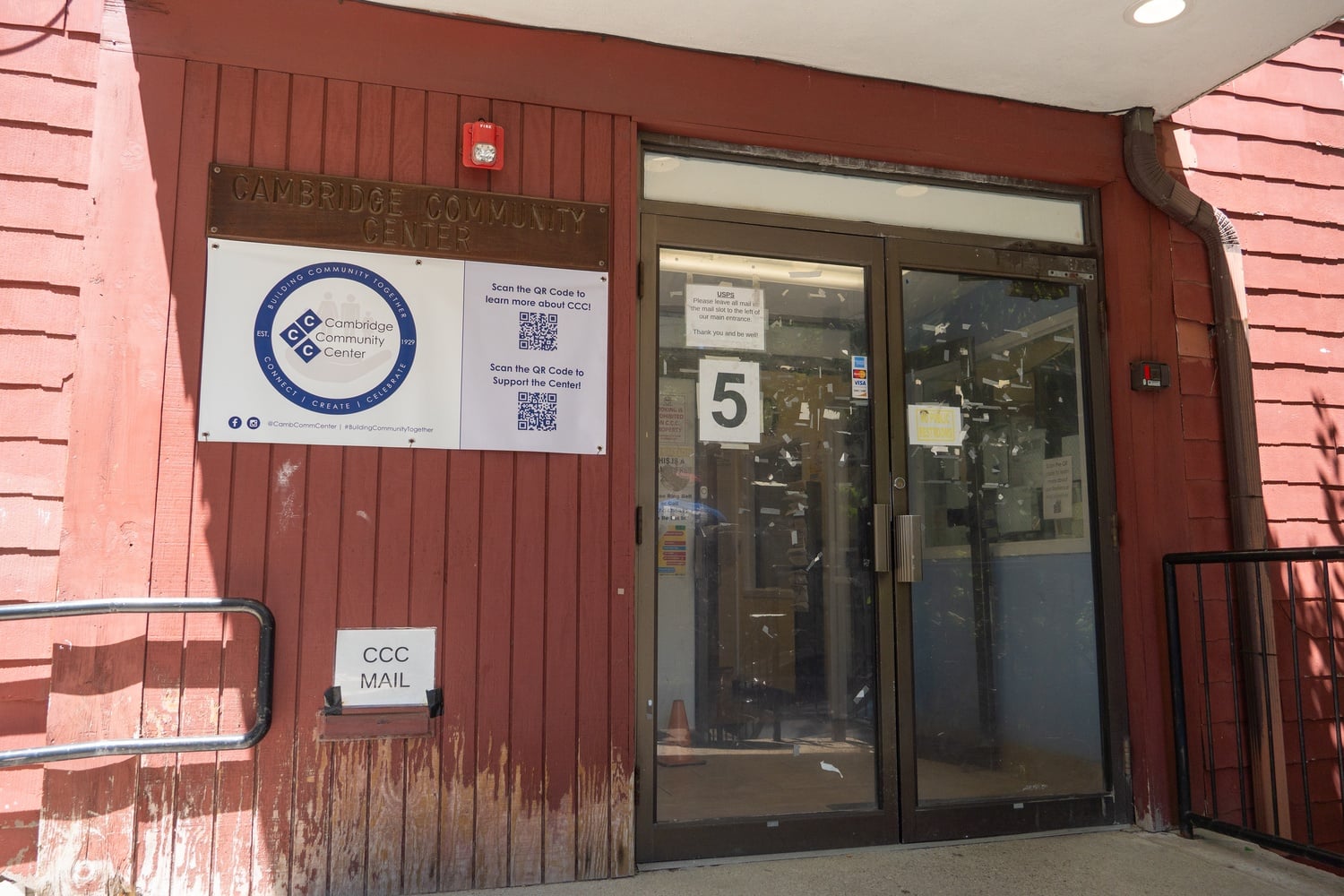
On a dreary Saturday afternoon, two volunteers in neon vests, N95 masks, and “safety team” lanyards idle by the side door of the Cambridge Community Center. Crimson paint peels off the walls and wet leaves litter the adjacent children’s playground. One of the volunteers sits on a chair knitting; the other stands by the door, hands in pockets. Together, they direct approaching passersby to the annual Boston Anarchist Book Fair: a hub for anti-establishment literature and artwork.
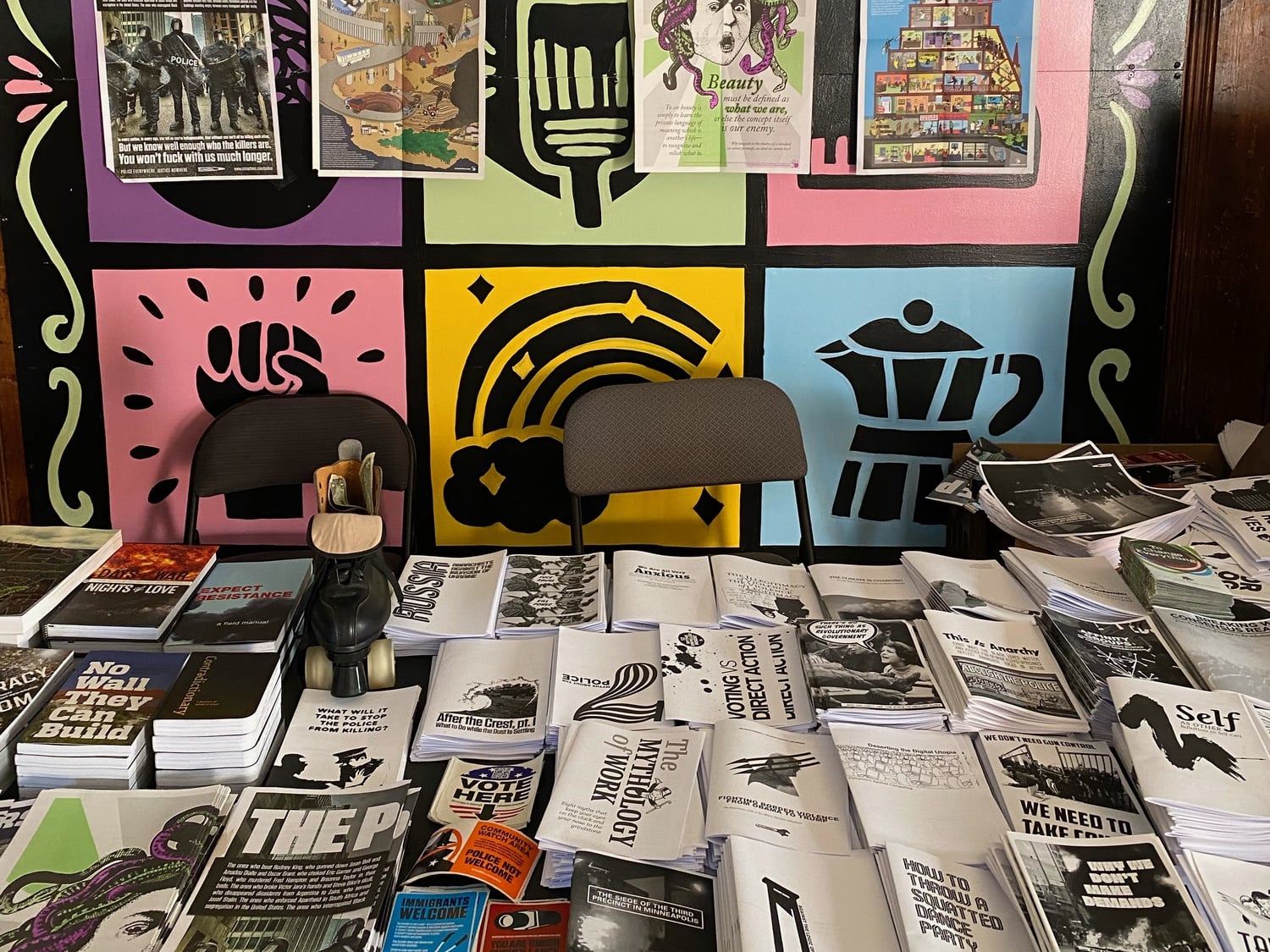
Around the corner, people mingle outside a few collapsible tents surrounding the open doors to the community center’s gymnasium. Inside the dimly lit space, several dozen vendors occupy tables full of zines, books, stickers, leaflets, jewelry, and clothing. A welcome desk offers masks — required indoors for all fairgoers — and informational zines with vendor names and a workshop schedule. A sizable crowd mills about the space.
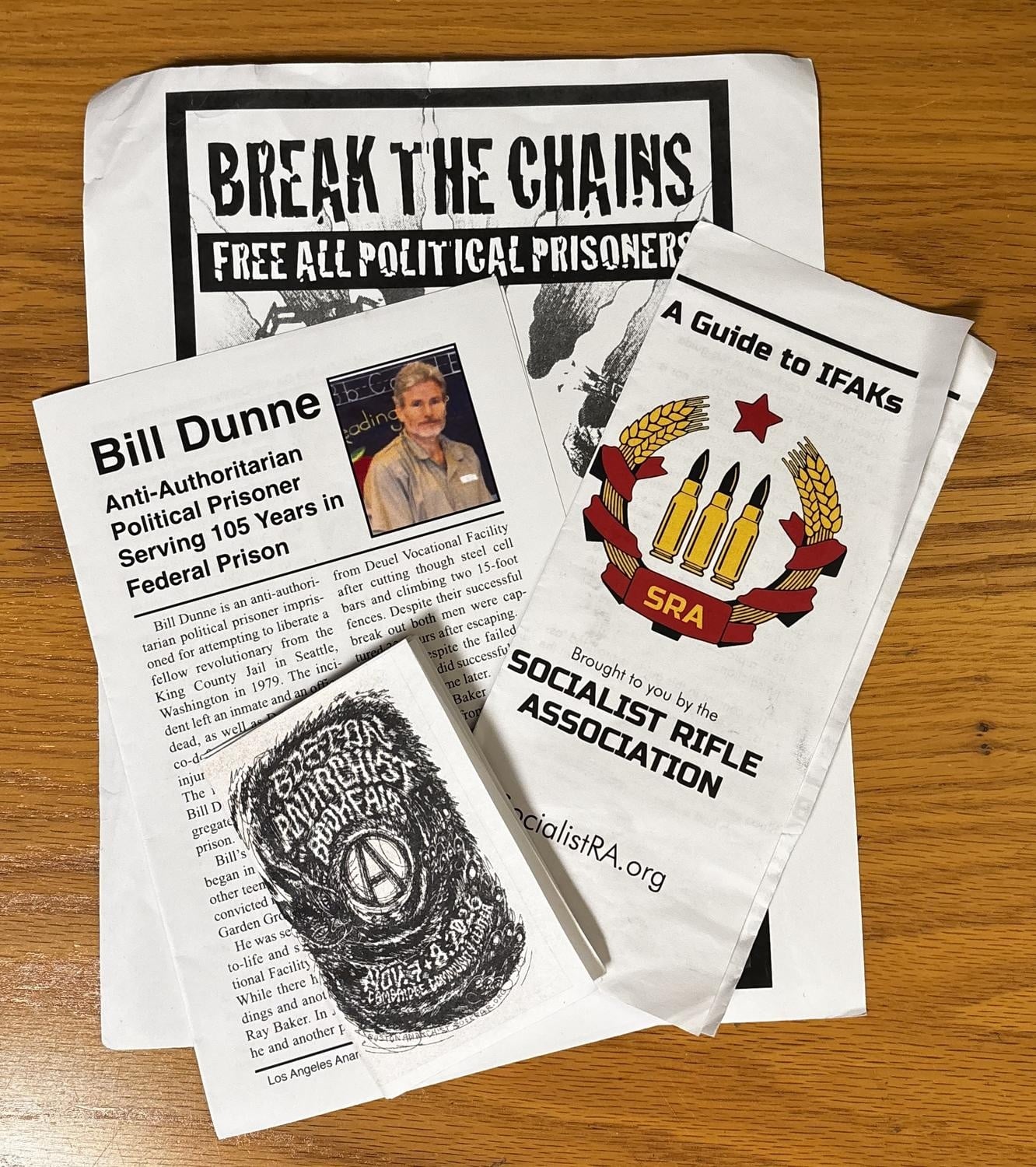
The Boston Anarchist Book Fair (this year on Nov.7 and 8) has happened nearly every year since 2011. According to its website, the fair is a platform for anarchism as “a philosophy rooted in voluntary cooperation, mutual aid, and challenging hierarchical structures.” But while the fair is rooted in anarchist principles, many vendors come with their own narrow interests: one man has a table stacked with single-page biographies of political prisoners; members of the Massachusetts Socialist Rifle Association bring a poster with first-aid information.
What unites attendees is perhaps best described as discontent.
The book fair is just one part of a broader anarchist political scene, united in the belief that governments are harmful and unnecessary.
Several attendees say anarchy amounts to “socialism without state,” where socialism is a theory advocating for the public ownership of property and natural resources. Anarchists tend to support personal liberty, mutual aid, and consensus in decision-making.
To that end, the book fair itself has no top-down organizational structure. According to an organizer, a leaderless cast of volunteers recruits vendors, secures the event space, plans workshops, and acts as security. Decisions are never voted on, made instead after extensive dialogue among the organizers.
The book fair is a forum for independent booksellers, writers, artists, and activists to increase their visibility and community outreach. Cambridge’s mirrors others across the world — just this month, there are anarchist book fairs in Kansas City, Mo. and the Netherlands.
Leslie J. Pickering comes to the Boston Anarchist Book Fair to represent Burning Books, a self-described “radical bookstore” in Buffalo, New York. He says Boston’s fair is one of the largest the store attends all year, anarchist or otherwise. According to him, the fair provides an opportunity for booksellers like him to connect with publishers and other activists.
“There’s certainly a lot of educated people in Cambridge, Massachusetts. So certainly a lot of these people are educated and engaged, and that’s a good thing.,” Pickering says. “It’s not just entry-level stuff.”
Pickering has been involved in anarchist activism for decades, he says. He is a former spokesperson for the North American press office of the Earth Liberation Front, an underground group of environmental activists that set fire to buildings throughout the 1990s and 2000s and was labeled a domestic terror threat by the FBI. Some members have since been imprisoned.
According to Pickering, the anarchist movement has changed over time. The kinds of issues that organizers care about have shifted to encompass pro-Palestine causes and increased attention to resisting fascism. There is less ideological “siloing”: Activists are more likely to see common ground across a diverse issue set, rather than isolate themselves in their own movement.
That ideological diversity is reflected in the fair’s vendors, who hail from a range of New England states and points of view.
39 vendors attend this year’s fair, up from 20 in 2022. Many are community institutions in and of themselves, including the Lucy Parsons Center, a non-profit Jamaica Plain bookstore that has existed since 1969, and Food Not Bombs, a volunteer food-distribution group founded in Cambridge that has since seen hundreds of autonomous chapters sprout up in countries across the world.
There are also many non-anarchist groups present. The Massachusetts Pirate Party, a political party aimed at increasing government transparency and curtailing copyright and patent law, has a table, as does Allston-Brighton for Palestine, a local pro-Palestine activist group, and the Luddite Club, a New York City-based anti-technology group.
Stephen A. “Steve” Revilak — who became the first member of the Pirate Party to hold public office in Massachusetts when he joined Arlington town meeting, a hyperlocal political body, in 2015 — mans the Party’s table at the fair. He says he appreciates that anarchists are ideologically open-minded: “It’s sort of like, ‘Well, I’m not the boss of you, and I respect your decisions.’ I like that.”
The fair’s expansion was enabled in part by its 2023 move to the Cambridge Community Center, a venue attendees describe as both more spacious and more secure. Security has been an issue for the fair in the past. In 2018, when the event was held at Boston University, a group of masked men chanting white nationalist slogans confronted activists at the fair.
The national political climate activists are working in has also changed. Multiple attendees cite the example of Daniel R. Sanchez Estrada, a man arrested in connection with the shooting of a police officer outside a Texas Immigration and Customs Enforcement detention center. Sanchez Estrada, who did not attend the protest where the officer was shot, was sentenced to 30 years in prison for transporting anarchist zines and other political materials.
When we speak with vendors, many refuse to be identified beyond their first names or “street names” — aliases used in activist spaces. At the door, a sign informs attendees that no video or recording is permitted. There is a sense among those at the fair that political shifts — including Trump-era policies targeting what the administration deems to be domestic terrorism — have increased both the urgency and risk of their organizing.
Nonetheless, the fair persists.
Sinan Goknur, who does not identify as an anarchist but is interested in anarchist literature, buys three books at the fair: two on insects and plants and a third about the Kurdish ethnic minority in Turkey. Goknur is familiar with Turkish political movements, and has also participated in anti-ICE protests in the U.S. He says he came to the book fair because he sees anarchy as a “timely political moment.”
“Doesn’t it feel like we’re all on — dumpster fire, a little bit?” Goknur says.
Meanwhile, Fin M. Leary, a fiction writer and faculty member at Emerson College, visits the book fair to show solidarity with marginalized individuals. Leary is concerned that some have self-censored support for those groups in fear of repercussions from the government — and adds that censorship is “a common early way to try to control people under fascism and authoritarianism.” Leary, who has been involved in grassroots anarchist activism for around nine years, tries “really hard to hold on to this idea of continuing to show up” in a fraught political climate.
“It’s hard to get out there and put yourself out there and continue to connect with people and not feel hopeless,” Leary says. “But, it’s really the antidote.”
—Magazine writer Sebastian B. Connolly can be reached at [email protected] or on Signal at sbc.23. Follow him on X @SebastianC4784.