
We’ve Caught the Thrifting Bug
In a world where goods from online superstores or international chains are pawning off low quality goods; where luxury outlets charge an arm and a leg, thrift stores seem to operate within a happy medium: a place where shoppers can get old, unique, and high-quality goods on the cheap.
It’s true: I’ve caught it, you’ve caught it, we’ve all got a case of the thrifting bug.
I can no longer ask any of my fashionable friends about where they sourced their one-of-a-kind necklaces, 100 percent wool cardigans, or worn leather jackets, for I already know the words that will come out of their mouth. “Oh, this? I thrifted it,” they’ll say, offhandedly tugging on a sleeve or accessory. The response we take towards the un-thriftlightened is less than laudatory. Revealing that you acquired your dorm room throw pillows from Amazon — or, even worse, SHEIN or TEMU — will elicit hushed disapproving glances from thrift-savvy savants. Some may pelt you with organic, locally sourced, non-GMO tomatoes.
In a world where goods from online superstores or international chains are pawning off low-quality goods, where luxury outlets charge an arm and a leg, thrift stores seem to operate within a happy medium — a place where shoppers can get old, unique, and high-quality goods on the cheap. It seems like such a good deal that it’s unthinkable, or at least unrealistic. When Marie Antoinette said to let them eat clothes (is that how the saying goes?), she probably didn’t expect TikTok ‘thrift flippers’ to dig her Chemise à la Reines and Robe à l’Anglaises out of the bargain bin to resell online. And yet here we are: an era of thrifting where everything is possible. We can have our cake and eat it too.
The thrifting zeitgeist is all the more alive in Cambridge: when I open maps and search “thrift stores near me,” an Ursa Major-shaped scattering of vintage outlets emerges around Massachusetts Avenue. While some are your typical Goodwill and Salvation Army outlets, most of the thrift spots within the Cambridge constellation are local businesses that have only recently opened up storefronts: The Attic in 2023, friends + family in 2024, and 2nd STREET in 2025. Seemingly, I can’t walk Cambridge for more than five minutes without being seduced by another compact hypercurated storefront.
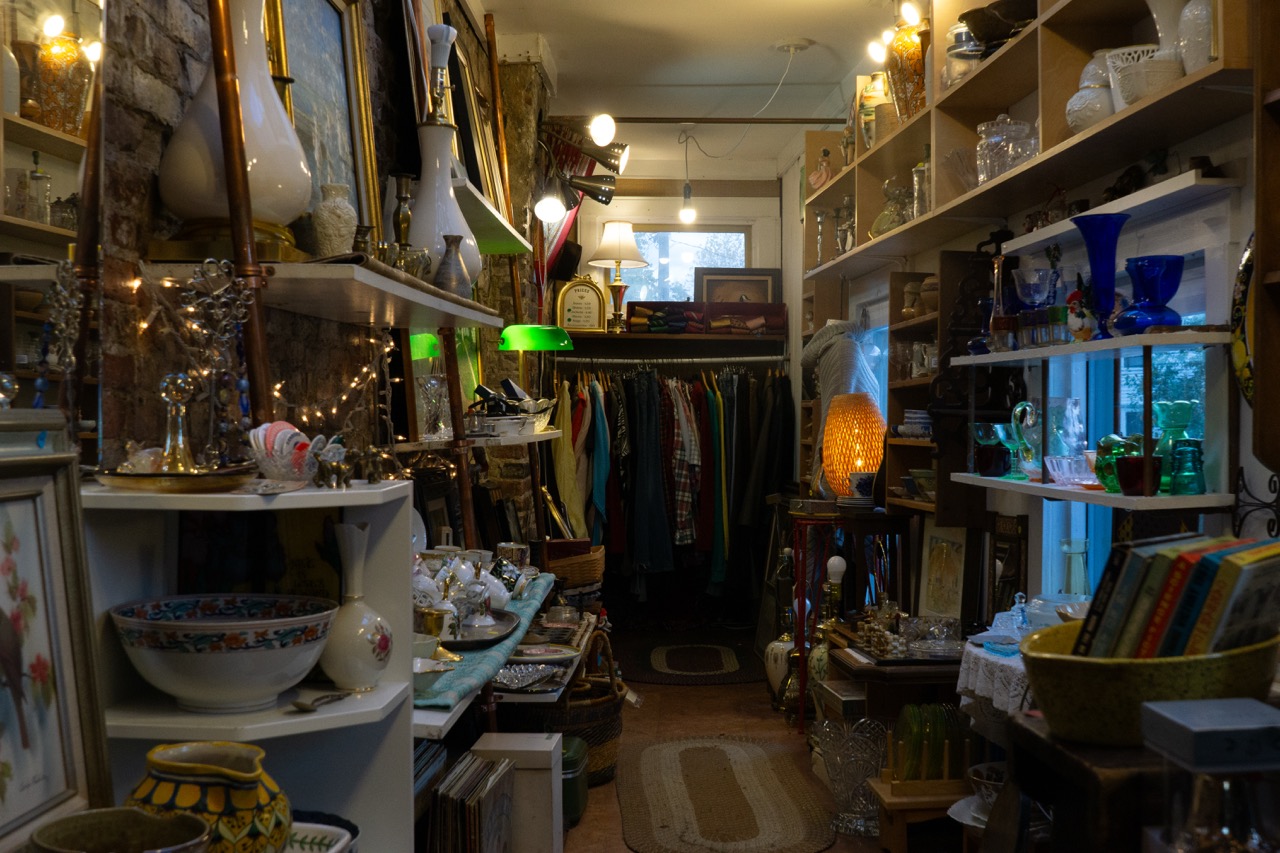
D’Beetle (short for Dung Beetle or Of the Beetles, depending on how you spin it) is one of many thrift stores that have popped up as of late. I first notice it on a walk back to campus, intrigued by the wooden A-Frame sign propped up outside the store pasted with an ANNIHILATE THE LANDFILL poster. Seeing that it is open (I happened to catch the store on one of the two days it’s open each week), I stop in, eager to browse. Entering the eight-foot-wide storefront with my backpack, I feel a bit like a bull in a china shop, worried I’d turn around too quickly in the narrow corridor only to obliterate a shelf of sea green crystal cups or muffin tins (they’re too old to be used for cooking, so I’m told they can be used as a display piece).
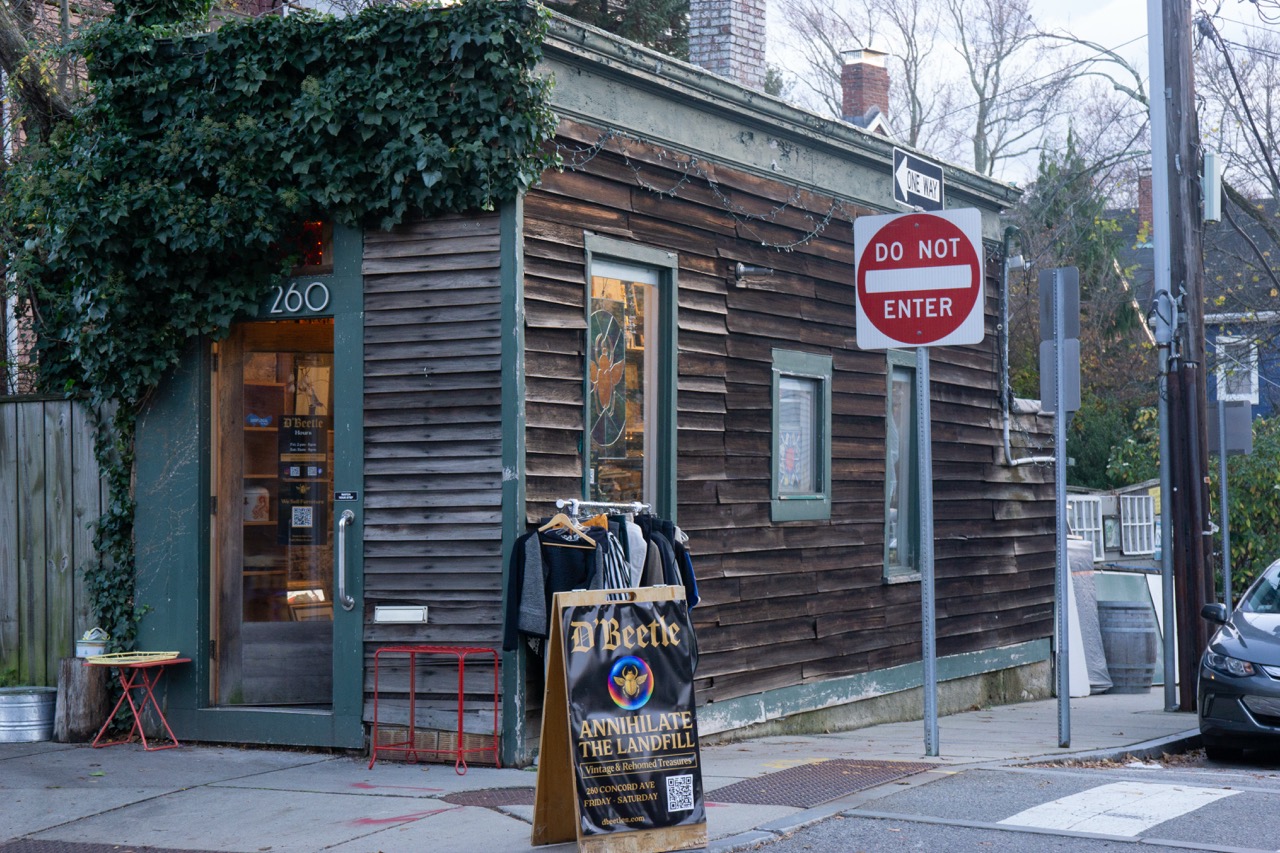
Founded by Calla T. Kennedy and Ryan B. Clinesmith Montalvo in 2025, D’Beetle functions as a half estate cleanout service, half secondhand store. The pair graduated from Harvard’s Graduate School of Education and pursued various startup ideas and business enterprises in education. They hadn’’’t set out with the goal of joining Cambridge’s thriving secondhand market.
But it seems they’ve found such an enterprise in D’Beetle, which, according to their website, isn’t just a thrift store, but “a second chance revolution.” The radical, environmental messaging seems pretty in line with the sign I first saw outside.
D’Beetle, as with most of these Cambridge collectors, signal to their buyer base through their good virtues and mission-driven approach. When people use D’Beetle’s services, they can rest easy knowing they’re ANNIHILATING THE LANDFILL and making sustainable choices. Consumer conscious spending is important, of course, especially if you have the means to do it. As I pick up the page of a vintage bird calendar (now upcycled into a poster), however, I wonder how Toussaint Louverture would feel if I told him this was how revolution looked in the modern age. It also costs $20, so I put it back down (for another buyer with a heftier joie de vire and wallet than I).
While D’Beetle’s marketing is nothing new, I find myself curious about their business model. While most thrift stores might rely on donations or buy bulk stock, D’Beetle sources their stock from their estate cleanouts — which, I assume, means they have more control of what goes into their inventory. Curious, I shoot them an email asking to tag along on one of their cleanouts.
When I first meet Kennedy at the site — a little blue house in Cambridge — she’s wearing a lovely colorful sweater (as I write this, I realize I never asked if she thrifted it). We chat as she scours for gems. Wanting to learn about how the collector’s collector curates, I ask Kennedy to walk me through how she selects items for resale. Her process, I learn, is an art — one that pays careful attention to market trends, customer demands, and personal taste.
Generally, Kennedy and Montalvo try to keep things that will go into their shop or warehouse and donate anything that doesn’t make the cut. From the kitchen, Kennedy points out a ceramic bowl and a row of conch shells — the shop-worthy trinkets of our survey.
I can’t help but notice the wooden cupboards filled with white plates and dozens of nondescript glasses. When I ask her about them, she says, “Someone’s gonna love these at Savers or Goodwill. They’re gonna be all over it.”
What D’Beetle values, I observe, is peculiarity: the sense that a piece of furniture or trinket is unique, historic, or one of a kind. Technically, all objects have a unique history — whether that’s a plastic bag drifting down the street or a piece of Medici porcelain. But clearly, there are certain kinds of histories that might appeal more than others. Ceramics might fly off the shelves, while white dinner plates won’t even make it through the door. And when your storefront is smaller than a garden shed, I’d imagine the selection must be pretty ruthless — keeping what seems the most interesting, valuable, or unique to the market.
But just who are the people who have access to these privileged peculiarities?
As Kennedy shows me around the unit, I imagine combing through, making split-second decisions about what I’d keep and what I’d give away. I feel as if I’m becoming ‘Of the Beetles’ already, but after an hour or so I have to bike off — leaving the real beetles to work.
Some time later, I return to ANNIHILATE THE LANDFILL once again. To my right, there’s a new giant Christmas tree in the entrance, decorated from tip to toe with ornaments (all of which are also for sale).
This time, however, I pay closer attention to the people who may purchase them. Couples looking for decor, elderly neighbors looking for ways to amuse themselves in retirement, women handpicking countertop decor for their kitchen. One pseudojournalistic college student, I note, staring at my reflection at the mirror at the front of the store.
I speak with Alisa S. Amador, a regular in the shop. “Through the window, I saw the details of this bowl and just how beautifully handmade and hand-painted it is,” Amador says. “I would have to let go of one or more equivalent objects to bring this into my home because I have enough at home.”
I crabwalk through the store aisle for a bit longer, but there’s only so much time you can spend in such a small space. Before I leave, Kennedy introduces me to Jerry, a white, big-eyed thing that perches near her stool at the door and a small “ALL SALES FINAL” sign. Jerry is made of clay and is about the size of my hand stretched out. We speculate upon Jerry’s identity and pronouns (is he a dinosaur? A bird?). Kennedy tells me Jerry came from the home of a famous nature conservationist — she had forgotten about him until he’d appeared in one of the many boxes that came from that estate cleanout.
“Sometimes I sit here alone for certain periods of time, so it’s nice to have a little friend,” she says. While Jerry is technically a common design made in Mexico, Kennedy finds him endearing for some unexplainable reason. He is also one of the only items in D’Beetle decidedly not for sale.
I imagine that when you enter a Goodwill, a store that is comparatively less curated, such distinct finds —“Jerries,” if you will — are more of a diamond in the rough. You’ll have to sort through hundreds of glasses and plates before you find something that meets our high bar for peculiarity. Perhaps thrifting seems like a good deal because we are trading the potential thrill of the find for the most expensive form of currency we can spend: time. And even then, sometimes paying in time is not enough — secondhand furniture finds on D’Beetle’s website can cost hundreds or thousands of dollars. Not the most expensive, but not necessarily affordable for everyone, either.
Thrifting purports a certain culture of accessibility: even if we can’t buy something, we can find it more affordably in the secondhand market. When everyone wants to cash in on a bargain, however, thrifting can very quickly become a competition of who can get the best objects and finds. This spurs the creation of more costly, curated storefronts like ones that emerge from Cambridge. Collectibles as far as the eye can see, even if the sticker price might make us shudder.
Then again, stores don’t pop up unless they’re trying to serve the needs of their customers. Compromising the thrift’s accessibility makes little difference in Camberville, where people have more than enough means to pay in both time and money.
Part of me wants to imagine a world where people’s Jerries aren’t attached to a price tag behind a beautiful storefront, but I guess that would be asking for too much. After all, no deal comes without a price. And even for the most small, woke, locally-owned thrift store — business is business.
—Staff writer Jona P. Liu can be reached at [email protected]. His column “Collector’s Edition” writes about the ordinary objects in our lives and the ways we use, collect, and preserve them.