
Finding Home — and Afternoon Snacks — at Memorial Church
When the Reverend Matthew I. Potts and his wife thought about how to connect with students, none of the old traditions quite fit.
Sparks House hides behind a pair of green trees and a manicured hedge. At first glance, the house, with its symmetrical twin chimneys and long windows, looks imposing. Situated directly behind Annenberg Hall, it has served as the home of Memorial Church’s Pusey Minister since the early 1970s. The first Pusey Minister to reside there was Reverend Peter J. Gomes, who began the tradition of hosting regular events to connect with students.
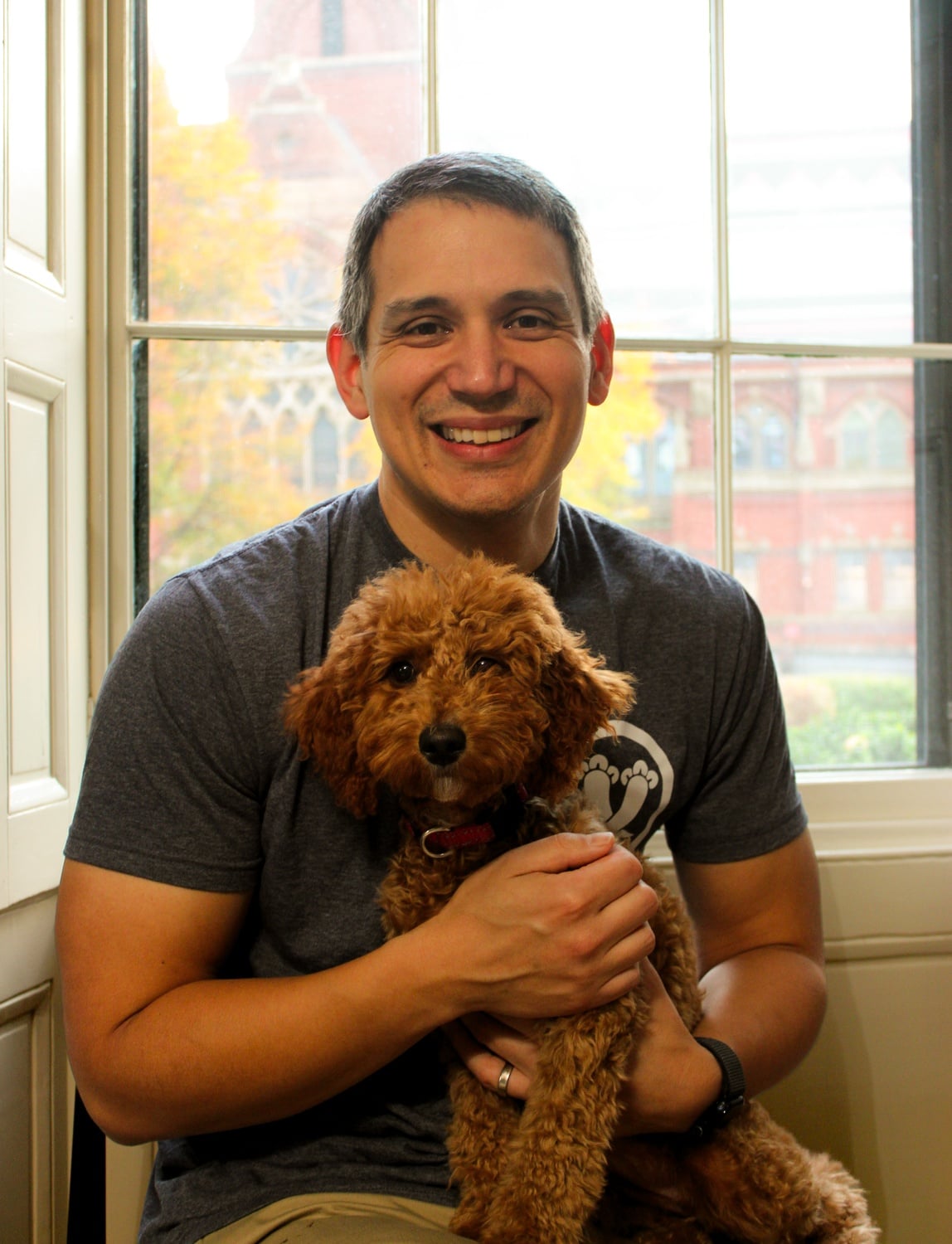
Gomes hosted weekly afternoon tea, and his successor, the Reverend Jonathan L. Walton — who held the position from 2012 to 2019 — opened his doors for football tailgates. When the Reverend Matthew I. Potts and his wife started to consider their own version, neither tradition quite fit, he says. His wife suggested that they offer students what they already had — a welcoming home: “We have kids. We have coloring books. We have a dog,” Potts recounts.
What came out of this conversation was After School Snack. Each Thursday at 4 p.m., staff from Memorial Church — affectionately known as MemChurch — lay out an array of fresh fruits and pastries. Stepping into the house on a Thursday in November, we find ourselves immediately tripping over shoes of all colors and sizes. Students are already crowded around a wooden dining table, sipping customized beverage orders of coffee, matcha, and hojicha.
Potts embodies a “my house is your house” attitude when welcoming students into his home, says Lara Tan ’27, a regular attendee. “I never really had a real host family,” Tan, an international student, adds. Over time, Sparks House has become “home,” a place that she looks forward to being in every week.
Since Potts and his family started After School Snack, students from all backgrounds have come through the house, he says, and Potts’ welcome is unconditional. “We have folks who have been going here for four years that don’t believe in God,” Potts says. “We don’t expect you to be or become Christian.”
Even so, there is a hard-to-dodge perception that MemChurch primarily caters to an older demographic. Jeff Barneson, who has been a Harvard chaplain since 1983 and is this year’s president of the Harvard Chaplains, says as much: “it’s an older congregation for the most part — not a lot of students on a Sunday. So that’s kind of the same way it’s always been.”
MemChurch tries to navigate this tension: serving a primarily older demographic while pitching itself to a student body as a vibrant undergraduate space distinct from other religious offerings at the University.
When Harvard was founded in 1636, Protestant services were central to undergraduate life. Attendance at prayers was required and enforced with roll calls and fines. After decades of growing student and faculty resistance, the University abolished required attendance at services in 1886.
MemChurch was built in 1932 as an interdenominational Protestant church dedicated to those who died in World War I. Today, the University is situated at the heart of a university that has long distanced itself from its religious foundation. Its self-described mission, per its website, is to serve as a “spiritual refuge to the entire community.”
Anna C. Burnham, the student coordinator at MemChurch, says that the church’s physical location in the Yard and mission give it a unique responsibility. The staff help students engage with questions of spirituality, faith, and religion.
“Our students tend to be seekers,” Potts says of his congregation. He describes MemChurch as a place with “no barrier to entry,” but also one that is not meant to pull students away from organizations and religious groups they already feel tied to.
***
“Blessed are the poor in spirit, blessed are those who mourn, blessed are the meek.”
It’s 11 a.m. on a Sunday, when MemChurch’s weekly service is held. Potts, wearing a pale white-yellow robe, is preaching on the Beatitudes, eight declarations from the Gospel of Matthew. He barely glances at his notes, and smiles and gestures expressively.
His sermon, centered on the relationship between love and mourning, often references his own experiences and family, sharing anecdotes from conversations with his dad and his son. Potts is effortlessly vulnerable, encouraging broader reflection in the congregation through his anecdotes.
“God’s love is not something we can earn through toil. We don’t have to persuade God or cajole God into loving us that way,” Potts preaches. “The fact that we exist is the most profound and deepest sign of God’s love for us.”
Reflecting on his own theology and interpretation of the Bible, Potts says that to take scripture seriously is to recognize the limits of one’s access to it. He resists declaring any interpretation as final.
“The best we have is a translation of a memory,” Potts tells us after the sermon. Even though he analyzes the New Testament in its original Greek translation, he admits that he cannot fully cross the distance between the written text and the divine meaning. For a minister, this might seem a disarming admission, but Potts makes it central to his faith.
Despite the lack of certainty, Potts’ preachings still emphasize civic duty and politics. To Potts, Jesus’s teachings are about power, who holds it, and who is left without it, so his preaching inevitably touches on politics.
His sermons build on a lineage of past Pusey Ministers. As Gomes wrote in a 2002 Crimson op-ed, “It is the nature of preaching to present ‘not just the facts,’ but opinions that strive to relate an understanding of the Gospel to an understanding of the world, indeed the world of politics.”
Those cross-cutting themes might make Potts’ sermon style different from other faith groups that try to exclusively appeal to undergraduates. MemChurch’s programming does the same, trying to appeal to both a student and non-student audience.
The church works with the Harvard University Native American Program, local agencies supporting those harmed by misogyny and homophobia, and the Liberal Arts for Returning Citizens program to mentor incarcerated people seeking college degrees.
Other offerings cater to undergraduates, like “Big Challenges,” a weekly Bible study group for undergraduates and Sunday Sessions, a recurring program with special events like “Reading Taylor Swift as a Sacred Text.” The church also allows students to write and give their own sermons.
The church also runs a pilgrimage to the Isle of Iona, the site of one of Scotland’s most important monasteries, and is offering a trip to walk the Camino de Santiago, a web of ancient pilgrimage routes in spring 2027.
Even with these diverse events, getting students through the church’s doors requires more than an invitation, for Harvard’s religious life has no shortage of student-facing options.
Harvard Undergraduate Faith and Actions, a Christian student group, for instance, circulates a list of services in the greater Boston area and offers students the opportunity to visit with their peers. But MemChurch doesn’t appear on these itineraries, and despite its prime location in the Yard, it doesn’t immediately become part of every student’s weekly routine.
Lily S. Madison ’29, who attended one of the church’s services last year, says MemChurch’s advertising of student programming appears to be in a “beginning stage.”
Madison says that she enjoyed the older hymns and traditional prayers, though she describes the service as Episcopalian, a tradition that she says holds some affirmations she doesn’t share. It also felt, she adds, “harder to be there as a young person.” Though she emphasized that she didn’t stop attending because anything offended her, she says that a couple of small things just “didn’t quite fit.”
Marty Martinage, a seminarian at MemChurch, knows that not everyone arrives at its doors with the same idea of what a good fit looks like. They acknowledge that students come to MemChurch with different backgrounds: some might worry their faith will be judged as too traditional in what is widely seen as a liberal religious setting, while others have negative associations with church settings because of their past experiences. MemChurch’s response is to keep their doors open but avoid forcing anyone in.
According to Potts, students who arrive on Harvard’s campus with a clear picture of their faith tend to migrate to churches of their own denomination. He himself did the same: he attended an Episcopalian church when he was a graduate student at the Harvard Divinity School in 2005.
The students who do end up at MemChurch, Potts says, usually don’t have as clear a picture. Some are leaving a denomination that hurt them, unsure of whether they still have a religious home. Others have felt excluded from the one they grew up in. Some have no Christian background at all, only some level of curiosity or a friend in the choir they visit on Sundays.
The fact of the matter is that the majority of the College’s student body does not identify as Christian, and, according to an interview Potts gave in 2025, the church is not, does not claim to be, an “office of religious life” — Harvard does not have such an institution.
Potts doesn’t claim to have a final decisive answer about what MemChurch is. In his telling, the church might be for students who haven’t found a home anywhere else. Not every student will find their place at MemChurch or even venture through its doors. As he puts it, “If you feel spiritually at home someplace else, God bless you.”
But for anyone arriving late or unsure of where they belong, Martinage says there will always be time.
“It’s a place that is waiting with open arms, and it’s also a place that will not be mad at you for having taken a while to want to receive that openness.”