
Berry Chantillyification
Must a birthday cake be unique?
What’s wrong with eating the same birthday cake at every party?
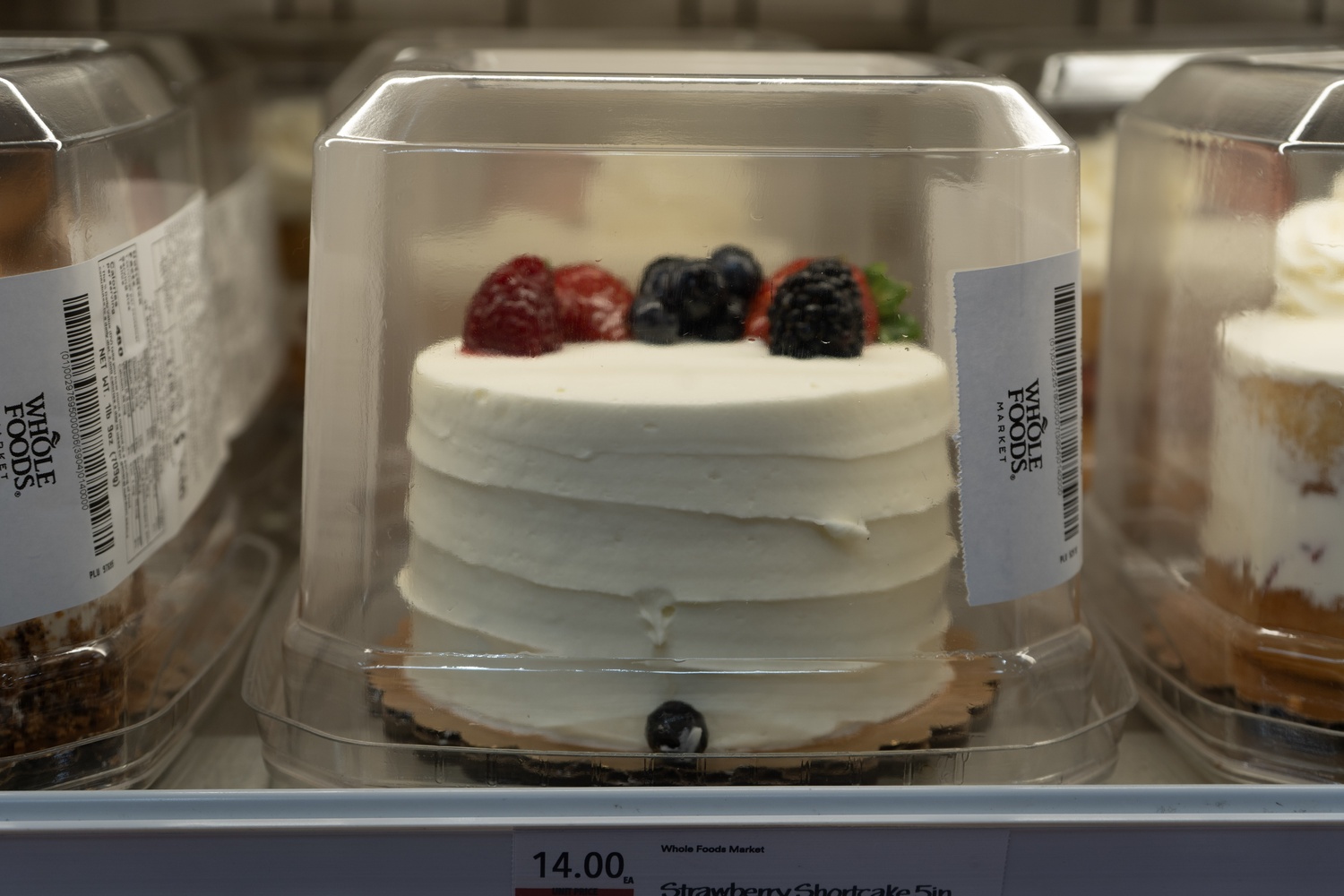
At some statistically improbable proportion of the common room birthday parties I’ve attended here at Harvard (the n here is albeit not especially large), the honoree has blown out candles that burned atop the apricot-glazed fruit topping of a Whole Foods Berry Chantilly Cake. In fact, for my own birthday, both this year and last, I sawed uneven slices of Chantilly sponge with a plastic fork and scraped them onto paper plates.
Initial anecdotal surveys seemed to confirm my hypothesis: many of my Harvard acquaintances were aware of the Berry Chantilly Ubiquity Phenomenon (B-CUP), and shared my perception of the uncanniness of eating the same cake at so many parties. (In the interest of statistical fidelity, a few professed no knowledge of the cake’s existence.)
I arranged to bring in some Berry Chantilly Cake into the FM offices in order to conduct an unscientific, double-non-blind study of my magazine colleagues — a survey so antithetical to the principles of social science researchers that it would sooner bring Max Weber to a myocardial infarction than would his consumption of an entire eight-inch Chantilly cake (roughly 210 grams of saturated fat).
My colleagues were of many minds about the confection. “I feel like it’s just okay,” one editor said — this, even though per Whole Foods, the Berry Chantilly Cake is “no ordinary cake.” Several editors criticized the Chantilly as overly sweet and too lavishly frosted; others remarked that they liked it precisely because it wasn’t so sweet. The Berry aspect was broadly more beloved than the Chantilly. “It kind of feels like eating butter,” one editor said of the frosting. (Though to be honest, I’m not quite sure what’s wrong with that.)
B-CUP is not universal, my focus groupies told me — “I have had croquembouche twice at birthday parties here,” one Chantilly virgin noted, referring to the French dessert centerpiece that binds cream puffs with hot caramel into a towering cone — but it is genuinely a thing: “Pretty much all of my sweetmates get this cake for their birthday,” one junior told me. “I’ve had this cake many times. Like, have it every single birthday,” another editor said.
And besides, I should hardly think it necessary to prove that even most Harvard students have experienced the alienating B-CUP for it to be worthy of inquiry. If even, say, a tenth of birthday candles were blown out atop a Berry Chantilly Cake, this would indeed be a remarkable thing.
In the Berry Chantilly Cake, we seemingly find an emblem of the homogenization of the cCollege experience, one that destroys the individual experience, and in my case, renders one thinking: “Why didn’t I have a more interesting cake for my birthday?” Am I so caught up in Heidegger’s das Man as to conform to the pseudo-sophistication of the Berry Chantilly cake (eating Berry Chantilly is “what one does”), and would I be more authentic were I to choose a different cake?
Indeed, are we to decry the B-CUP as symptomatic of inauthenticity, and should we all be trying on some other cakes for size? (Perhaps a black forest gateau?)
***
Sources vary on its exact birth date, but the Berry Chantilly Cake has been around for more than 20 years. It was only in the last few years, however, that internet virality produced B-CUP and rendered the cake perennial fodder for food editors with (seemingly) nothing better to write about. These articles too often do little more than remind us that the cake has a “cult” following (popular cake is popular).
Many, however, seek to establish a definitive copy-cat recipe: perhaps you love the Berry Chantilly Cake, but the risk of buying your birthday cake and admitting that your tastes are the same as everyone else’s is far too great, so why not bake the cake yourself, based on the copy-cat recipe?
In 2024, Whole Foods — in a move that, to this writer, reeks of New Coke — replaced the Berry with jam and frozen fruit (citing a desire for consistency — fresh berries resist commodification), sparking a backlash (and another profusion of articles) which subsequently led to the reversion to the original recipe. That same year, a series of tabloid-y articles celebrating the cake’s 20th birthday gave the impression that Chantilly was a spry Windsor prince; I await the silver jubilee.
The cake itself is remarkably unremarkable. The “delicate sponge” is of a light vanilla flavor (though texturally, it is rather like the milk-soaked sponge of tres leches) and, rather than the standard American buttercream, the cake is frosted with what is marketed as a “fluffy Chantilly cream frosting.”
Viewers of the Great British Bake Off, upon examining the ingredients list, will at once be suspicious. Chantilly cream is merely a fancy word for whipped cream. The Berry Chantilly Cake is itself already a lie: whatever concoction of chemicals and pasteurized dairy products that might coat the yellow sponge, it certainly isn’t simply whipped cream, powdered sugar, and vanilla (definitionally Chantilly cream).
One could even forgive the addition of the various gums that underpin the American prepared foods industry (guar, xanthan, carob bean, and gellan gums all arrive by way of dairy product). But this frosting is enriched with mascarpone and cream cheese, and flavored with an “almond emulsion.” There isn’t even vanilla in the chantilly! (Many eaters misattribute the almond flavor to the vanilla sponge.)
In short, there is little sense in which the cream of the Chantilly cream is Chantilly cream, even though it contains cream.
Some eaters alleged that Whole Foods was attempting to piggy-back off the success of the whipped-cream filled sponge cakes of French-Korean bakeries like Tous Les Jours and Paris Baguette. This allegation is patently untrue.
The Berry Chantilly Cake was in fact invented in New Orleans by a Whole Foods baker named Chaya Conrad who drew inspiration from her grandmother’s cream cheese frosting. Hence, it is rather more ironic that cream cheese frosting — arguably a confection even more American than American buttercream — should be dubbed with the aristocratic name “Chantilly.”
(Then again, largely on account of the thousands of French Acadians, expelled from Nova Scotia by the British in the mid-eighteenth century who came to constitute the Louisiana Cajuns, there is perhaps some basis in a cake with a French-derived name arising from Louisiana.)
There is a certain sense that the cake counts itself as better than your average, vulgar supermarket yellow-cake-n’-sugary-fondant-like-frosting. Chantilly evokes a French sophistication, a kind of elite panache one perhaps might argue is undeserving of what is fundamentally a most plebeian creation.
Chantilly cream does have an aristocratic pedigree. The common story credits François Vatel, a 17th-century maître d’hôtel at the Chateau de Chantilly, but the very website of the current Chateau de Chantilly — which now can be booked for film shoots and private events — shoots down the Vatel story in favor of a textualist argument that connects to the feasts of the Prince de Condé, once the owner of the Chantilly Estate.
(Ironically, the present Chateau de Chantilly was rebuilt in the early days of the Third Republic by none other than a certain Henri d’Orléans, Duke of Aumale, the Orleans family — yes, as in John Kennedy Toole’s New Orleans — having taken possession of the chateau in the mid-1800s.)
At Harvard, “aristocrat” is defined as “one who eats fresh berries,” and so in that sense, the Chantilly cake is still thoroughly aristocratic; unless you live in Kirkland House, whose dining hall receives thrice-weekly berry rations in recompense for Eliot House construction noise, fresh berries are difficult to come by at Harvard.
***
For most of my younger birthdays, my mother would bake a two-layer chocolate fudge cake that my paternal grandmother Marlene used to make for my dad, the recipe now recorded in slowly-fading sharpie in the inside-cover of a Martha Stewart cookbook.
The cake is the bizarre product of mid-century America, the rather un-sponge-like sponge requiring an entire can of Hershey’s chocolate syrup. Mercantile readers will know that Hershey no longer sells chocolate syrup in cans, and so come birthdays, the baker must look up how many ounces of sugary syrup once filled a can. (No one has yet thought to write this number down.)
No Chantilly pretentions surround this most American creation, and what mattered was that this cake was my family’s cake. I could be quite confident that none beyond the bounds of my paternal relations ate “Sandy’s cake,” as my family calls it, on their birthday.
That individuating streak seemed to continue, and for the latter two years of high school, I had the pretension to make my own birthday cake: junior year, a pistachio and raspberry cake I cobbled together from the Aleksandra Crapanzano French homebaking guide Gâteau, and senior year, I followed the Claire J. Saffitz ’09 recipe for a buttermilk carrot and pecan cake with a brown butter cream cheese frosting.
What individuality did I seek? From my own family? Or perhaps I didn’t have many occasions to make birthday cakes — the vaguely French bakery I worked in mostly made bread — although I once made a Yotam Ottolenghi beet and ginger cake for a friend’s birthday, which only narrowly survived a subsequent perilous car ride. Eating Whole Foods Berry Chantilly Cake at Harvard felt like a return to the real world — my birthday was common, vulgar.

***
We still have failed to address the central question of the existence of B-CUP. Perhaps it really is as simple as that a pseudo-upscale vanilla cake with cream and fruit is an unobjectionable choice for a diverse crowd: a chocolate lover will usually settle for vanilla, but the true chocolate hater will probably complain of the chocolate being too rich.
Perhaps we are all bad friends that don’t know what kind of cake our friends want — but good (different) friends have now bought me the Berry Chantilly cake twice, and I haven’t yet found reason to cast them in such a harsh light.
Then there’s the fact that Whole Foods is evidently the closest grocery store to Harvard that sells a decent cake. Flour Bakery (incidentally, the venture of a College grad) sells an eight-inch vanilla celebration cake for $57, and I suppose one could build a log-cabin with cannoli from Mike’s Pastry (something of a funeral pyre, once you add the candles) but the reality is that — surprisingly, considering the number college students in the area without a readily available mother — few bakeries in the immediate vicinity of Harvard Square cater to the birthday cake market.
Whole Foods, then, fills an eight-inch cylindrical niche (if an Amazonian behemoth such as that could ever fit into such a crevice), that runs you only $37, a bargain in comparison to Flour.
If we consider the premise that one gains individuality by their consumption choices invalid, then that one eats the same cake as his fellow celebrants cannot be considered any sacrifice of individuality. Yet even still, I do feel alienated by my birthday cake. I did derive some individuality from the particularity of a non-fungible birthday cake — and what is the Berry Chantilly Cake if not faux-aristocratic, mass-produced sameness?
But perhaps there is some community-forming effect in B-CUP. The birthday is the holy day of American individuality, the day when we are tacitly given permission to give in to our basic desire to celebrate and elevate ourselves to our rightful position at the center of the universe. Perhaps picking a mundane cake is the right counterbalance.
And besides, I think the Berry Chantilly Cake is pretty, pretty, pretty good. I have half a mind to keep on eating Berry Chantilly Cake for the rest of my college days.
—Associate magazine editor Andrew W. Shlomchik can be reached at [email protected].