
The Lone Artist Who Loves the Collective: Agnieszka Kurant Talks Collectivity, Complex Systems, and the Purpose of Art
Following a chance encounter on the train, Polish conceptual artist Agnieszka Kurant welcomed me into her multidisciplinary universe, where anthropology meets art meets sociology meets philosophy meets a colony of termites.
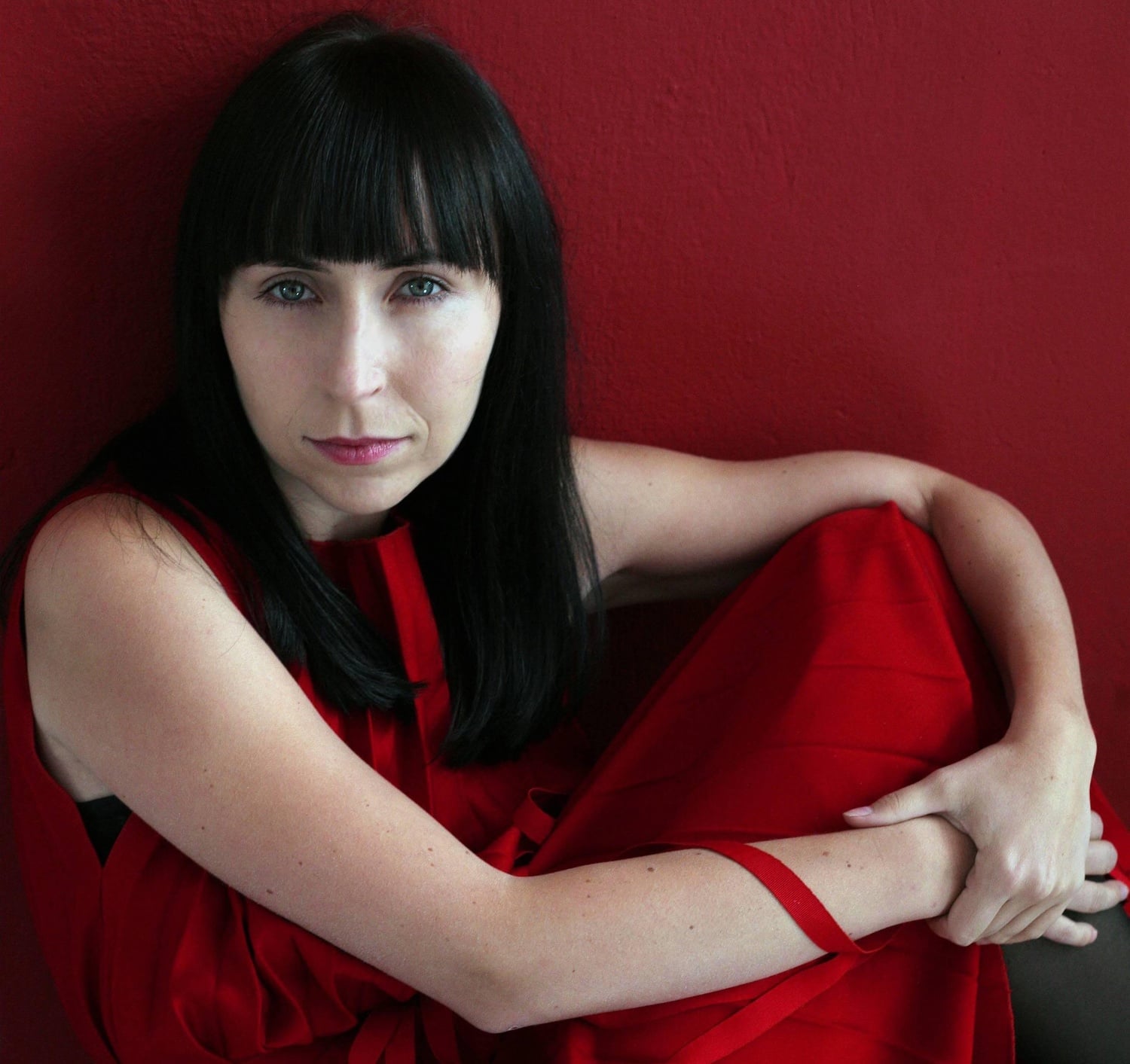
y first encounter with the Polish conceptual artist Agnieszka Kurant happened by accident. Specifically, it happened on an Amtrak train. It was December of 2024, and I was heading home to Brooklyn from Boston for the holidays. The lady next to me couldn’t find her ticket. She was rummaging in her purse, apologizing in an unplaceable European accent to the ticket inspector, a hardliner named Johnny with a very placeable Boston accent. Something about her fascinated me right away. Maybe it was the inky fringe cut sharp across her forehead, her cool accent, or simply that, as someone who once tried transferring trains and ended up traveling in a circle, I feel automatic kinship with other discombobulated travelers.
Once Johnny had moved off, we began to talk. Her name was Agnieszka Kurant, she said, and she was a conceptual artist from Poland. Then she crumpled up small talk and tossed it over her shoulder. She kept it real, as the youth say.
“Do you have someone?” she asked me around five minutes in. I must have looked confused by the concept, because she added, “Boyfriend? Girlfriend?”
“Oh,” I grunted. “Boyfriend.” (It was true at the time.)
“Well,” she stage-whispered loud enough for the whole car to hear, “Is he a GOOD LOVER?”
We talked almost all the way to New York.
***
If you have ever walked past the MIT buildings in Kendall Square, there’s a good chance you’ve already encountered Kurant’s artwork. Look up at the facade of 238 Main Street, and you’ll see an electric-blue signature signing and unsigning itself in LED curlicues. This is “The End of Signature,” an amalgamation of thousands of signatures of MIT students, professors past and present, and underpaid and overworked interns. Next door, a second neon sculpture-scrawl hangs from a cantilevered facade — this collective signature belongs to thousands of residents of the Kendall Square and East Cambridge neighborhoods.

“The End of Signature” questions the idea that any one individual and any one signature can claim sole credit for progress. “Everything in society is a result of the effort of the labor of the multitude,” she tells me when we meet for an interview at Evelina, a hip cafe in Fort Greene, Kurant’s Brooklyn neighborhood.
“When you think about the main monuments of culture, such as the Bible or the mythologies, how were they written?” she asks. “They were not written by a single person. They were written by mostly anonymous thousands of people, very often over generations.” Listening to Kurant talk is an exciting experience; you can hear the pop and sizzle of thousands of her synapses firing.
Collective intelligence is one of Kurant’s many fascinations. It is the force behind so many manmade marvels, she tells me, from the anonymous hands who painted the caves of Lascaux to the modern-day machinations of AI. To Kurant, the narrative that innovations are plucked out of the sky by genius loners is an incomplete story, one that appeals to “the ideology of capitalism, that the individual that has to be strong, the entrepreneur, the industrialist.” Yet even the greatest individual intelligence would be impossible without collective intelligence. “Our tools, our currencies, our social organizations — it’s all a product of collectivity,” Kurant says.
But collectivity is not necessarily the same thing as collective intelligence. For Kurant, the dark side of collectivity is conformity, a mindlessness that is the opposite of intelligence. In the modern world, where our gormless brains bob in a brine of TikToks and Instagram reels and YouTube shorts, it is hard to imagine many ways out of this collective swamp short of becoming a hermit or chucking your phone into the Gowanus Canal.
“There is exploitation, massive exploitation, of various kinds of people, from workers working in mines to extract metals to power computers to millions of ordinary people that are just liking stuff on Facebook,” Kurant says. “Every single ‘like’ brings the corporation a tiny bit of profit. Of course, this is an aggregate, so a single person’s ‘like’ doesn’t matter, but in the aggregate, in millions, all together, this is a lot of money, and it’s the money in which we don’t participate. But we’re just kind of being passively exploited. Hence the termites, you know.”
The termites she’s referring to are the ones who helped her construct one of the pieces in “Artificial Artificial Intelligence,” a series that explores both the wonders and dangers of collectivity. “A.A.I” has appeared in museums around the world, including the Museum of Modern Art in New York City, the Centre Pompidou in Paris, and the Louisiana Museum of Modern Art in Denmark. Supplied with colorful sand, gold, glitter, and crystals, the termites pursued their natural talents and constructed tall, turret-like mounds. The exhibit’s title makes reference to Jeff Bezos, who coined the term “artificial artificial intelligence” to describe the workforce of human beings that his company, Amazon Mechanical Turk, employs for a few cents a pop to complete minute tasks that computers struggle with.
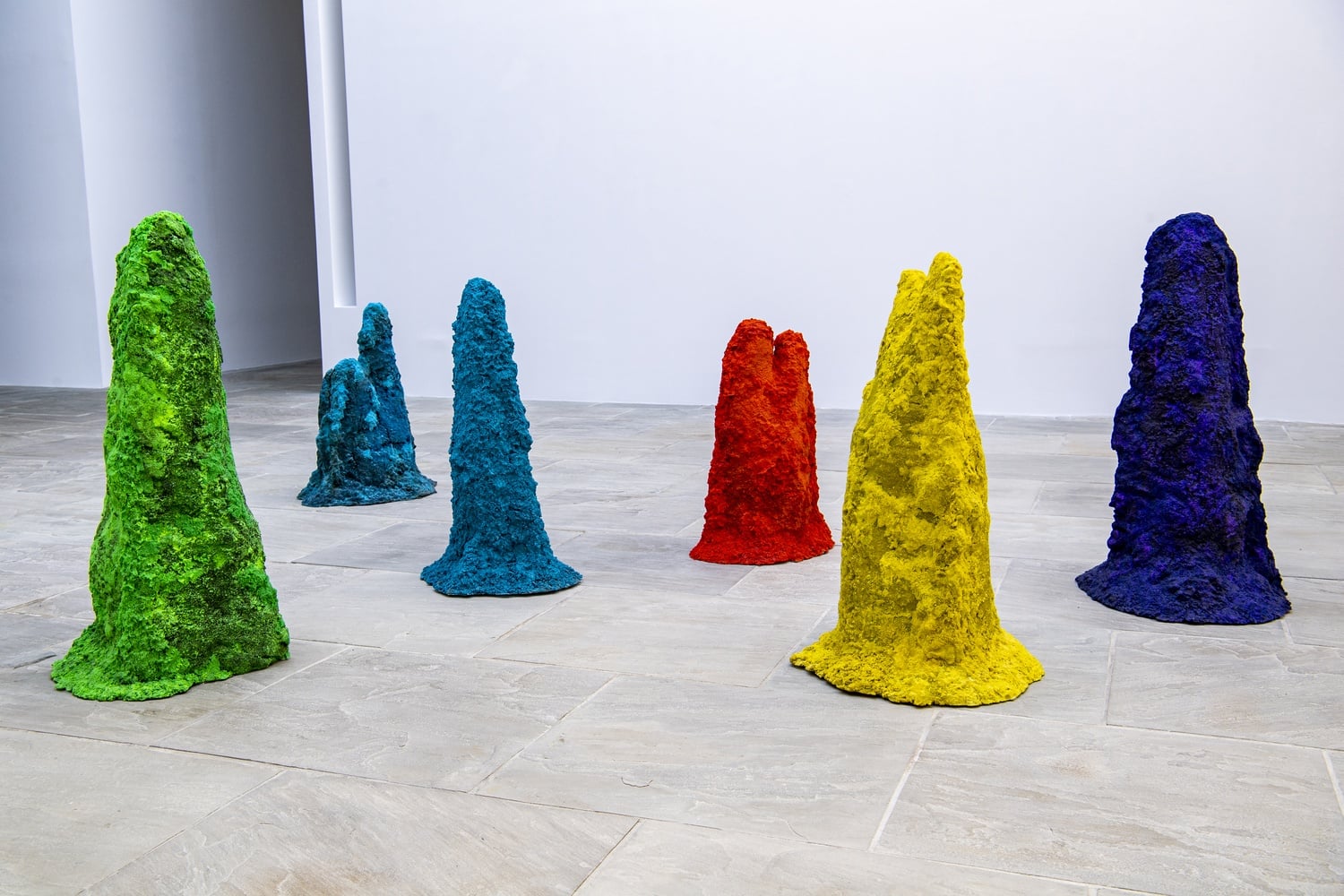
The termites likely do not think too hard about the fact that they are constructing day-glo glories to serve the higher purpose of a human artistic vision; they are marching to the steady beat of a survival instinct, doing what needs to be done to get by. Perhaps humans are no different.
Kurant’s interest in collectivity and the multitude drew her into a fascination with “complex systems,” networks where thousands of elements ricochet off one another, creating unpredictable patterns and reactions. These “complex systems” exist everywhere, from neural networks to termite colonies to human societies, Kurant explains. “These complex systems are actually kind of humbling, because it means that we’re not part of a program,” Kurant says. “We actually cannot predict the future, even if we have all these amazing technological tools.”
Kurant herself couldn’t have predicted becoming an artist. Born in Łódź in 1978, she studied philosophy and photography in Poland before earning a scholarship to attend Goldsmiths, University of London, to study curating. But as a curator, the way Kurant arranged art began to morph into art in itself: “Each exhibition that I organized was a bit like an artwork,” she says. “So there was an exhibition inside of a song, inside of a movie, inside of a space ship, inside of a computer virus. And each one of them was a form, and it contains maybe artwork or contributions by different people, but at the same time it had a form in itself.”
More experienced curators smelled something original in Kurant. “They were all telling me, ‘Agnieszka, actually, we think you are an artist,’” Kurant says. But she brushed off the title of “artist.” It sounded too highfalutin. “My parents were brought up in very difficult times in Communist Poland. They were electrical engineers. They were practical. They were all interested in culture, but the idea of going and studying art, this kind of idea of having something meaningful to other people, to society, never crossed my mind.”
In 2005, after an ardent professional courtship by the French gallerist Yvon Lambert, Kurant finally yielded.
***
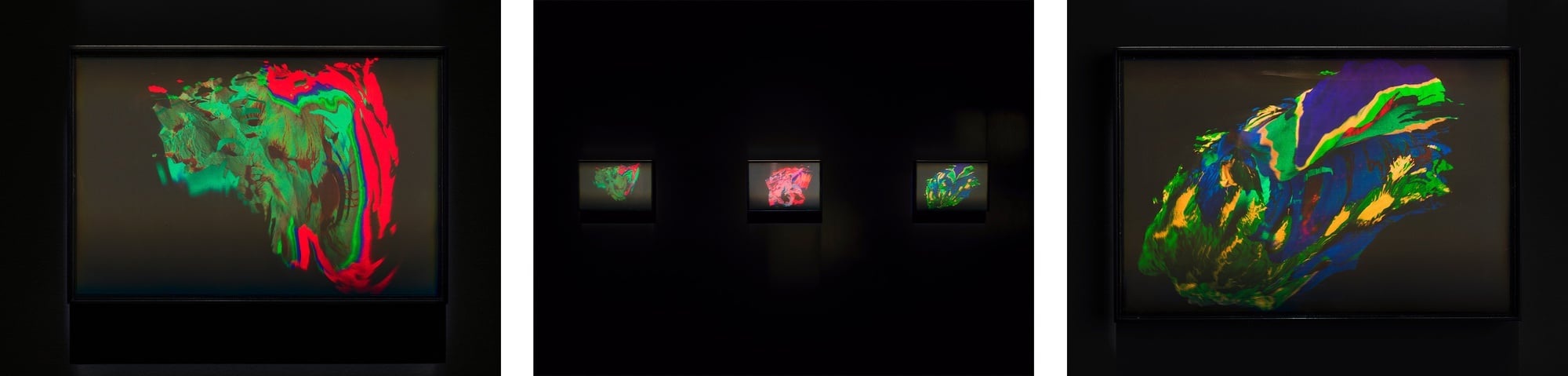
Over twenty years after becoming an artist by accident, Kurant is still obsessed with the future, specifically with the inability of both humans and artificial intelligence to predict it. In “Risk Landscape,” one of the pieces in Kurant’s solo exhibit “Recursion” which is running from Feb. 6 to Mar. 21 at Marian Goodman Gallery in New York, Kurant presents holographic predictions of the financial, political, and environmental futures of places like Florida, Luxembourg, Lviv, Gaza, and Doha. These possible futures, calibrated with the help of data scientists and catastrophe-modeling specialists, hang in the air like hallucinations, phantom islands spotted through the fog. These future worlds might be real places. Or they might not.
But if the future is a place, then Kurant believes that the days when humans once imagined it as a promised land of progress are over. “Your generation is really growing up in a world where it’s the end of the future,” she says. “The belief that the future will bring something better, something better than the status quo, than today is over. I think kids are aware of it — the future will either be a continuation of the same, or, likely, it will be worse. Climate-wise, polarization-wise, the alienation in society, the collapse of societies in general.”
Kurant hopes that art will help to steer humanity away from this apocalyptic vision. But art that inspires change must be different from propaganda. “Art is not propaganda,” she declares. “Art that is propaganda is bad art.” To Kurant, the “best forms of culture make people ask their own questions. Not the questions even of the author, of the sculptor, of the writer, but their own. You know, it’s a catalyst. It’s a chemical reaction. And then it can go in different directions, maybe even contradictory directions.”
All too soon, it was time for Kurant and me to go in different directions, too. She had a plane to Europe to catch. I waved her cab off.
Setting off down DeKalb Avenue that bright December morning, the word she used, catalyst, bobbed up and down in my brain. I wondered what catalyst it was that led us to collide. Maybe it was Amtrak. Maybe it was Johnny. But there are too many elements in the complex system of life to say for certain. I thanked Chance.
— Magazine writer Clara E. Shapiro can be reached at [email protected].