
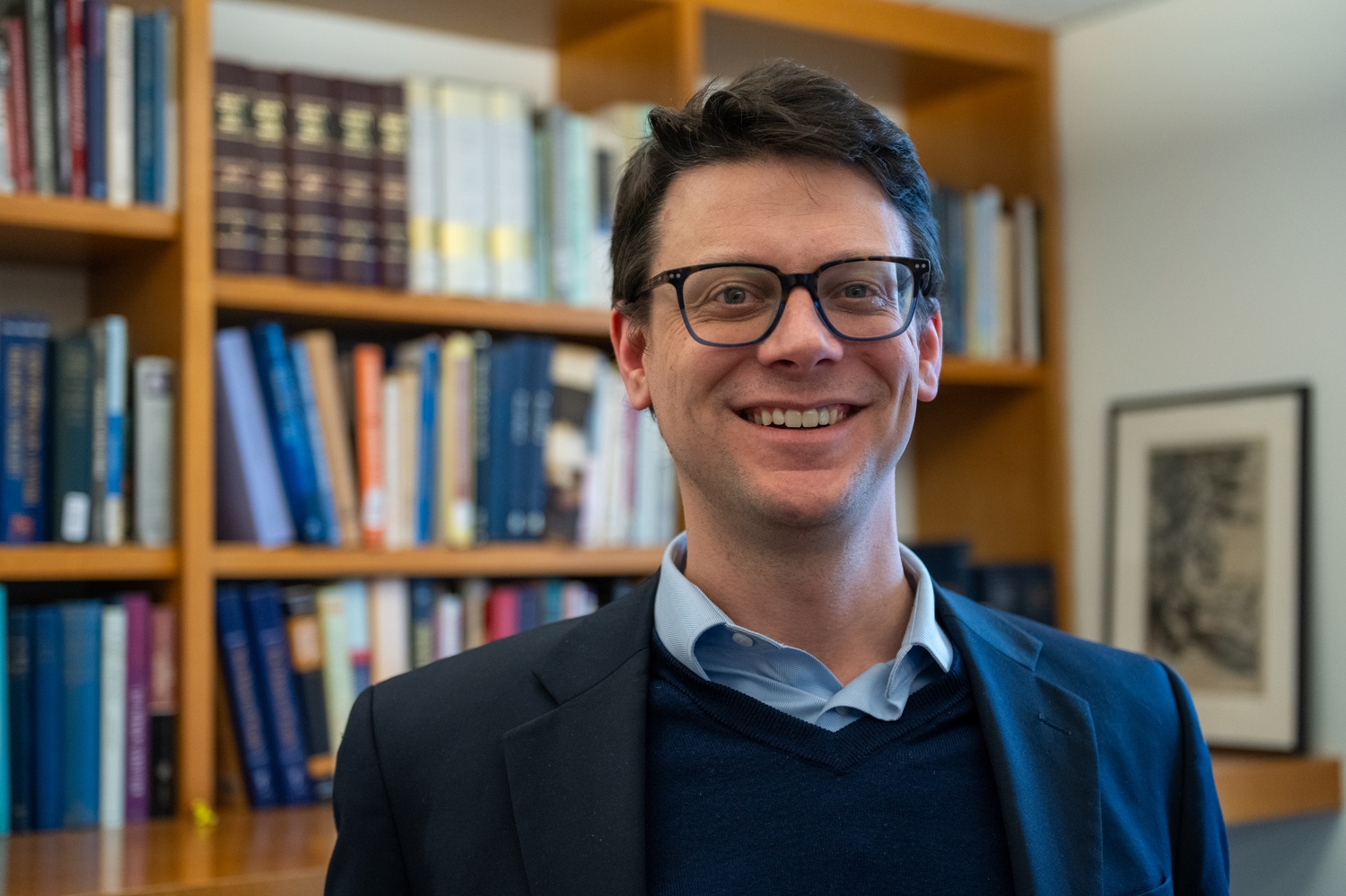
Fifteen Questions: Jason Rubenstein on Pluralism, Reflection, and Leadership Through Crisis
The Executive Director of Harvard Hillel sat down with Fifteen Minutes to discuss antisemitism on campus, the pressures of leadership, and what keeps him grounded.
Jason B. Rubenstein ’04 is the Executive Director of Harvard Hillel, as well as a graduate of Harvard College. This interview has been edited for length and clarity.
FM: You said that your time at Harvard Hillel as an undergraduate had a profound impact on your life, including meeting your wife, Arielle. Can you share the story of how you met and what Hillel meant to you during those years?
JR: I grew up in a reform community — actually, I was deciding between Harvard and Stanford as a high school senior — and remember standing in the Hillel dining hall, it wasn’t called Visitas at the time. Just being surrounded by the energy and looking, “Oh, this is the kind of community I want to be part of.” And when I arrived, I was thrilled and shocked, I would say, at the amount that some of my peers knew and could do intellectually and ritually, and envious of that, and perplexed as to why I hadn’t been taught that.
Hillel was a place where I felt like there were kind of good, thoughtful, curious, interested and interesting people and really a way of life that I think I’ve been looking for my whole life, and hadn’t kind of realized until I found it here.
The summer before my senior year, I was one of the leaders of the Conservative Minyanim prayer group. And we put on high holiday services, which is very ambitious, because most places they’re led by trained professionals, whereas this was all student-led.
And we’re mid-summer, and there was one service we hadn’t found anyone to lead, and we got an email from this incoming student saying, “Hi, my name is Arielle. I’m from Houston, and I imagine you probably have all the slots, but there’s this one service I know how to lead.”
And Arielle said to her friend, “I’m gonna marry that guy.” And we didn’t start dating at the time, I was dating someone else and I was a senior. She was a freshman, scandalous. But then it was the summer, kind of a year after that, we were both working in a summer camp together, and started dating. And it was very quickly a question of when, not if, we were gonna get married.
FM: Is there a moment from your undergraduate years at Hillel that you find yourself thinking about more often now that you are running Hillel?
JR: It was my sophomore year, we all woke up to an email from a student, Avi Heilman.
And the subject line was, “Were my parents wrong?” — clickbait before we had that word. And so he said, “I grew up Orthodox, and we’re a real Zionist family.”
And he said, last night was Yom Hazikaron, which is Israeli Memorial Day, and there’s a service, and there is always one here for veterans of the IDF who fell in service, and also victims of terror attacks. And he said the only people who were in attendance were Israelis and Orthodox students. And were my parents wrong? Are reform and conservative students not as connected to this? And over the subsequent week, there were some really hard conversations.
This was in the middle of the Second Intifada and the pluralism held. People, they talk to each other, they listen and while we’re doing a hard thing, being disappointed by maybe feeling betrayed by each other, maybe feeling shocked that someone else sees the world so differently — someone else who you’ve spent a few years with in college, right?
You think about what it means to be Jewish differently.
FM: In just a few years your leadership has unfolded under intense public and political scrutiny. How did you navigate, and still do navigate, pressure?
JR: The first thing has really been not trying to convince or combat or marginalize certain positions, but giving people who believe in, whether it’s an ethos of your big family or very classic liberalism here, something to believe in and be proud of. And I feel like that has worked.
And the second thing we really tried to do is to not lead out of fear. I think there’s a lot of ways, a lot of reasons to be afraid, definitely, like the emotional intensity of some of the passages of this around like anything I’ve ever experienced, someone I wouldn’t wish on my worst enemies. And to really believe, not even primarily in myself, but to believe in other people. Believe in a shared project. Believe in what’s true and good. And sometimes I feel like I don’t know how we’re going to get there. Sometimes I don't even know how we’re getting to but I know that these are the right next steps, and to really trust that, and that has, I think, held up and brought the community through.
FM: When Harvard settled two antisemitism lawsuits last January, you wrote in a statement that was published in The Crimson that “no settlement or report is worth more than the consistency and breadth of its implementation.” How do you assess the University’s follow-through so far?
JR: Institutional change is never you flip one switch and it’s done.
My sense is that the University leadership has been principled. Have they done everything I would do? No, but have they done what I think have been the most important and most difficult things? Yes.
I think a critical part is: before the antisemitism report, President Garber had the right formulation of both the structure of the problem and the solution, in that the problem was not anything flashy, as much as it was like social shunning students, having real reason to fear that if other people knew their beliefs, that they would pay a very, very social price for that. And I used to hear a lot of stories like that, and I hear very few to none of them now. So I do think that’s very significant.
The other thing, which I think is extremely important and has been critical, is President Garber’s method, where the idea is to focus not primarily on eradicating antisemitism, but actually to focus on the work of the University on excellent scholarship, on building groups that in seminar rooms can think well together.
And I think by focusing rather than kind of imposing a whole other set of norms or structures, but working through the core mission of diversity, that is the right way, orally and strategically, to operate.
FM: How do you create space for disagreement within the Jewish community at Harvard, especially around Israel?
JR: The idea of this is that if you and I disagree about what Judaism teaches — ethically, religiously, et cetera — the dividing line between that being, on the one hand, interesting, versus very fraught and we’re in a no-holds barred fight, is the question of whether you trust me. I would never use my social power influence to try to marginalize or exclude other Jews or your type of Judaism.
So that’s the core ethos.
There’s an affiliation agreement that student leaders sign in order to be granted access to health, credit cards and staff resources and space reservations, which basically says that they will lead their group in that type of way.
You can’t just tell people, “be respectful to one another.” Commitment is actually coming to love the people around you as the foundation. And then people are not just willing, but able, and again, proud to create space for one another.
FM: Do you think this political moment has changed what it means to be Jewish at Harvard, or what Hillel does to serve Jewish students compared to when you were an undergraduate or not?
JR: It’s a great question. So I think it’s changed what it means to be Jewish in America, I would say, in a large way.
And I often use the image of something tectonic having shifted this kind of invisible, very strong foundation on which everything is built starts to move all of a sudden, and that's what we're seeing and feeling.
FM: And what keeps you grounded when campus life feels volatile?
JR: I always say, we’ve got our ancestors through 100 generations, to this point.
We’re going to make Rosh Hashanah really beautiful, we’re gonna create something, sing together. And I think that we’ve taken a very wrong turn as a community if we allow 40 people in an encampment and five administrators who don’t discipline them to be the most important people. We should create something of a surpassing strength that no one can take away from us.
The headlines are for some people, but I think resisting the kind of gravitational pull of the headlines and focusing on these are people with lives that in some ways, transcend the churn of the story, is true and important.
FM: You left Yale to take on this role at Harvard — does this mean that you’ve officially chosen the side of the rivalry?
JR: Well, I always had a side. I just had some conflicting professional obligations for a few years.
FM: I’ll accept that. Why do you wear two different color shoe laces?
JR: You know, men’s fashion provides precious few opportunities for accessorization.
I wear fun mismatched socks normally, and was trying to build on that, because it was working for me. And so at Yale, I decided I wanted colored shoelaces. And I was like, ‘you know what I’m going to do is I’m going to have a blue shoelace for Yale and a red or crimson shoelace for Harvard. So that’s what I did for my years there. And then I came here, and I was like, I don’t want any blue shoelaces here. So I just went with different combos.
FM: How do you balance being a pastoral presence for students while serving as a public facing institutional leader?
JR: I think the main thing is just understanding very clearly my role in different situations. And ultimately, sitting opposite a student, there’s a sacred set of responsibilities you have toward them.
I actually think that the through line is to understand deeply and care passionately about the welfare of the members of this community.
FM: On that same line, what are students coming to you most frequently with now?
JR: I think there’s a set of existential questions which are both timeless and timely, right internal and also kind of inflected in an age of polarization and AI and so I’m working very closely with students. One of the vehicles for this study group that meets every Friday morning, and the structure of it is, each week, the way I prepare, we set the topic — a student actually picks the topic — and I meet with them and discuss it, and then I pick a set of Jewish sources that we study together.
They’re like, “how do you deal with anxiety around the knowable grounds for truth?”
And the week before was about a student who’s in a relationship conflict.
And so, those are very timeless issues.
FM: How would you describe the philosophical and practical differences between Hillel and Chabad?
JR: The first thing I would say, as an alumnus and a member of this community, I’m so grateful for the Zarchis and what they built for generations of students at this point, and they’re just incredible asset to the community.
I think the core difference is, Chabad presents a very clear and confident and compelling picture of what Judaism is and what it looks like, how its leadership speaks and dresses, and there’s a lot of integrity, and some sense something unshakable about that. And you know that youre gonna be welcomed into the home of these two amazing people.
And here, there’s this kind of two-way faith.
I want this to feel like, when students walk in, it’s not that they’re entering my home, but they’re entering a home that they create for each other.
Judaism is not any single instance. Each one of those is vital. It’s like a tapestry. You can’t pull out one thread, but there’s something that grows out of that ongoing exploration and the Jewish people, the name Israel, struggling with God. And so I do think that that ethos really on the empowerment of students and a faith in what will emerge from their encountering one another, and the tradition with their own mind and soul, which has never existed before, is at the heart of what we do.
FM: Harvardians look to you as a spiritual leader. Who do you turn to for guidance and support?
JR: My parents always. I always ask my wife about stuff, so wise and brilliant. And my teachers from when I was a student.
It’s an incredibly rich group of people that have blessed my life, and in many ways, trying to give students even a fraction of the insight and generosity of spirit and mind that my teachers give me, that’ll be enough.
FM: This is one of my favorite questions, because I am a Social Studies concentrator. As an undergraduate, you concentrated in Social Studies. What drew you to that field?
JR: I went to an incredible math and science high school in Montgomery County. My best friend from high school runs the quantum lab at Stanford. And I was already — I don’t want to say falling out of love with that — but falling more in love with reading. And I found myself really perplexed my freshman fall that I was more into my Expos class, which was philosophy of religion. I was more into doing that reading than my Physics 16 psets.
FM: Hillel is famous for its bagel brunches. What is your bagel order?
JR: It’s probably scallion cream cheese, tomato, onion, capers and cup of black hot coffee.
—Magazine editor-at-large Caroline G. Hennigan can be reached at [email protected]. Follow her on X @cghennigan.