
There’s a Lot You Don’t Know About Divya Narendra
Fifteen years after ‘The Social Network’ made him — and his Facebook lawsuit — famous, we check in with the ConnectU co-founder.
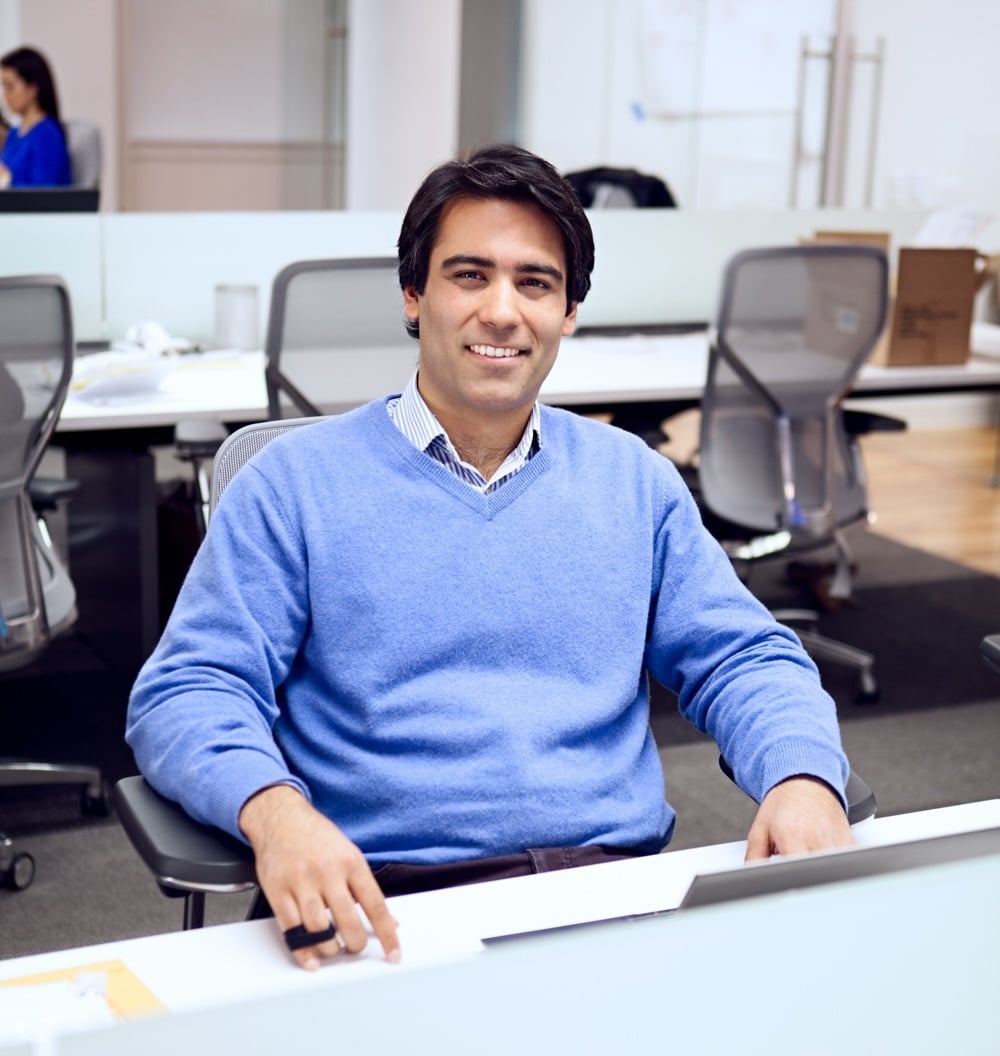
ivya K. Narendra ’04 is not the cashmere-and-collared-shirt-wearing Harvard man you watched in “The Social Network.”
Narendra is best known for his role in founding ConnectU, a forerunner to the social media platform Facebook — designed by fellow alum Mark E. Zuckerberg ’06 — that allowed students, verified by their college email addresses, to connect online. Narendra, alongside co-founders Cameron S.H. Winklevoss ’o4 and Tyler O.H. Winklevoss ’04, would later sue Zuckerberg for allegedly stealing their idea to launch Facebook. The lawsuit was settled in 2008, awarding Narendra and the Winklevosses $65 million in cash and Facebook stock.
But the version of Narendra that the film chooses to depict — an arrogant, trench-coat-clad Harvard student and menacing rival to Zuckerberg — doesn’t align with the real Narendra. However, Narendra says he’s amused by the film’s discrepancies, laughing it off while quipping that he has “never owned” a trench coat.
His friends’ characterizations support Narendra’s own assessment. In Brian Flanagan ’04’s account, Divya — “a mononym” in their class — was “intellectually omnivorous” and a “social animal.”
Over the course of multiple lengthy phone conversations, a different version of Narendra emerges: an ambitious but self-effacing man who, more than two decades after graduating from Harvard, is still looking for his next great idea.

Narendra did not enter Harvard expecting to become an entrepreneur.
The son of two doctors who immigrated from India, Narendra grew up in Bayside, Queens. Though he initially thought he’d follow in his parents’ footsteps, when he arrived at Harvard he felt compelled to deviate from that track, or, as he puts it, “do something interesting.” He says that this desire was partially driven by recognizing that he didn’t enter Harvard with talents of the caliber boasted by some of his classmates.
“I wasn’t the star tennis player,” he says. “I wasn’t the guy who was on a path to win a Nobel Prize in chemistry or physics.”
Narendra was a college student in the early 2000s, at a time when some of the first social networking sites, such as MySpace and Friendster, were just being launched. According to Narendra, that environment helped inspire him to come up with the idea for ConnectU.
But before ConnectU became the center of an intellectual property battle, Narendra bonded with Cameron Winklevoss, whom he met in Spanish class, over their love of music, despite different tastes — the Dave Matthew’s Band for Cameron Winklevoss and death metal for Narendra. “He would come over to my dorm — I was in Holworthy — and just listen to me shred on the guitar,” Narendra says.
Narendra lets himself get carried away talking about his favorite bands, including Van Halen and a Swedish death metal group called “In Flames.”

In their junior year, Narendra and the Winklevoss twins co-founded ConnectU, an idea that Narendra describes as a low-tech solution to bring university students together. In 2003, Narendra and the Winklevosses hired Zuckerberg as a programmer for the social platform. According to the Winklevosses’s and Narendra’s lawsuit, Zuckerberg allegedly went behind the trio’s backs to appropriate ConnectU’s idea, and elements of their source code and intellectual property. Over two decades removed, however, Narendra says he can look back on the event and appreciate the lessons he learned.
“I feel privileged to have experienced that early in my career,” he says, “because that’'s the age when, frankly, I think you can afford to take a lot of risk, and nobody expects you to succeed, and at the same time, people want to help you.”
Narendra adds that one of the biggest benefits of his Harvard experience was the opportunity to connect with other students.
“If you can take a break from just finishing your work and take that extra time to get to know people in a meaningful way,” he says. “You can’t help but notice the talent at the school, and it’s amazing.”
Today, Narendra continues to explore and build new ideas. After several years working for larger financial corporations like Credit Suisse, Narendra founded SumZero in 2008, a platform where vetted investment professionals can share theses and publish research.
Narendra seems most excited by SumZero’s potential to be a “24/7, 365 day a year idea contest” — which allows him to continue to learn from those ideas, too.
Retail investors, who are not qualified to post, are also able to access the information on SumZero through reader-only subscriptions.
Narendra finds immense fulfillment in pursuing his own venture.
“The whole idea behind entrepreneurship is you put in a ton of sweat equity. You have ownership in what you do, which is a big deal, like emotionally,” he says. “I didn’t feel that when I had a job at a big corporation. I just felt like a cog in the wheel.”
By contrast, Narendra speaks about SumZero with the same passion and depth with which he discusses the music that he loves. When talking about his current entrepreneurial ventures, Narendra does not shy away from the gritty details, weaving technical descriptions of his latest venture’s investment strategy and AI technology into the broader narrative of his entrepreneurial life.
Continuing to capitalize on the latest technological developments, Narendra launched SumZero Capital in 2024, a hedge fund run by machine learning models trained on the data shared on SumZero’s networking platform. Artificial intelligence algorithms, rather than human analysts, make investment recommendations.
From January to September of this year, SumZero Capital’s stock portfolio rose 15.34 percent in value.
Narendra now lives with his wife Phoebe A.G. White and their two daughters in Greenwich, Connecticut.
Almost two decades have passed since the conclusion of Narendra’s and the Winklevosses’ founder dispute with Zuckerberg. “I don’t lose any sleep at night over what happened,” says Narendra — who now follows Zuckerberg on Facebook.
—Magazine writer Sebastian B. Connolly can be reached at [email protected] or on Signal at sbc.23. Follow him on X @SebastianC4784.
—Magazine writer Noah N. Gilligan can be reached at [email protected].
—Magazine writer Chloe Xue can be reached at [email protected].