
Fifteen Questions: Richard Renaldi on Strangers, Self-Portraits, and Soul Food Restaurants
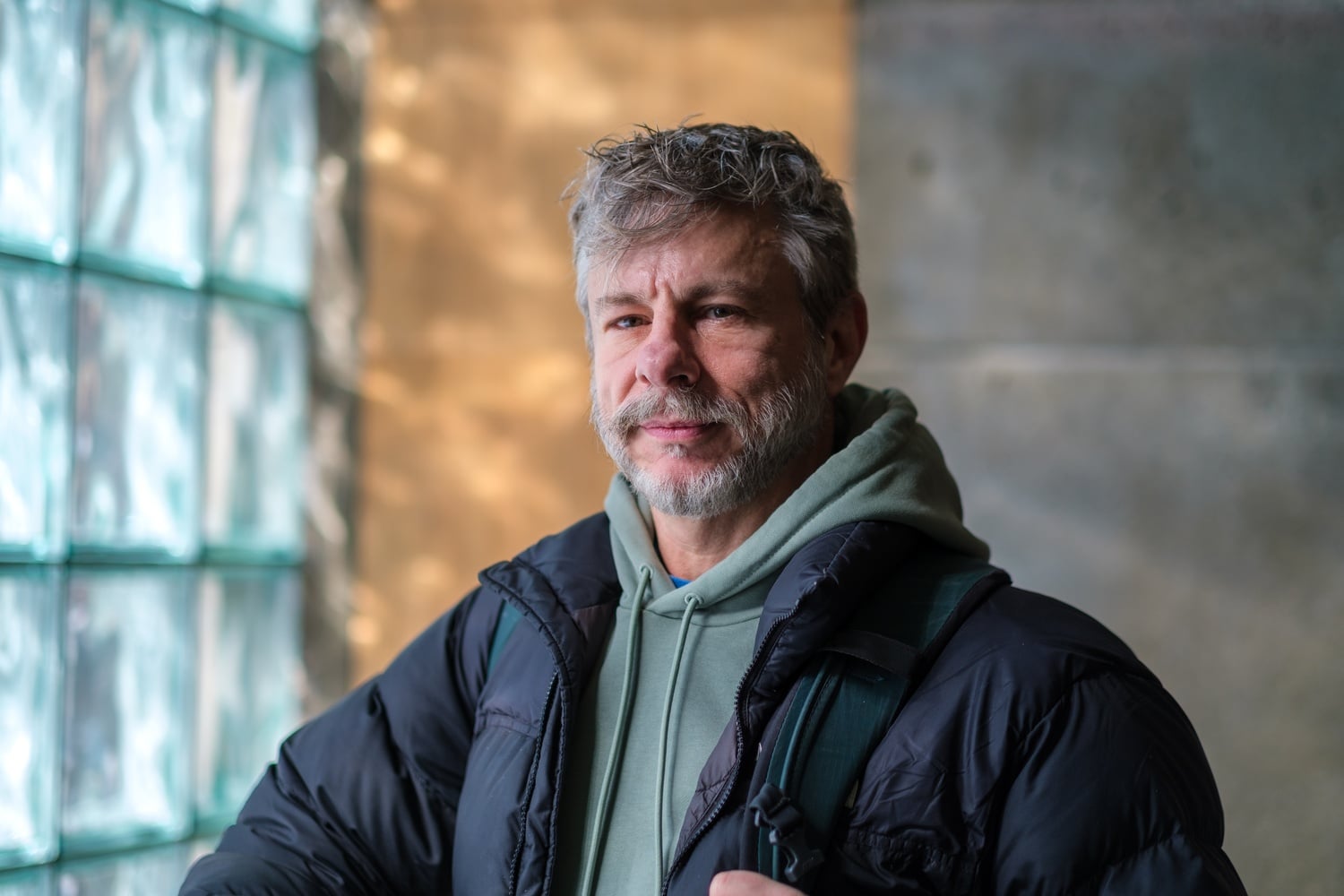
The professional photographer and current visiting lecturer sat down with Fifteen Minutes to discuss how he approaches photography and interprets art.
Richard Renaldi is a photographer and visiting lecturer on Art, Film, and Visual Studies. He has published five monographs, including “Touching Strangers,” in which he asked strangers to pose in contact with each other.
FM: I want to start off with your work “Touching Strangers,” and ask you what it was like to get people to pose for that project.
RR: It was painful for me, because it just took a certain amount of vulnerability, both from the subjects and myself to prepare for that possible rejection and the sort of unusual aspect of the request.
Once someone agreed to do it, then it became fun and problem solving. How do I put these people together, and how do I make it intimate?
FM: I wanted to follow up on that with a question about a review I read in The New York Times for “Touching Strangers.” That review noted, “What makes Renaldi’s photographs thrilling is that even knowing his strategy, the viewer can’t help fabricating a story.” And I want to ask what stories you, as the artist, hope people would fabricate about this sort of work.
RR: That’s not the artist’s job to interpret the work for the viewer. I think that I can have my own idea about what the work is about, and it’s coming from multiple parts of myself, inside, and also my experience in the world.
I think it’s better, in a way, that people come look at work without a curatorial statement first. Because I think you want their mind to start, the wheels to turn and have them interpret what they’re seeing, from something in their own story and from their own understanding. So if you tell them exactly what it’s about, you’ve kind of ruined that, in a way.
A lot of work, though, needs a mediator, because it may be more opaque or it might be more extremely academic. So, that’s where the curator comes in, and the justification for their job is to explain. But my feeling is, before we get to that, let’s just look at it and respond.
FM: What are some of the stories behind “Touching Strangers” that stick out to you?
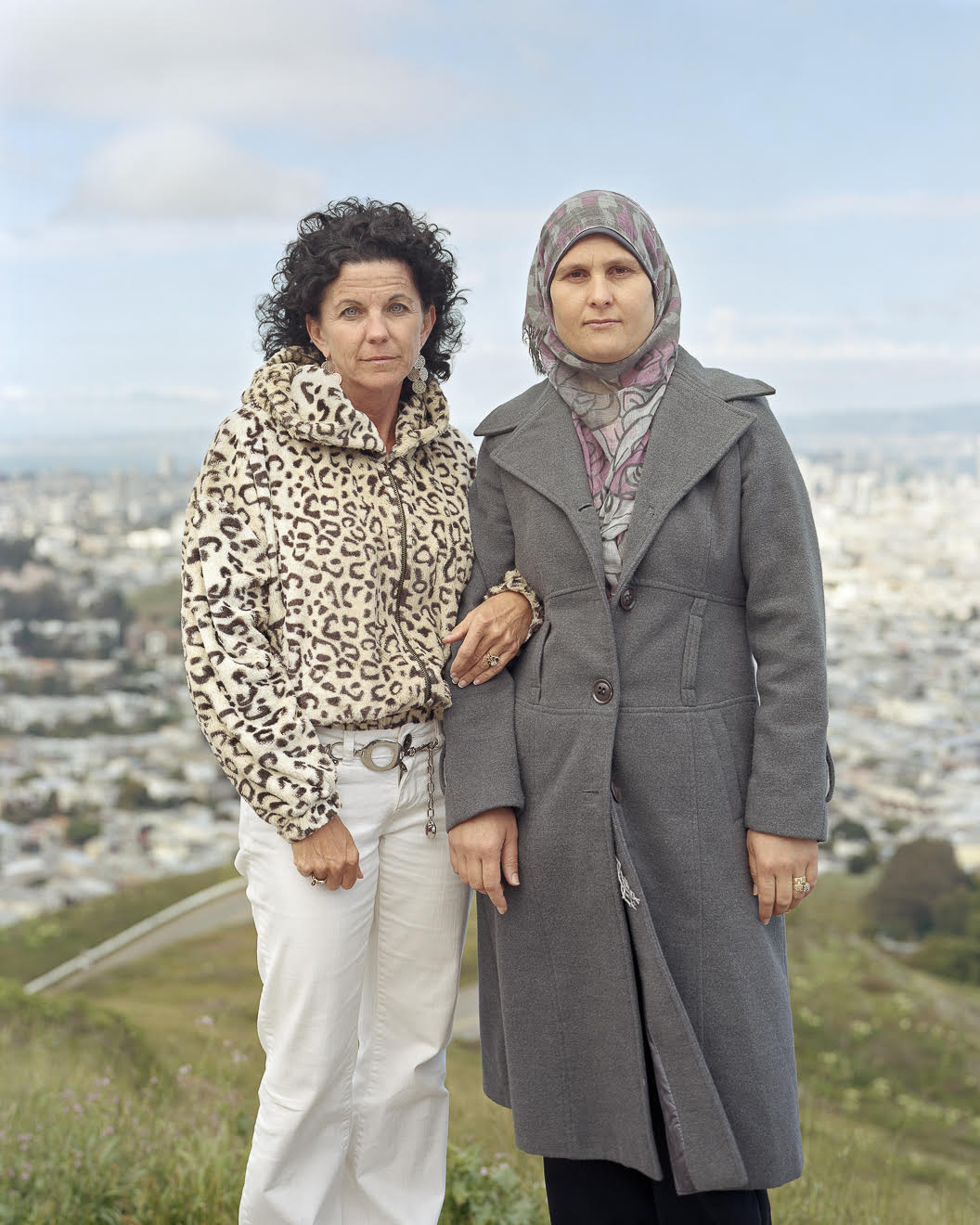
RR: There’s quite a few, but I think one of the most profound stories is the story of Rayqa and Annalee.
This was in San Francisco, I was up on Twin Peaks looking to make a photograph Part of my mission with “Touching Strangers” was a sort of cataloging — in very much the same way that August Sander cataloged all different types of German citizens from this project “People of the 20th Century”. So, I was thinking about bringing into “Touching Strangers,” all different types of Americans.
I had always wanted to cast a woman in a hijab. I would approach them on occasion when I was out shooting if I did see them, and they always sit down.
That’s sort of like the background, but at first I saw this woman named Annalee. She was visiting, she was a tourist from South Carolina, she was with her husband. She had this really old leopard or cheetah print jacket on, and I approached her. I thought she had a really expressive face, and she had a very strong southern accent, deep southern accent.
And so I went up to her, and she was with her husband, and I told her the concept, and I asked her if she’d be willing to do one and she looked at him, he was like, “do it if you want." And she’s like, “Okay, I’ll do it.”
So then I went to go find a partner for her, and that’s where I saw Rayqa and she was walking with her husband. I approached her, told her this concept, showed her some pictures on my phone and she politely refused.
But I still had to go find a partner for Annalee, so kind of feeling a little dejected and frustrated, I went looking for someone else, and then I hear this voice say, “Hey, photographer,” and it was Annalee, and she had approached Rayqa, and asked her to take a picture with her.
Because Annalee was from the South, I thought she might be biased against Muslims. So I brought my own bias into the whole encounter. So in the off chance she had said yes, I was concerned that there might be this uncomfortable incident of intolerance.
Annalee subverted every expectation.
It was one of the most memorable experiences from the project.
FM: Some of the images that I saw capturing history and politics in your work are the photos from ACT UP protests, and I want to ask you about those protests and what makes those images unique, and why they sort of appear in a couple different of your collections.
RR: I was living in New York in the height of the AIDS epidemic, and I was going to demonstrations and photographing them. I had gone to actually an ACT UP meeting, not because I had been at that point, yet, touched by the pandemic. It was because I was hoping to meet somebody.
I was looking for community.
I really became more inspired by the politics as an observer and somewhat as a participant. I started to go to demonstrations all through college, I was involved in the peace and justice movement in Central America and South Africa, and so those pictures are kind of important in my development, in my stories, if you will.
FM: You grew up in Chicago. You went to NYU. One of your first major projects was Fall River boys, chronicling the lives of young men in Fall River. What drew you to chronicle the experience of masculinity in Fall River, Massachusetts? What drew you to that place?
RR: Provincetown. I started going to P-town with my gay friends in the mid-90s, and the drive from New York takes you right through Fall River, and you drive over the Taunton River on the Braga bridge there, which is extremely picturesque.
So I was drawn to the aesthetics, and then I didn’t know anything about it and one time on the way to P-town, I was like, I’m gonna check that town out.
I guess what I observed visually was the manifestation of a town that was of 50% Portuguese and Portuguese Azorean descent. And so it was very Catholic, and I think some of the manifestations of boyhood had a certain machismo. And so I initially was just drawn to also the old mills. And I decided that one day, I would go.
And so I went and I did photograph some of those mills, but I also ended up photographing kids that day, and I got my film back from just that experiment. And I was like, ‘I think there’s a story here to tell, especially about these boys in this town growing up.’
Fall River at this time, was post-industrial, and I think today it’s more a bit of a bedroom community for Boston, rails go out there now, but at the time it was, it was a little worse for the wear, but a town that I think if you grew up in, most kids would try and find a way out. I was kind of drawn to telling that story of young men coming of age in that town.
FM: I read an interview where you described yourself as a “self-portraitist”. What draws you to photographing yourself?
RR: What draws me to photographing myself? Narcissism. No, that’s a joke, everyone.
I think I had mentioned earlier to use the word vulnerability. That’s a big part of, I think, being an artist and making art., and especially with portraiture. Can you get your subjects to be vulnerable with you? Can you be vulnerable in front of the camera? I think it’s a challenge.
I think the character of American culture is particularly surface-based. So, I think self-portraiture, not selfies, but self-portraiture is a way to kind of dig deeper than how we’re trained to look at ourselves and look at other people. And I think that self-portraiture can reveal something, if we are vulnerable, or if we even can reveal something in portraying confidence, just emotion in general.
FM: How does film photography capture the human experience in relevant and novel ways, in an age where everyone has a camera on their phone and in their pocket?
RR: I think you can make a really good picture that has some meaning with your phone. It’s again, it’s not a great lens.
To be intentional is super important and part of the process of making something. Sometimes you can just shoot willy-nilly with no intent, and then put something together later, and you can bring intent into it.
The difference is that you have thought about it, you have cared for it, you have nurtured the work you’re putting out there. Whereas, I think this visual culture, it’s almost without thinking, it’s almost spontaneous, right? We have this spontaneous visual culture that’s constant, right? And people recording things now all the time, it’s often meaningless. It’s just pixels.
FM: In that same vein, with photography so accessible now, how do you ensure that the art form of photography still interests ordinary people?
RR: It’s a challenge right now, the photography galleries are closing right and left, the middle, mid-tier galleries are not able to stay afloat. People used to buy more photographs than they do now.
So that sort of has fallen out. You talk to any one of my colleagues that used to have some secondary income from print sales, and for most of us, it’s kind of dropped off precipitously, and it’s happened in the last five years, and a lot of that has to do, with the proliferation of TikTok, social media, everyone having a camera phone now, it not being sort of special.
And I think those addictions are taking people away from looking at art.
You don’t have to be trained to be an artist, but looking at things by people that are reflecting on the world or reflecting on their lives, you can’t replace that. That’s where the value is.
FM: Much of your published work is also on your website. What’s the rationale for making your work so accessible?
RR: So someone in a village in India can see it, that doesn’t have access to a library with photo books.
If we think about screens as sort of a mediator between us and the piece of art, I think seeing someone’s work on the internet can give you — it’s not the same as a print, of course — but it’s still an approximation of what you’re communicating.
So I just think it’s important that people have access to art.
FM: What’s your favorite photograph by another artist?
RR: No. There’s thousands.
I can’t even choose. I can give you my top 50 photographers, and I’m sure I’d be leaving people out.
It’s a not fair question. I hate the favorite question. It’s just not fair. There’s too much.
FM: How does the type of camera you use for your street photography shape the final composition?
RR: It does shape it. It slows you down. It gets you time for your subject to not be as nervous to shake out the giggles, so to speak.
The camera is important-looking, so people approach it with sort of a different level of seriousness than they would an iPhone. And also the tilts and shifts you can do with the actual equipment can actually allow me to have, like, this hand in the foreground in focus, or my eyes in focus, and then sort of everything else softens out.
FM: What kind of camera would you recommend for a beginner learning photography?
RR: You could probably learn on any camera, but I think the standard good advice would be to learn on a handheld SLR camera, either film or digital.
FM: I read an article that had your soul food recommendations attached to it. What are your tips for finding good soul food, or a good soul food restaurant?
RR: I look at Google reviews, or I’ll just use the internet.
I always cross reference, usually, my reviews.
Especially if a restaurant’s new, and there’s 70 five-star reviews, you’ve got to wait a little while, because that’s all their friends that are reviewing it.
FM: I’ve also heard you like modernist and brutalist architecture. This building, the Carpenter building, is the only building that Swiss architect, Le Corbusier, designed in North America. What do you like about modernist architecture, and how does it connect to your own art, if at all?
RR: I don’t know how it connects to my art, but I think it does. I think because architecture is a form of art. Certainly a camera is thinking about space and it’s thinking about geometry in some ways, just as much as an architect might be. So there are parallels.
FM: Last question here, after talking with me in this space and this moment, how would you frame a portrait of me, and why would you choose that composition? You can also choose a different space.
RR: I like that, up on the fourth floor, where Mae photographed me in front of the green wall. I’d bring you up there, I like that area because there’s lots of good natural light. If I had to work with you here, though, I would figure it out. There’s something about this, the coat hangers and the cords and the shadows they’re making.
—Associate magazine editor Jack B. Reardon can be reached at [email protected]. Follow him on X @JackBReardon.