
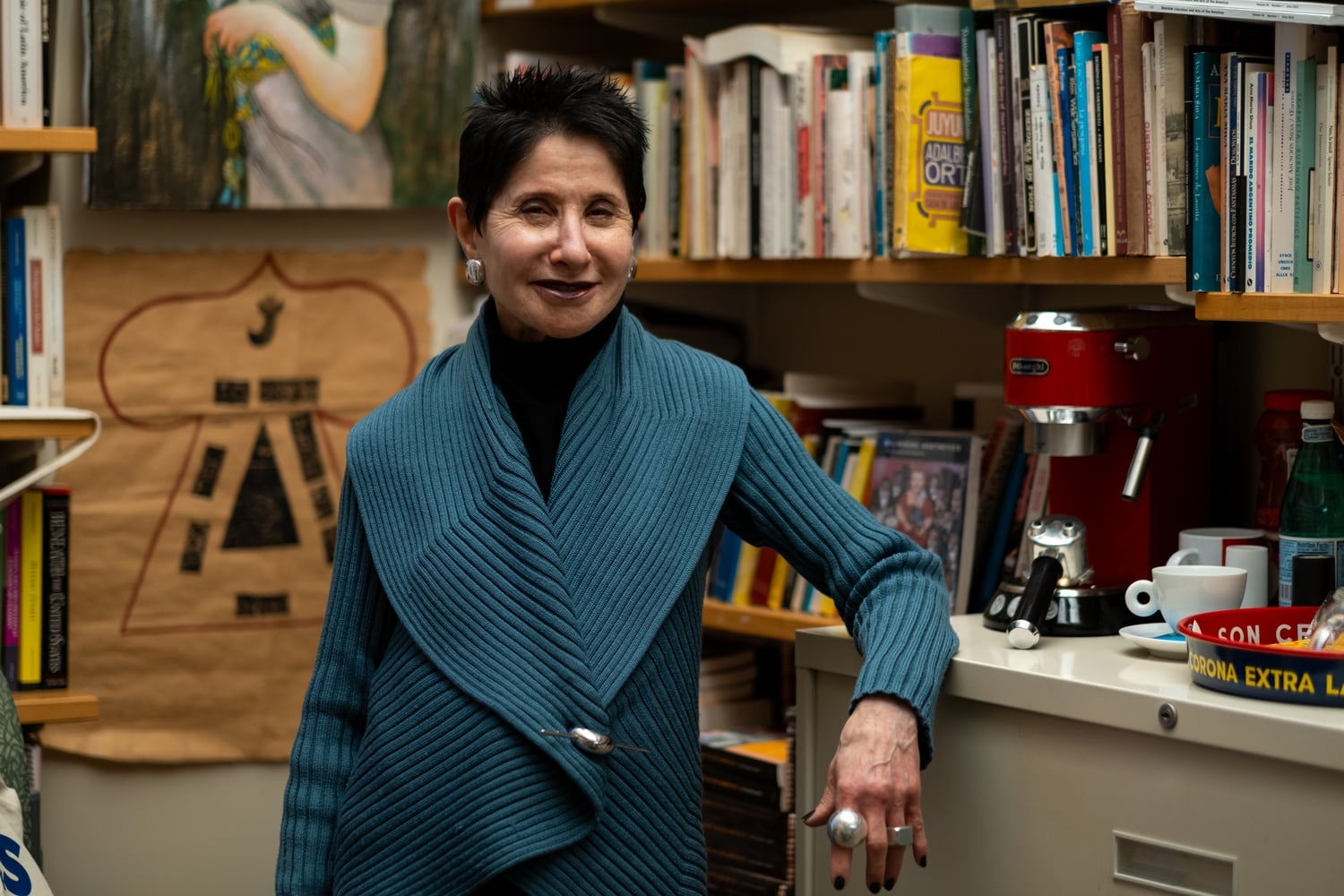
Fifteen Questions: Doris Sommer on Optimism, the Role of the Humanities, and the Montessori Education
Doris Sommer sat down with Fifteen Minutes to talk about her work with “Pre-Texts,” an arts-based training program for teaching literacy and citizenship, what brings her joy, and the role of optimism in higher learning.
Doris Sommer is the founder of the Cultural Agents initiative and the Ira and Jewell Williams Professor of Romance Languages and Literatures and of African and African American Studies at Harvard University. This interview has been edited for length and clarity.
FM: Your work reflects a deep interest in the role of the humanities and art in public and civic education. How did you start exploring this topic, and what made you interested in this connection?
DS: I’ve been a public school girl all my life. I went to public school in Brooklyn, and then in Queens and Douglas College in New Jersey and Rutgers University. My doctorate is from Rutgers University. So I believe in public education. And I also have read Montessori and know what she could accomplish in the worst imaginable situation.
I know that education works. I grew up in an immigrant neighborhood where people thrived because they like to learn and and if you look at the statistics about the success rate of people who went to Montessori school, even for a couple of years, versus people who went to conventional military style, industrial style road schools, it’s astounding.
That’s why I want to democratize education: not by lowering the level but by raising a soul. There are important political movements in Latin America and in Europe that start with public universities, where people from the university have one foot inside and another foot outside.
FM: What would be your vision of the ideal educational system?
DS: Well, it won’t surprise you now for me to say that it would be to train young teachers to be facilitators, to induct them into something that I sometimes call Montessori light. We could call it, you know, Vasconcelos’ popular education.
FM: I’m very interested, very invested in this. I went to Montessori school, so it’s really interesting to hear about. I never knew about the pedagogy behind it.
DS: What happens with Montessori is if you have 40 kids and you have one rookie teacher, you can still do it. You sit kids at tables, you give them some stuff to play with. You give them a prompt, and you circulate them on the table, and they’re asking each other questions, and they ask you a question, and you say, I don’t know, let’s look it up. You can manage great numbers of kids and do good work with no money.
FM: It is different in the sense that Montessori is more self sufficient, like just let kids be kids.
DS: Yeah, but with real prompt and real materials.
If you’re trying to figure something out and a teacher comes and helps you, you are instructed to tell the teacher to please stop, because you’re stealing my lesson. I don’t know if that was true in yourself. “Please stop. You’re stealing my lesson.” So brilliant, just as a procedure. Don’t stop the kid’s curiosity.
FM: Tell us the story about how you started Cultural Agents and Pre-Texts. Why did you found it, and what kind of work do you do?
DS: We started Cultural Agents over 25 years ago at Harvard.
Even before I got to Harvard, what concerned me about universities is that they had become what I call factories of pessimism. To sound smart at a university, one generally says, “What isn’t working?”
Students come to university with very good intentions, with energy to do something useful in the world. And then they go to a class and learn that everything is bad and there’s nothing to be done about it. So I would like to show a different possible route. That’s why we established Cultural Agents. And Pre-Texts — you asked about that — is my day to day practice as a pedagogue.
It’s another name for leadership. “How do we teach in a classroom?” is a question about how we form young people, how we form citizens. When you teach in a conventional way with rows of children that look at one person who tells them that they shouldn’t be talking to each other, and then asks questions and creates a competition among those children, and the person who wins doesn’t notice that he or she has made everyone else lose, and the kids who already feel excluded from that competition are sitting in the back. Tell me if they are listening to the lesson or playing their own games? They’re usually playing their own games.
So what we teach in a conventional classroom — and if I’m exaggerating, please tell me — is authoritarianism, aggression, and corruption. If we can change the way that we teach and protect this very simple method of doing that, then we can form citizens as well as leaders.
FM: 20 years ago, you saw this kind of pessimism regarding teaching and in regards to life itself. I’m wondering if you’ve seen that change or shift at all. Or whether you see perhaps maybe even a worsening of these feelings.
DS: I haven’t seen a great change in course assignments about politics and economics. What I think we’ve all seen is a deterioration of our mental health. Think about the many studies that are being done today over the last decade or more on depression, anxiety and suicide among children and youth. Things are worse today, I think, emotionally and in terms of perspective. And this is another reason that I’m committed to Cultural Agents, because we can reinforce the good energies that young people come with and put it to a purpose and not have it misinterpreted as naivete.
Part of the mission of Cultural Agents is to say that life is an improvisation. If you have a training in arts as a way of life, rather than an extra thing that you do — the way that Montessori understood education as a way of life — through creativity, through making things, through using manual exercises, then there’s a purpose to life just because there’s satisfaction, there’s joy, there’s experiment. And I think we have a responsibility to spread that word.
One of the rhetorical campaigns that we’re involved in at Harvard is to get people to acknowledge — to recognize — that a decline in the humanities runs parallel to a decline in democracy. And there’s a very simple reason: the humanities are the only field that enjoy difference, enjoy doubt. A difference is not an error in the humanities. It’s a gift. Nobody wants to go to a course on poetry and learn the one right interpretation. In other fields, you need the right answer. But in the humanities, you are hungry for different perspectives, different possibilities.
FM: I was reading one of the reviews of your last book, “The Work of the Art in the World.”
It wrote that you were very much an optimist about the humanities.
In a world where it does seem like things are quite negative, why is optimism useful, and how do you wake up optimistic every day?
DS: I’d like to turn that question back to you. What does one do that can be useful without optimism?
Nothing.
If you don’t anticipate a good result, why do anything? Pessimism is a privilege of people who don’t need to do anything to survive and to thrive. Pessimism is a privileged position. Despair can be a position of people who have felt excluded and just are beyond feeling. Despair is no hope. But optimism is a spark for responsibility. So one decides to be optimistic, one doesn’t necessarily feel optimistic.
With Pre-Texts, I can show you endless testimonies of people who didn’t enjoy life, didn’t enjoy reading, didn’t enjoy other people, didn’t enjoy anything, and all of a sudden they wake up to the beauty of a rainbow to the joy of a poem. It’s a small pleasure, but it’s a real pleasure.
FM: Of the many ways to approach education and democratic work, why is academia and scholarly work your main mode of inquiry?
DS: It’s a laboratory, and it’s a forum to meet young people who are engaged. I could just be a trainer of teachers as some provider, but we get to think together and talk out why something works.
And I hope to be engaging young people with good energy and vision and a lot of future.
FM: You’ve worked with such a wide range of individuals, from a president to academics to public educators to people in the Business School. What has your work with Cultural Agents and all these different people taught you about mobilizing and working with people from different walks of life?
DS: That it is necessary and difficult. I’ll give you a little tangent just to say why it’s difficult.
Do you know Raymond Williams’ book “Keywords”? It’s a standard book for humanists and social scientists.
So he wrote a book, a lexicon called “Keywords,” and “culture” has the longest entry. And he starts by saying it has incommensurable meanings. That’s why we don’t understand each other. If you’re a social scientist, culture means shared beliefs and practices and places. You studied sociology, anthropology, economics — business people like to say that culture eats strategy for breakfast. It’s a package and an obstacle. What happens if you’re a humanist and an artist or an artist? What does culture mean? It’s a platform to interrupt a package. It’s an irritant. It changes things. It’s irreverent. It surprises you.
The artist says, “I just woke you up. I want to be an agent of change, so I need to change the package.” These are not easy conversations. Artists and humanists don’t want to be instrumentalized. Decision makers don’t want to waste money on decoration. To get them to recognize each other as necessary resources is our collective project.
FM: I want to read something you wrote in your manifesto “Renaissance Now.”
It reads: “Computation now constitutes a third pillar of science alongside scientific theory and experiment, but its innovations will dead end if they stop at writing and debugging code. The ever increasing complexity of software solutions makes this familiar paradigm already outdated and untenable.”
How can the study of humanities contribute to the area of computation?
How would you respond to someone who says you need to have a background in computation or coding and technical skills in order to address these issues?
DS: We wrote that four years ago, five years ago.
But AI has advanced so much that people in computation now and in coding are saying that their days are numbered. What is not dying? What is not dying? It’s the particular human skills of judgment, imagination, relationality.
AI is incapable of judgment because judgment means that you have several good ideas, several opinions, and you have to come to a consensus or decide on one or the other. That’s a particular human talent. And if we give up the work of judgment to AI, just thinking that the most likes are the winners, we will allow our human capacities to atrophy.
FM: What brings you hope and what brings you joy?
DS: In a conventional classroom, a teacher will ask you for an answer about something, or will say, “Oh, we had to read this for today. What’s your summary? Or what’s your comment?” Doesn’t it sound familiar?
Yeah, what happens if I didn’t understand it?
I might feel excluded or stupid.
Now what happens with the same text, if a teacher says, “Okay, everybody ask a question of the text?” The price of admission is your ignorance, not your intelligence. So you know, these very tiny adjustments make magic. I was just in Italy, and we did a few refresher sessions just for fun.
I brought a text in English, and then for the next three days, everybody was playing with the text in Italian and bringing in tangents and talking to each other, because you own the thing. When you ask it a question, you own the thing. And one of the teachers said, “Finally, my students want to read Petrarch.” He had trouble getting them before Pre-Texts to read poetry.
That makes me happy, the simplicity of it, the familiarity of it. We honor popular arts. We go to a village and say, “What do you want to do with this text?”
It’s always student centered. I bring in the text, but then you figure out what you do with it. So these simple, simple adjustments of very familiar practices make magic — that makes me happy.
—Associate Magazine Editor Claire Jiang can be reached at [email protected].