

Finding Home in Dudley House
Over dinner — chickpeas, sweet potato fries, hummus, and green goddess salad — students come in and out of the building. Most stop by with a greeting, and the experience feels as much as being at a family dinner table. They offer me a seat and ask if I’d like a plate of food. Any College student, they explain, is welcome to join the Co-op’s dinners each night.
hen I arrive at 3 Sacramento Street, I look for a sign signaling that I’ve found the Dudley Co-op. Maybe a house flag bristling in the winter wind or a wooden marker staked into the ground. Instead, as I turn the corner, I see a large yellow building. Above the door hangs a painted wooden sign that reads: “Center for High Energy Metaphysics.”
Close enough.
When I ring the doorbell, Aaryan Rawal ’26, one of the student stewards of the building, greets me. I’m ushered inside where a few residents are finishing up cooking dinner.
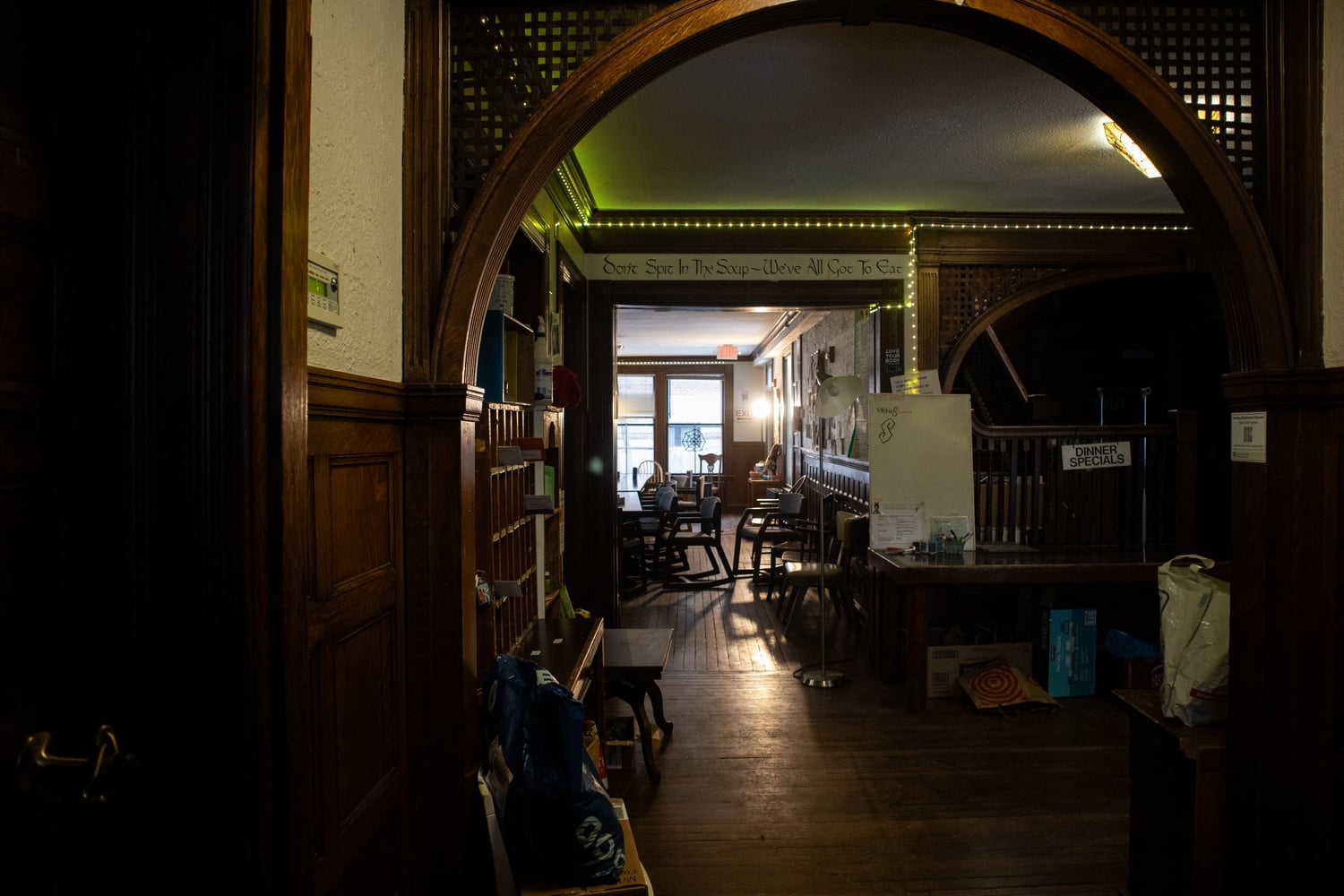
It’s almost 6:30 p.m. when Dudley residents gather each evening to eat together. Co-opers are responsible for cooking their own food, cleaning the house, and maintaining the grounds. They tend to a garden in the backyard and shop for groceries, managing their own budget throughout the year based on the menu they set at the start of the semester.
Over dinner — chickpeas, sweet potato fries, hummus, and green goddess salad — students come in and out of the building. Some of them eat and leave fast, others pack food in Dudley’s to-go containers, and a few sit around the table with time to chat. Most stop by with a greeting, and the experience feels as much as being at a family dinner table. They offer me a seat and ask if I’d like a plate of food. Any College student, they explain, is welcome to join the Co-op’s dinners each night.
Harvard’s housing system is a perennial topic of conversation among all College students. Debates over the best house never quite end: the river versus the Quad, Quincy’s hot breakfasts, and of course, the dorm-storm spirit of Housing Day.
Both the University and its students are deeply invested in building a system aimed at supporting its students within the house system. Proctors, house deans, and resident tutors aim to provide pre-professional and social support for students, while House Committees are tasked with cultivating house spirit. The promise of the housing system, then, is that students will find connection and transformation through these structures.
But for some students, that sense of belonging emerges elsewhere. “I think it’s really good that Harvard has a strong housing community,” Barbara Sheehan ’27 says. “I think that it is really good for a college to have that sort of culture.”
Still, they recognize that the system does not fit everyone. For Sheehan, living in the Dudley Co-op has offered a different model of residential life. “I feel like it’s nice that we also have something that offers a little bit of a different vibe.”
The Origins of Dudley House
Established in 1930 by President Abbott Lowell, Harvard’s housing system was closely modeled off of the college systems at Oxford University and Cambridge University and meant to foster greater community.
In a 1904 essay, “Dormitories and College Life,” Lowell argued that Harvard’s residential life was lacking.
“If we do not altogether succeed in making college what it should be,” he wrote, “there is surely another cause: and that is the defective community life.”
The new housing system, he believed, would bring students from different socioeconomic backgrounds together, fostering both social connection and intellectual exchange.
Yet even after the system's creation, many students continued to live off campus. In the 1950s and 60s, more than 14 percent of students were commuters, traveling to campus by bus or subway to college and often packing their own meals for the journey.
Dudley House emerged partly to serve this population. It provides a physical space where off-campus students could gather and build community.
The Co-op was founded in 1958 by students seeking to reduce their cost of living. Today, living in the Co-op still costs significantly less than living within Harvard’s traditional housing system. In 2026, Harvard’s housing rate is nearly $14,000 and food costs roughly $9,000. Students who live in Dudley say they pay about 20-30 percent less than the full cost of housing and dining.
Because students cook their own food and collectively manage grocery costs, dining expenses are much lower. For students on full financial aid, living in Dudley allows them to allocate any leftover tuition after housing and dining costs for their own spending.
Like the rest of Harvard in 1958, the Co-op was originally all men. The first set of residents saved costs by doing their own cleaning and maintenance, but would hire female students from Radcliffe College to cook their dinner.
Today, the Dudley Co-Op keeps its place on Sacramento Street, while the Dudley Community has a space to gather on the third floor of Sever.
Dudley House Today
Amber Simons ’26 joined the Co-op last semester in her senior fall. They say that it is the closest they have ever felt to being a community. Beyond traditions like Housing Day and River Run, Simons found the nature of the housing system physically disjointed — having one friend who lived in one location and someone in another. Even in Harvard’s traditional housing system, they had to go out of their way to build community: “The community that I had was just community that I built for myself and wasn't a product of the culture of the housing system,” they say.
“I actually know everybody who lives here. I actually can sit down and have a conversation with, genuinely, anybody who lives here,” they say. “It builds community in a different way.”
We’re interrupted briefly by a laugh at the table. “Sorry, we’re making fun of David,” Rawal says.
Sitting around the large wooden table in Dudley’s dining room, it’s easy to see how these connections form. My conversation with the co-opers is punctuated by jokes about whales, a Nutella stash, the local neighborhood cat, and references to the posters and drawings that have accumulated on the Dudley walls over the years.
For the Co-opers, being in such a space means mastering skills that are essential for most in post-grad life. “College is also your life. And I think that that’s an ethos that’s very much here, and gets lost in some of the culture around the rest of university,” Addason R. Harris ’26 says. “I really believe that part of it is just being in an environment where you have real responsibilities and real accountability to other people.”
The Co-op has a points system for chores. Throughout the week, a task like washing the dishes or mopping the floor will add up to a student’s cumulative points, which count as their contribution to the residential community. These collective chores are also part of why the Co-op’s cost of housing and rent are significantly less than living in one of the 12 residential houses.
Olivia G. Pasquerella ’26, a Crimson Magazine writer, says that Harvard’s housing system removes many everyday burdens from students’ lives. “If you’re able to optimize in the houses, it’s always at someone else’s expense, right? You don’t make your plate of food. Harvard doesn’t even ask you to separate paper trash from food trash the way that other schools do before you put your plate on a conveyor belt and it gets taken away.”
At Dudley, those tasks fall to residents themselves. But the labor, they say, also strengthens their sense of camaraderie.
“We do spend more time at this place doing labor. We share chores and all of that stuff, but it's like we're taking care of each other. And I think that's a really beautiful thing,” they add.
The sentiment seems to have endured across generations of Co-op residents. A 2008 Crimson article celebrating the 50th anniversary of the Dudley Co-op featured a bold headline: “Take a Chill Pill.”
Residents quoted in the piece said that Co-opers didn’t share the “sense of jumping to the next thing right away,” referencing the intense career ambitions that often shape Harvard culture.
“There’s a lot of priorities put around wanting to better your community and having direct impacts in the world around you. Even if that doesn't mean you’re making $200,000 or some absurd amount of money, respectfully, per year,” Sheehan says. “It’s in the same way that we do for one another, to keep each other afloat and to take care of one another.”
At this point, an hour into our conversation, most co-opers have finished eating. Those who are assigned to dish duty have finished washing and drying the plates and cups. A few of them have sidled into a study nook in the corner, chatting as they work on senior theses and problem sets.
When I head out, they wave goodbye — and invite me to come back another time.
Or even to consider moving in.
—Associate Magazine Editor Claire Jiang can be reached at [email protected].