
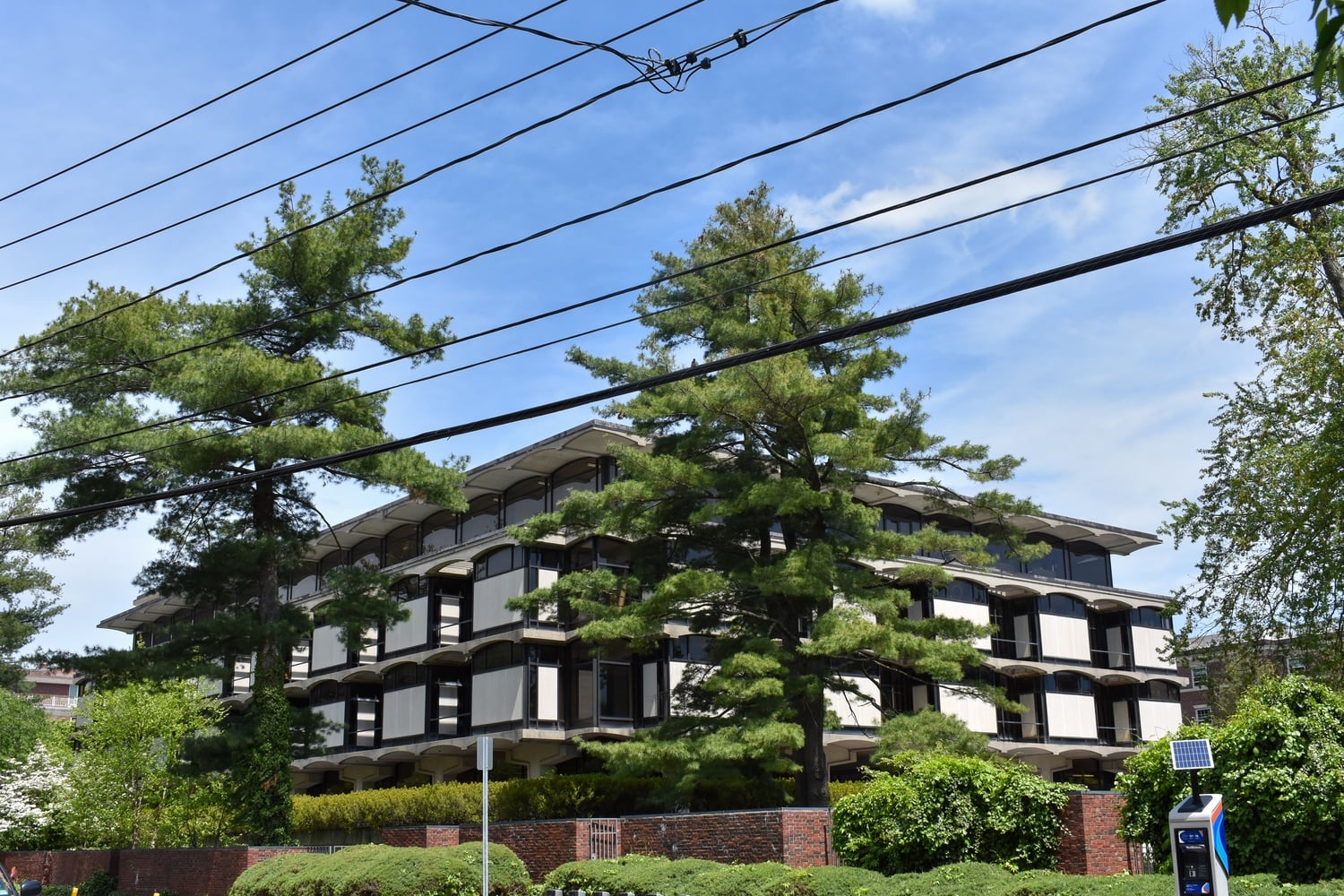
As Student Groups Move Out of the SOCH, Latinx Organizations Work to Preserve Decades of History
Fatima C. Mendoza ’26 and Lucia C. Lopez ’28 were among the student leaders from Latinx organizations who made a joint effort to clear out their designated room of the SOCH. From 1 p.m. to 3 p.m. on March 6, they moved decades of student group history.
n early February, Fatima C. Mendoza ’26, the co-chair of Concilio Latino de Harvard, was informed by a board member of an email from Dean of Students Thomas G. Dunne. Dozens of student organizations were being ordered to evacuate their offices on the third floor of the Student Organization Center at Hilles, including many recognized Latinx student organizations, who had been keeping their supplies in a large storage closet.
The announcement of the SOCH move out occurs amid a $365 million budget deficit for Harvard’s Faculty of Arts and Sciences. According to Dean of Students Thomas G. Dunne, the moveouts are part of broader efforts to identify cost-saving opportunities.
Mendoza and Concilio’s historian, Lucia C. Lopez ’28, were among the student leaders from Latinx organizations who made a joint effort to clear out their designated room of the SOCH. From 1 p.m. to 3 p.m. on March 6, they moved decades of student group history.
Carefully, they stacked their pre-packaged boxes and slowly wheeled them from the SOCH to the Ethnicity, Migration, Rights offices on Mass Ave. According to Lopez, the 24-minute walk ended up taking an hour, as they followed extra precautions to make sure nothing fell or was unloaded.
Lopez describes the timeline as “tight.” She and Mendoza were responsible for finding a temporary location for the group’s historical documents, organizing their inventory, and coordinating with other organizations.
Lopez says the SOCH moveouts have accelerated Concilio’s archival work, prompting the group to sort through documents more quickly and consolidate the rest of their materials.
Concilio worked quickly to comply with the DSO’s mid-March deadline while continuing to document Latinx student group history through a revived archival initiative called La Vida.
Because they were working with other organizations’ materials, Lopez struggled to coordinate with different storage providers who wanted to know their inventory more clearly. “We were mostly guesstimating what our inventory would be until about a week ago,” Lopez says, describing back and forths with providers and other Latinx groups.
Lopez says that it started raining during the move out, but no materials were damaged. “I feel like, always with these types of things, there’s always something that happens,” she says. “I’m happy to report everything made it over safely,” she adds, saying she was excited that the archives had finally been established.
The Origins of La Vida
Mendoza and Abbeny B. Solis ’25, a former co-chair of Concilio, had discovered two editions of a guidebook for Harvard Latinx culture titled “La Vida at Harvard,” according to Mendoza. The guide shared recommended courses, local restaurants, study abroad opportunities, and Spanish slang for Latinx students. Inspired by the work and drawing on their own background with historical research, the two hoped to revive the documentation efforts.
Since spring 2025, members of Concilio have made efforts to connect with Latinx history at Harvard, including partnering with the Harvard Art Museum and running an archive workshop at Schlesinger Library.
In August, Mendoza onboarded Lopez as the club’s historian, and Lopez began emailing Latinx organizations to ask them to join their archive initiative. They named the initiative La Vida, an homage to the original guidebook.
Over the past few months, Lopez has been working with Concilio, the Cuban-American Undergraduate Student Association, the Caribbean Club, Candela, Fuerza Latina, Latinas Unidas, and Harvard Radcliffe RAZA on both the SOCH clean out and the La Vida initiative.
For Melina Fonseca ’27, co-president of RAZA, working with La Vida and its archival work came just in time. She says the SOCH move-outs gave her the push to further document RAZA’s history.
In a statement to The Crimson, College spokesperson Jonathan Palumbo wrote that the DSO “remains committed to the expectation that all groups which currently have office space in Hilles will be provided with some degree of storage option elsewhere in the building.”
“Further, the DSO is in touch with student organization leaders to coordinate logistics regarding packing and moving stored materials after an initial round of cleaning,” he added.
For now, RAZA’s items, from historical documents to Day of the Dead facepaint, have — like Concilio — found a temporary home with the Ethnicity, Migration, Rights department, though club leaders say they still need to find a new storage plan for next semester.
Some student group leaders described the move out process as difficult and frustrating. Michelle I. Jean-Louis ’26, president of the Harvard Caribbean Club, called the move out a “nightmare.” She says Harvard did not communicate directly with the club or provide an alternative storage space, as the group had accessed the SOCH space through Concilio rather than through a direct arrangement with the College.
Jean-Louis is planning on bringing the Caribbean Club supplies to her dorm room until the group can find permanent space, potentially outside of Harvard’s campus. Though the Caribbean Club was invited to join the archival effort, most of its historical records are already online. Still, Jean-Louis says that if it wasn’t for La Vida’s invitation to join the archives, she might have missed the notice about the SOCH cleanouts.
“The Dean of Students Office (DSO) has communicated directly with recognized student organizations impacted by the recently announced changes to the current student organization offices in the Hilles building,” Palumbo wrote.
Digging into Discovery
For members of Concilio and other Latinx student organizations, spending time in the SOCH and sorting through documents has led to historical discoveries about the presence and work of their clubs in the past few decades.
“There were just so many initiatives that I never really knew existed because these materials were in the closet, but people weren’t really engaging with them,” Mendoza says.
She found documents and letters referencing conferences hosted by students across various colleges, as well as a letter signed by the past Chairman of the Migrant Farm Worker Committee to RAZA, dated March 20, 1992.
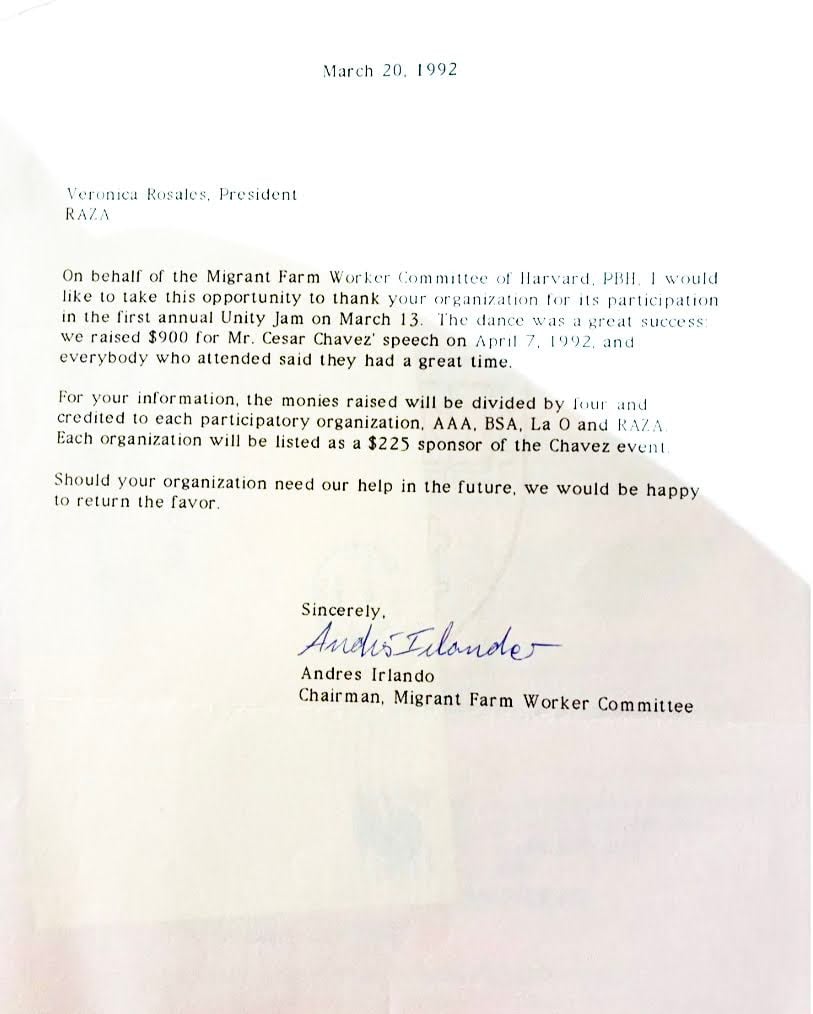
The letter thanks RAZA for participating in the “first annual Unity Jam,” which raised $900 to support a speech given by Cesar Chavez, a leader of the farmworkers rights movement, in 1992.
“Should your organization need our help in the future, we would be happy to return the favor,” Chairman Andres Irlando concludes in the letter.
For Mendoza, a History concentrator, the archival work with “La Vida” holds a deeper significance.
“I was thinking a lot about Latina presence on campus, and how we sort of start to preserve that and document that in a way that’s a little bit more organized — but also in a way that gets people involved, because I think it’s important for communities to document themselves,” she says.
Still, she says that the progress made on the initiative is significant: “It’s come a really long way in a very short time.”
Mendoza says that she was not expecting to find so much evidence of strong, structural organization in the documents. “I remember being surprised that Latino organizing was so prevalent on campus, because I just hadn’t seen any record of that,” she says.
In particular, Mendoza says it is interesting to learn about Harvard Latinx engagement across the country and solidarity among Latin American groups across universities.
“To think that there were student groups that had entire frameworks for doing this across the country, I think it would be a really great reference for us to think about more closely,” Mendoza says.
Through the process, Lopez is also finding “lost organizations.”
“We’re still finding some that we just had no idea existed, or they morphed from graduate school to undergrad, or the latter, the other way around,” Lopez says. “It’s kind of like a puzzle — you have a bunch of different random pieces and photos, and we’re trying to know roughly what is going on.”
The majority of the Latinx artifacts discovered during SOCH cleanouts are from RAZA, Fuerza Latino, and Concilio. Lopez describes Concilio’s archives as more focused on correspondence and alumni, while RAZA’s and Fuerza’s document “vida contiliana”— the “everyday life” of being Latino.
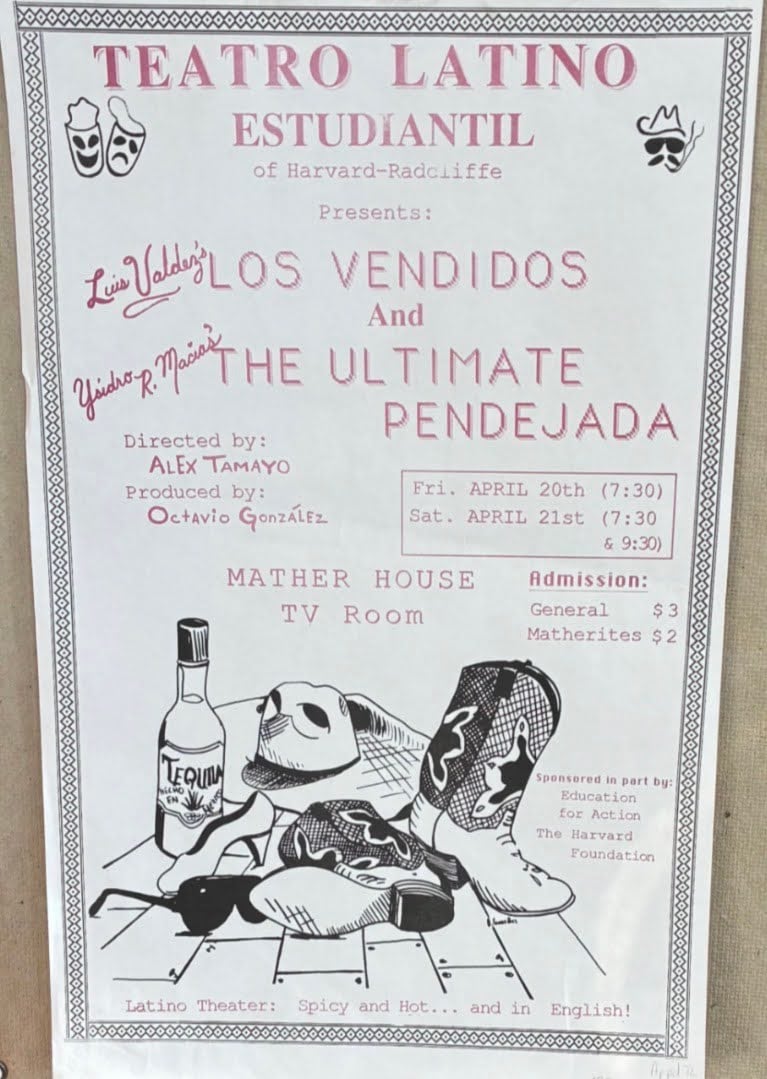
Lopez found a poster from 1990 advertising a show presented by a lost organization called “Teatro Latino Estudiantil of Harvard Radcliffe.” The poster advertised productions of Luis Valdez’s “Los Vendidos” and Ysidro R. Macias’ “The Ultimate Pendejada,” which took place in the Mather House’s then-TV Room. The caption reads “Latino Theater: Spicy and Hot… and in English!”
Lopez says that the club poster is going to be featured in Concilio’s “Lost Organizations and Conferences” exhibition they hope to host later in the spring.
Correction: March 22, 2026
A previous version of this article misspelled “Feurza” as “Feurtas.” In fact, the correct spelling is “Feurza.” It also referred to “Latinas Unidas” as “Latinas Unitas.” In fact, the correct phrase is “Latinas Unidas.”
—Staff writer Alexa M. Schmitt can be reached at [email protected] or Signal at alexaschmitt.15. Follow her on X @alexa_m15_s.