
Harvard During World War II: A War Archivist’s Story of the University’s Bygone Era
Charged with documenting Harvard during World War II, Sterling Dow conducted laboratory visits, interviewed researchers, corresponded with faculty who had served in the war, and compiled extensive records detailing shifts in University policy and programming.
n a 1946 report addressed to Robert A. Lovett — then a custodian at the Office of the War Archives and later the United States’ fourth Secretary of Defense — Harvard University War Archivist Sterling Dow laid out his work.
“The principal objective was to gather data for any type of future history of Harvard during World War II; and for whatever other uses the University might choose to make of such material,” he wrote, noting that the project began in 1944, when University President James B. Conant, class of 1914, called for a comprehensive record of Harvard’s wartime history.
Dow, a professor of History, Classics, and Archaeology at Harvard, was an acclaimed scholar. He was particularly known for his work in epigraphy, including developing techniques to create portable replicas — or “squeezes” — of Ancient Greek stone inscriptions.
During World War II, however, Dow worked in Cairo, Egypt with the Office of Strategic Services, a national intelligence center and precursor to the Central Intelligence Agency established in 1942. Upon his return to Harvard, he was approached by Conant and appointed to the War Archivist role.
Under Conant’s leadership, Harvard had transformed into a hub of defense research, military training, and weapons development.
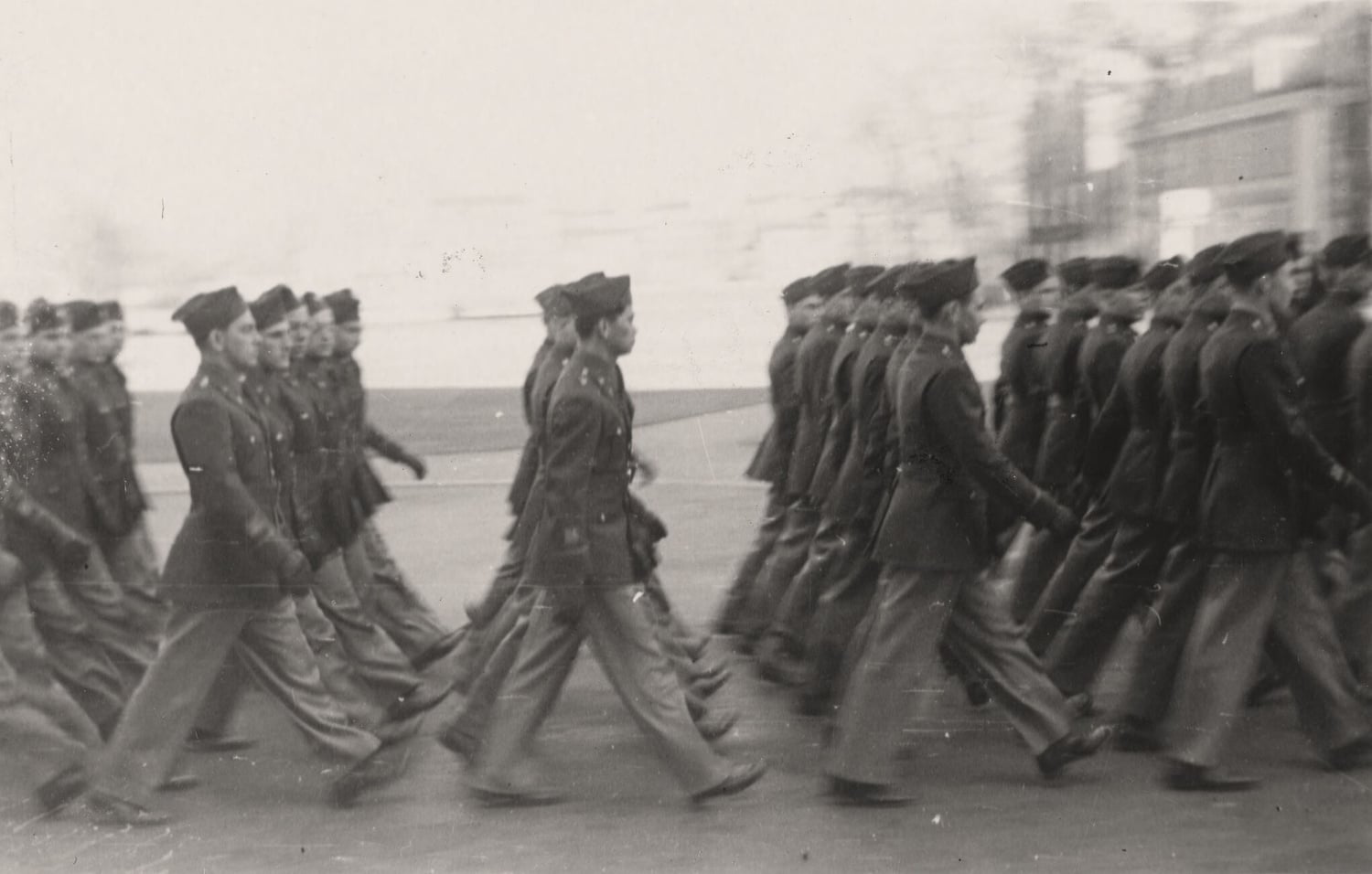
As students and faculty left campus for military service, Conant established 13 Army-Navy service schools at Harvard, training roughly 60,000 military personnel on campus over the course of the war.
The University adopted a trimester system to accommodate a summer term for training, conducted drills in Harvard Yard and Memorial Hall, and added courses on meteorology, aerial mapping, geology, and radio electronics detection — all of which had direct military implications. By June 1943, The Crimson reported that Harvard Business School had been “completely converted into an Army-Navy establishment.”
Scientific research constituted another major component of Harvard’s wartime contributions. From the University’s first war research laboratory, the Electric-Acoustic Lab — established in the wake of Pearl Harbor — to the $16 million Radio Research Lab, formed in 1942, approximately 80 laboratories developed tools and medicines in service of the war effort. Devices developed in the Radio Research Lab alone saved 4,500 lives, The Crimson reported in 1946. Faculty members also played significant roles in the Manhattan Project and the invention of napalm.
Conant himself, a chemist before becoming University President, chaired the National Research Defense Commission, which coordinated civilian scientific research for the war. He spent substantial time in Washington D.C., working closely with federal officials while continuing to oversee the University.
“Our war effort was not remarkable for the enormous size of any one job, but rather for the extraordinary diversity and number of jobs undertaken,” Dow told The Crimson.
“There are more men in uniform than in mufti,” Time magazine wrote in a 1942 article. “Latin, Greek and philosophy are in the doghouse.” The Crimson, similarly, dubbed Harvard an “Annapolis on the Charles,” pointing to the sweeping changes reshaping campus life.
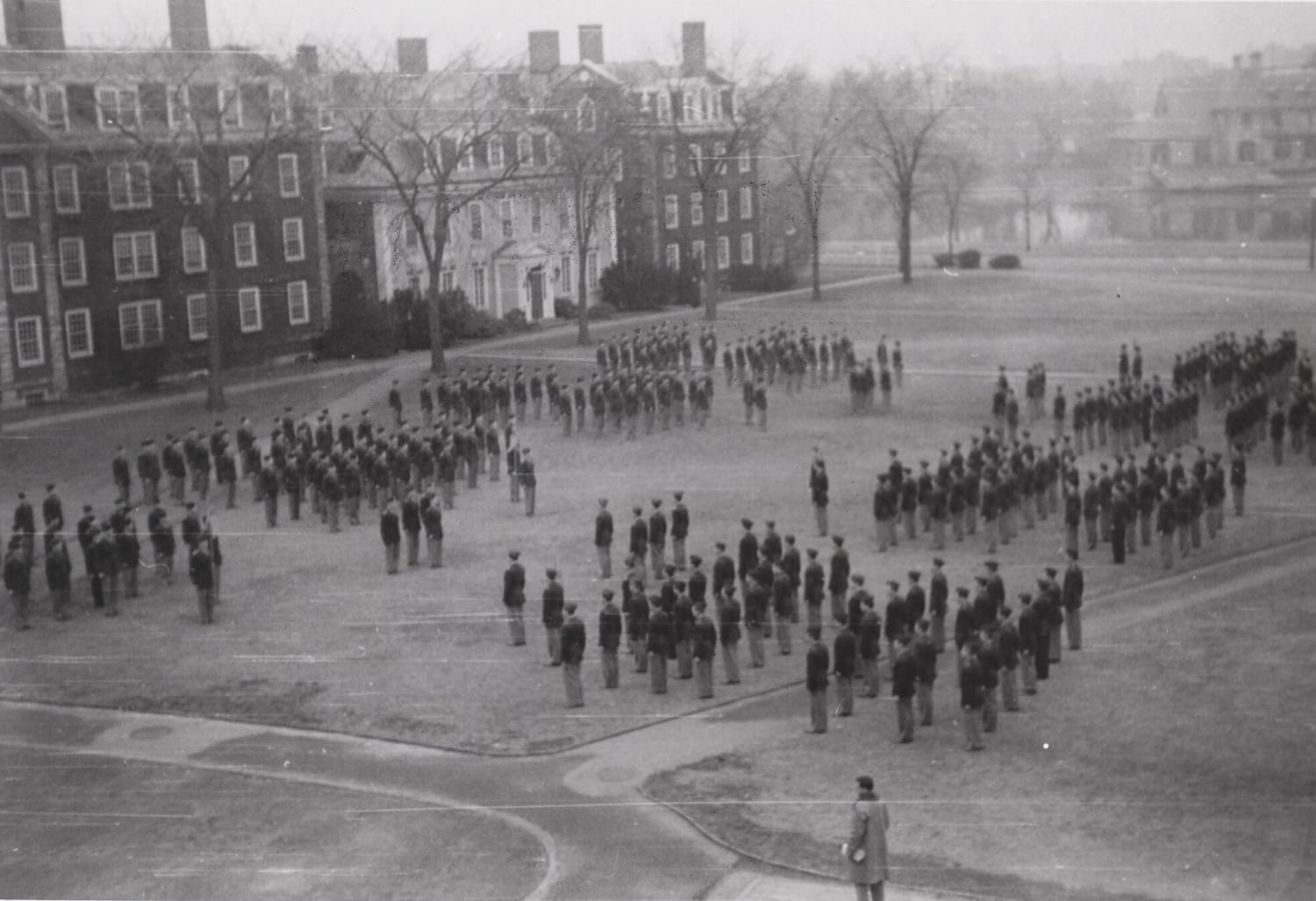
Charged with documenting Harvard’s war effort for “the first half of 1945,” Dow conducted laboratory visits, interviewed researchers, corresponded with faculty who had served in the war, and compiled extensive records detailing shifts in University policy and programming.
His archival work was also forward-looking.
“It may be pointed out incidentally that in the event of another war, these papers would form a convenient first point of reference for University preparation,” Dow wrote in the 1946 report describing his archives.
But in the decades since World War II, Harvard has not mobilized on a comparable scale for any subsequent military conflict to date. Recently, the University’s relationship with the Department of Defense has become increasingly fraught.
In February, Secretary of War Pete B. Hegseth announced that the Department of Defense would cease funding support for active-duty military personnel pursuing graduate studies at Harvard. Last year, the Department of Defense also halted certain research grants to the University as part of the Trump administration’s broader reduction of more than $2 billion in federal research funding.
The shift stands in stark contrast to an era when soldiers-in-training drilled in Harvard Yard and the University’s president divided his time between Cambridge and Washington.
As Harvard recalibrates its relationship with the federal government, Dow’s words in his 1946 report resonate anew. Harvard has “opposed the forces which then began openly to threaten the lives of all Universities, and ultimately the very life of free civilization,” he wrote at the time.
In an April 2025 statement to University affiliates announcing that Harvard would challenge demands from the Trump administration, University President Alan M. Garber ’76 framed Harvard’s stance in similar terms, writing that “the fearless and unfettered pursuit of truth liberates humanity — and with faith in the enduring promise that America’s colleges and universities hold for our country and our world.”
— Magazine writer Maahi A. Bose can be reached at [email protected] or on Signal at @maahibose.36. Follow her on X @BoseMaahi.