
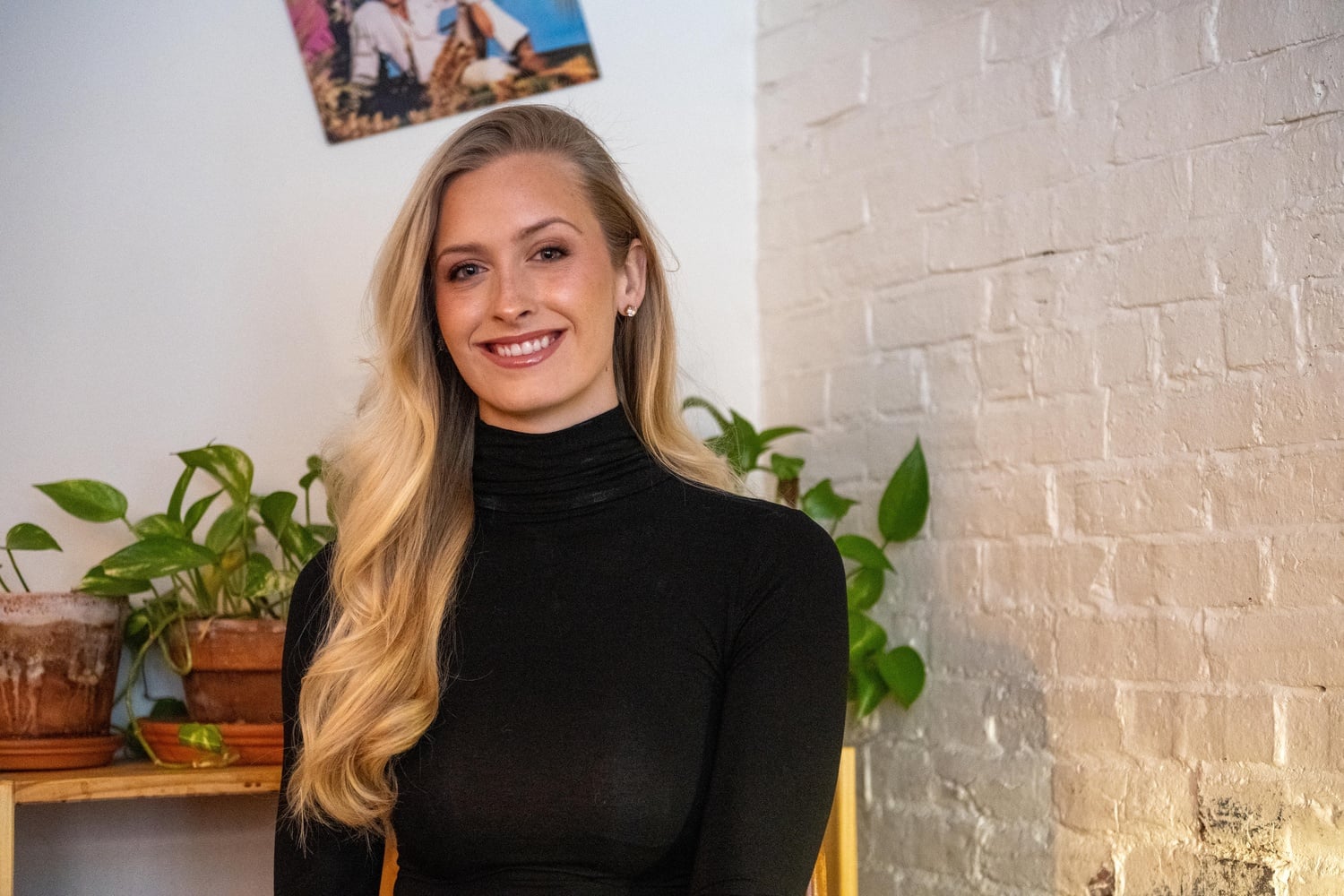
Letting Go of Mars: Madison Marsh’s Path in Service
Marsh’s life now — from winning Miss America in 2024, to serving in the United States Air Force, to enrolling as a graduate student at the Harvard Kennedy School — is far from what she ever imagined. And while grappling with ever changing dreams and passions hasn’t been easy, Marsh is certain that life will always “pan out the way that it’s supposed to.”
rom the very beginning, Madison Marsh Morris had a plan — or rather, a dozen. She imagined herself as an archaeologist, a scientist, an astronaut, and even a marine biologist studying animal behavior.
Marsh’s life now — from winning Miss America in 2024, to serving in the United States Air Force, to enrolling as a graduate student at the Harvard Kennedy School — is far from what she ever imagined. And while grappling with ever changing dreams and passions hasn’t been easy, Marsh is certain that life will always “pan out the way that it’s supposed to.”
***
At a marine biology camp in eighth grade, Marsh discovered her passion for space.
During an overnight sail across the ocean she says she saw the stars without pollution for the first time.
“It was so incredible that I was like, ‘Maybe I want to study space instead,’” she says.
A new dream of becoming an astronaut took root, and soon became a detailed 20-year road map: first stop, the Air Force Academy, final stop, Mars. For the next four years, she worked relentlessly towards chasing her dream. By her sophomore year of high school, she was in the air and earning her private pilot’s license.
Then, in her junior year, tragedy struck. Her mother Whitney was diagnosed with pancreatic cancer. To cope with the grief and uncertainty that followed, she held tight to her passion for flying.
“Being able to fly gave me kind of a space away from everything else in the world,” Marsh says.
Flying helped her reach her first pitstop. The night before her mother’s passing, Marsh found out that she had been accepted into the United States Air Force Academy.
“I truly think USAFA was one of the most transformative places of my life,” Marsh says.
Eight months later, Marsh found herself in the six-week Basic Cadet Training. With its rigid environment and exacting standards, it tested her limits. The environment stripped away distractions she had been relying on to navigate her grief. There were countless moments when quitting seemed easy, when surviving felt impossible.
“You lost what you believe is your individuality because you’re having to wear a uniform all the time,” she says reflecting on her freshman year.
Yet, through the struggle, Marsh found valuable anchors in camaraderie and invaluable mentors. With their support, she found herself falling in love with the academy.
“I think it stands as a testament to embrace your hardship, embrace the bad stuff in your life with good people alongside you, leaning in and struggling with people that you care about,” she reflects.
It was during this first year that Marsh met Monte Anderson, an assistant professor of physics and meteorology. On the first day of class, she approached him with her 20-year plan of becoming an astronaut. At the time, she was an astronautical engineering major, but that day, Anderson advised her to study physics instead— the degree that she would go on to graduate with.
In her senior year at the academy, Marsh received a pilot slot in the U.S. Air Force — a milestone that she had long envisioned. But it forced her to recognize a difficult truth: the dream that she had so tightly clung to might have become one she had outgrown.
“It wasn’t something in my heart that I knew I wanted,” Marsh says.
Letting go of the plan was more complicated than simply choosing a different career. One of the last things Marsh had told her mother was that she would become an astronaut. Stepping away from a part of her identity linked so intimately to someone she loved felt like leaving a piece of herself behind. Marsh’s loved ones reassured her that her mother would only wish for her to be happy, helping her make the difficult decision to relinquish the slot.
Breaking the news to Anderson was another challenge.
“I felt like he had poured in so much to me,” Marsh says. “He was someone that had helped me all along the way — getting to Harvard, every scholarship that I’ve ever received. He was always one of the people that was front row.”
Further complicating Marsh’s feelings, Anderson had gifted her a pair of special pilot wings — the very first that Anderson’s mother had pinned to his own chest when he had first joined the Air Force as an aviator.
But when she finally told him her dreams had changed, Marsh was only relieved. “I didn’t give you the wings because I wanted you to be a pilot,” Marsh says Anderson told her. “It was just about being able to do something difficult.”
Marsh has found a new passion in cancer policy, and applied to HKS, where she now attends. She received the Truman Scholarship in 2022, and later won Miss America two years later.
When asked about the highlights from competing for Miss America, Marsh doesn’t point to the flashing lights or the crystal crowns. It was the people she met and the connections she made that left the deepest impression.
Strangers approached her in coffee shops, sharing how her platform inspired them. Marsh used the platform to encourage others to pursue a life in service — whether that was in the United States Air Force or just by giving back to their communities.
“I can serve in and out of the crown,” she says, “and truly live a life in pursuit of serving others.”
After one appearance, a woman approached Marsh and told her that she attended high school with Marsh’s mother. She shared stories and memories with Marsh about her mother that Marsh had never known before.
In hindsight, Marsh believes that her manifold experiences have led her down the right, if winding, path. Had she pursued the life she once envisioned as an astronaut headed for Mars, she thinks it may have kept her away from her family and separated her from her core values and interests, including advocacy work.
Following her mom’s passing, the 17-year-old Marsh and her family started the Whitney Marsh Foundation. What started as a small non-profit has since grown to a team of over 20 year-round volunteers.
Wanting to rally people around her mother’s passion for running, Marsh created Whitney’s Race — an avenue that transformed her personal loss into collective action. The organization hosts an annual 5K and 10K, raising hundreds of thousands of dollars for hospitals to ease the financial burden faced by cancer patients. The foundation also recently established the MD Anderson Grant, which offers funding to cover non-medical expenses so that families don’t have to face decisions between survival and receiving quality care.
Ultimately, she hopes that the Whitney Marsh Foundation can provide lasting hope and support to families facing the same hardship hers did years ago.
Now, coming full circle, she hopes to provide support and enact change from the legislative side through her cancer policy research. She’s traveled to study different healthcare systems, from major cancer centers in Colorado to hospitals in Germany, to examine how different countries approach treatment, access, and patient support. Her policy analysis exercise, the culmination of her HKS studies, is focused on access to pancreatic care.
When asked whether she ever imagined herself in this position, Marsh takes a long pause before answering. “I knew that I was going to work — I was going to will it into reality,” she says. “In terms of actually, in my heart, believing that I could do some of these things? No.”
Perhaps the greatest change through all the shifts in her ambitions and dreams has been learning how to avoid being consumed by a 20-year plan.“I know now I need to just do what I can best today and be open to what new opportunities and change is going to come later on down the road.”
— Magazine writer Anne Sun can be reached at [email protected].