
No Grades, Just ‘Profound Discussion’: The Humanities Reading Group
Formed in response to students’ desire for an intellectually stimulating space to probe texts in the humanities without the pressures of comparative metrics such as grades, the new Humanities Reading Group platforms student-led conversation.
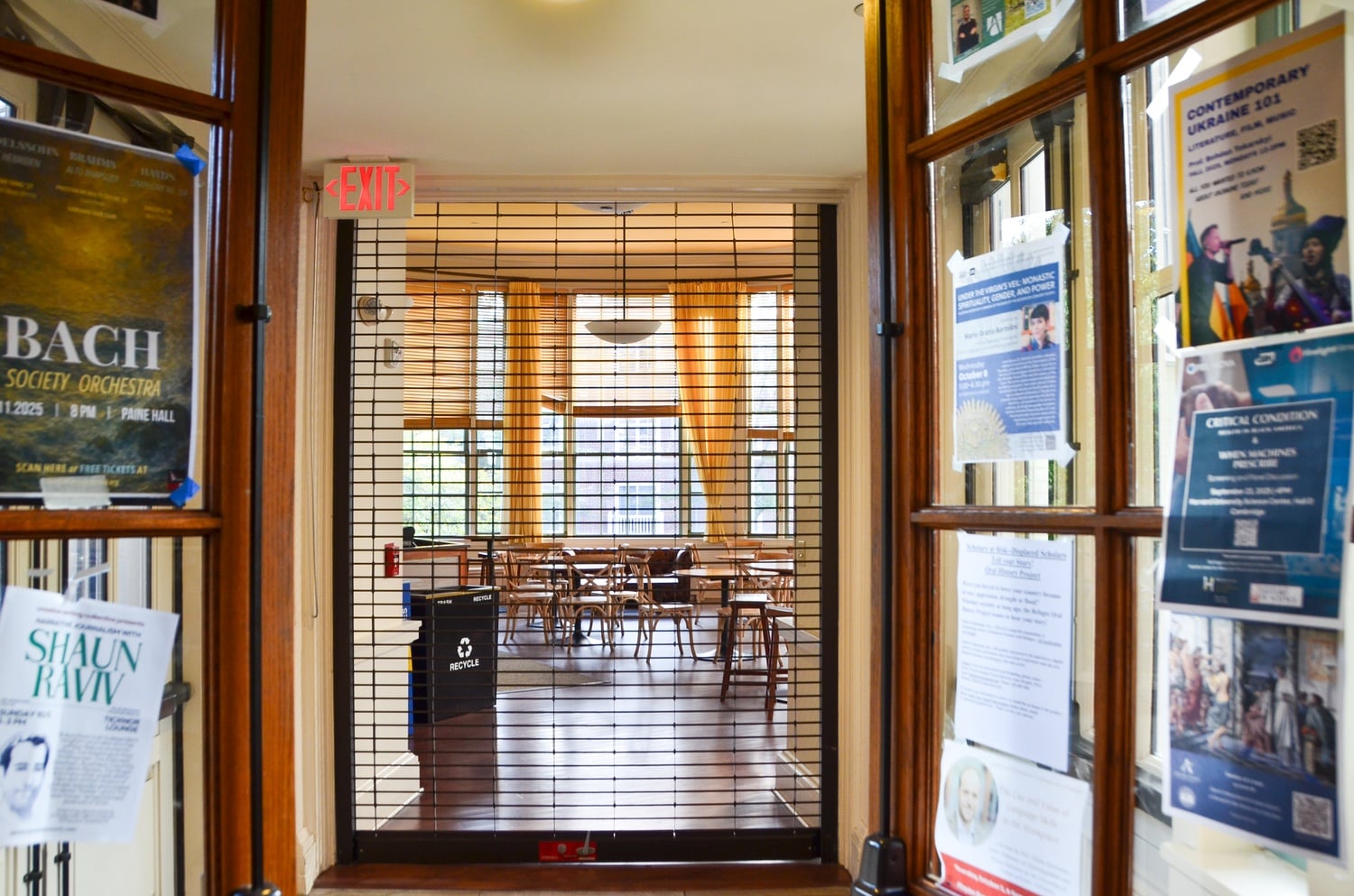
n Thursday evenings, students and faculty bring new life to the Barker Center Cafe. There, relics of the former student hotspot — an empty cashier’s box and shelves that once held almond croissants — are the only constants besides the butter yellow walls. As I enter the rotunda, my attention pivots to a collection of small round tables pushed to the center of the room, surrounded by students chattering amongst themselves.
These students form the Humanities Reading Group, a forum for undergraduates, graduates, and faculty devoted to careful reading of difficult texts.
Formed in response to students’ calls for an intellectually stimulating space to probe texts in the humanities without the pressure of grades, the new group platforms student-led conversation. HRG offers a community free of the typical hierarchical classroom structure, granting students a discussion environment where they have autonomy.
Assistant professor of Government Shterna S. Friedman, whom I speak to after the meeting, says she sees the HRG as a “more egalitarian” space. She corrects me when I refer to her as the group’s leader.
A former fiction author, Friedman discovered her own passion for political theory through a one-on-one reading group with a friend. A philosophy major at the time, she says it was “very exciting” to read theory together.
When students approached her looking for a space to engage with philosophical inquiry, she and other faculty members and students worked to set the reading group in motion.
Among those students is Andrés Muedano ’27, who became HRG’s student coordinator through his work on the Arts and Humanities Student Advisory Board. On the board, he works with Dean of Arts and Humanities and philosophy professor Sean D. Kelly on campus initiatives that enrich student engagement with the humanities.
Muedano, a Crimson Editorial editor, hopes the group can offer elements of a Nunninan educational model on campus — a pedagogy celebrating self-directed learning and centering what he calls “epistemic humility.” The model traces its roots to Deep Springs College, a small two-year liberal arts school enrolling under 30 students near California’s White Mountains.
“The pedagogical structure is much more horizontal, so everyone is approaching the text with greater curiosity,” Muedano says. “I think confusion is much more central to the pedagogical experience, and so people allow themselves to be confused, and that confusion makes for greater conversations than what you’ll usually have at your regular Harvard seminar,” he adds.
Sofia E. Mikulasek ’27 came to HRG looking for something similar. She joined the group at the recommendation of a close friend and recent college graduate. Mikulaseck transferred to Harvard after spending two years at Deep Springs.
“I think I’m here because the open source seminar — where professors are less of an authority than they are either in lecture or what Harvard calls a seminar — is a model of education that I experienced for my first years of undergrad,” Mikulsak says. “It’s something that I really missed.”
Taking a seat beside Friedman, I open the night’s selected reading: the second elegy of Rilke’s Duino Elegies (they read the first the week prior). Printed photocopies of the text — the original German on the left,English translation on the right — were provided to attendees. Nine of us, including Friedman, begin reading stanza by stanza, attendees interjecting on the unfolding pages. Behind student voices, the persistent hum of ambient noise fades away.
Takenoshin Yaza ’26, a Philosophy and Art, Film, and Visual Studies concentrator, is among the students joining me at tonight’s session. We talk about intellectual vitality in the group: even without grades, profound discussion unfolds.
“We don’t have any assignments, and there’s no grades here. But still, we see that everyone is very much committed to this text and committed to trying to get as much as possible,” he says. “I think that tells us already that simply having more strict guidelines for how to grade people or having more homework is not really going to change the way we approach the subject.”
Undergraduates are not the only ones drawn to the group. There are also academics and students from different schools at Harvard. Yicheng He, a first year masters student at the T.H. Chan School of Public Health, says he learned about HRG while auditing a course taught by history professor Peter E. Gordon. He says he sees the group as a living practice of the intellectual vitality Harvard says it aspires to.
“Vitality comes from original human experiences and diversity of those experiences, and especially for vitality of humanities,” he tells me. “If we want to rely on humanity, we’ll have to go back to humans, right? So we need a space where we can share more.”
Yaza, He, and I all take turns reading that night. We read sequentially, each person leaning into the pages, periodically underlining, circling, and annotating the text. I notice an abundance of black and blue G2 pens. One participant has a green, cylindrical pencil case; he rotates between pen and yellow highlighter, flagging passages he presumably finds resonant.
Muedano and Friedman, who both know German, discuss interpretive differences between the original and translated versions.
The earnestness in the room is palpable. The conversation is self-directed and unhurried, devoted to a text that might otherwise be skimmed before a discussion section or lecture.
But the intentionality of their reading doesn’t mean the conversation is all somber. Together, we encounter moments when the entire room erupts into laughter, one time over whether “theirs” referred to the lovers or the attic figures featured in the poem.
Muedano, for one, stresses the difference between earnest commitment and traditional understandings of “rigor.”
“I think if we maintain that the seminar ought to be rigorous, then we instill a framework of rigidity that hinders the possibility of more playful or novel ways of thinking around the text,” Muedano says.
Rory O’Connor, another HRG attendee, interjects at this point, borrowing from the “great American philosopher John Dewey.”
“Education is always, or at least ought to be, in my opinion, collaborative and democratic and open-ended,” he says.
To have a space to share ideas, engage with education, and teach others, O’Connor says, “is a real gift.”
Correction: March 8, 2026
A previous version of this article misquoted Muedano as saying seminars can instill a “framework of fragility.” In fact, Muedano said seminars can instill a “framework of rigidity.”
—Magazine writer Adedoyin Adebayo can be reached at [email protected].