
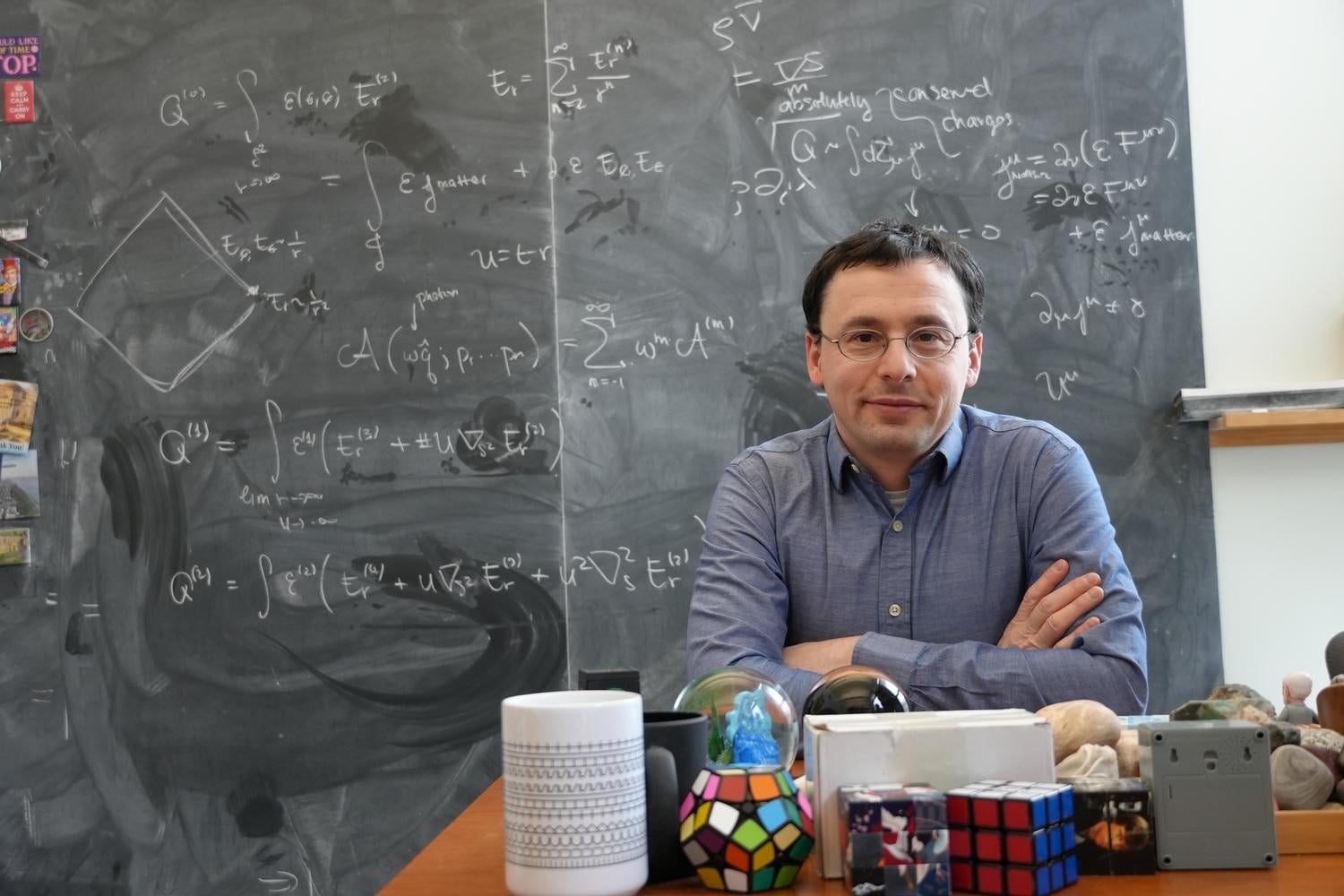
Fifteen Questions: Jacob Barandes on Quantum Theory, Teaching, and Oppenheimer
The physics senior preceptor sat down with Fifteen Minutes to discuss New York City, interdisciplinarity, and the origins of math.
Jacob A. Barandes is a senior preceptor in physics and associated faculty in philosophy. This interview has been edited for length and clarity.
FM: You’re from New York, and you’ve since moved to Boston. What do you miss most about New York?
JAB: What I miss the most is the American Museum of Natural History. And Central Park.
I think to people who are not from New York, you may have this idea that Central Park is just a small park, or something like that, or maybe a big park, but it really isn’t. Central Park is vast. And you can get lost there. It just seems to go on forever.
FM: Is there anything you don’t miss about New York?
JAB: When I was growing up in New York, the pace of the city felt very normal to me. When I visit it now, I find myself sometimes thinking, “can’t people just chill out?”
FM: You work on the intersection of philosophy and physics, and you have categorized your work broadly into two categories: “philosophical physics” and “physical philosophy.” What is the difference between the two?
JAB: Physical philosophy is scientifically informed philosophy — broadly speaking, metaphysics and epistemology, somewhat more narrowly speaking, in philosophy of science. Physical philosophy is what I call the practice of addressing traditional questions in philosophy — usually analytic philosophy, philosophy in the analytic tradition — informed by developments, by progress made in physics.
The kinds of questions that I like to talk about and think about and write about in physical philosophy are questions about ontology. What physically exists? Laws of nature — what is it to be a law of nature? What kinds of laws of nature should we expect to find? How is it that laws of nature interact with patterns of phenomena in what we either take to be the ontology of nature or what we take to be our observations?
I’m very interested in scientifically informed questions about the philosophy of space and also the philosophy of time, among many other topics. So I would call that physical philosophy.
Philosophical physics is the use of conceptual tools from philosophy — usually analytic philosophy — to make progress on outstanding questions, usually of a fundamental or foundational nature in physics.
Philosophical physics means subjecting our best physical theories to rigorous scrutiny. Scrutiny comes from the notion of separating out garbage. That’s a bit of a harsh way to put it, but when I say rigorous scrutiny, I mean taking our best physical theories and looking at them in a very careful, precise way, looking at the definitions they use, looking at their assumptions and premises and axioms, making sure that the things that we infer from those premises and assumptions and axioms take the form of good, valid arguments, looking for gaps in those arguments, looking for hidden assumptions that need to be brought out and might be questioned, looking for inconsistencies that might have been overlooked.
Sometimes you engage in this process, and what comes out is simply better definitions of things, tighter, more reasoned arguments for things we already know. And sometimes what comes out is discovery. It’s been said that the greatest philosophical physicist or philosopher of physics in that way of the 20th Century was Albert Einstein.
If you just think about how much he accomplished by interrogating the precise meaning of an inertial reference frame, you begin to see just how powerful the set of techniques can be.
FM: We really like to think of modern medicine as apolitical and aphilosophical because there’s this real desire to make sure that science is very pure. I’m wondering if you see the same with physics, or if there’s pushback to this field in that sense.
JAB: The way I think about really good philosophy is that it’s like the people who do the planting, who seed the soil.
If the people who are planting seeds on your farm do a bad job, then your crop won’t be very good, and you will see the need for more planting very clearly. But if they do a spectacular job, it may be a very long time before you realize that you need anyone to come back and plant again, and you might forget just how important a role they’ve played.
The enormous success that physics in particular has had over the course of the 20th and into the 21st century, I think, is a manifestation of that kind of enormous harvest. I think the harvest was so bountiful that generations of physicists have forgotten why they need anyone to do any planting. I think it’s safe to say that the pace of fundamental discovery in physics has slowed down in recent decades.
I think there’s been a growing awareness among many people in physics, especially among younger generations and students, that we need to do some planting again. And there’s been a lot more interest in engaging with people who work in philosophy broadly.
FM: And what might a new philosophical seed look like?
JAB: Everybody has heard that correlation does not imply causation, so then what does imply causation?
Do we have all the right tools we need to identify causal relationships in the world: to find them, to discover them? Arguably, no. So where do we find new tools for causal discovery? Where do they come from?
FM: A lot of your physics work is involved with questions about quantum theory. For a layman audience, what are you working on now in that field, and why is it important that we understand it?
JAB: When you pick up a textbook on quantum theory, students are presented with a set of basic principles, the axioms.
Those principles feature two different ways that physical systems change with time, and these two different ways that physical systems change with time are categorically different. They’re different not only in degree but in kind. One way they change, which von Neumann called Type I evolution, is when an external observer carries out a measurement or observation of some feature of a system. And that form of evolution involves the system singling out one particular measurement outcome with a precise associated probability. The other kind of evolution, von Neumann called Type II evolution. And Type II evolution is evolution that a system undergoes when external observers are not conducting measurements or precise observations of the system, and that form of evolution doesn’t feature a singled-out measure of outcome, or a notion of probability.
What demarcates which form of evolution to use hinges on concepts like external observer and measurement that the axioms do not define. You’re supposed to just know when you have an external observer doing a measurement, the way that the Supreme Court Justice Potter Stewart once said you’re supposed to recognize an obscenity — you know an obscenity when you see it. Is it really appropriate for what purports to be a fundamental physical theory that its principles should bake in undefined, seemingly non-fundamental constructs, like external observer and measurement?
The Bell inequality, a famous and very important mathematical statement about what can be achieved with certain kinds of classical theories and which is violated by quantum theory — and it’s important to note that those violations turn out to have practical use in things like quantum cryptography, uses that might not have been predicted back when people thought these were just philosophical questions. Even things like “can a computer built on quantum principles using hardware that can access the rules of quantum theory — can such a computer do some calculations vastly more efficiently than any known classical computer?”
And so it begins as a philosophical question or an attempt to provide some kind of empirical or experimental justification for a philosophical claim motivates the idea of quantum advantage, which is the goal of quantum computing: finding ways to do things more efficiently than we think are possible with classical computers. If you just make a list of all of the spinoff discoveries that have come out of deep philosophical investigations and definitions of quantum theory, and you compare that against the vanishingly small number of people who’ve worked in that area, and you take into account how many of them were working on this stuff on the side because they couldn’t get full-time gainful employment doing it, and how many of them suffered professional repercussions for working in areas that were regarded as too philosophical. And you think about how little money has been invested in those areas, you add all that up, and the return on investment is practically divergent.
So I would just say at this point, I would happily stack up the record of philosophy of physics and philosophy of quantum theory and quantum foundations in particular, against many other research programs that get a lot more funding and jobs than this field does. So if anyone is looking to invest, this is a field where I think your investment could pay off enormously. There is a sense in which so many of the things that we do are just applied forms of different kinds of philosophy. What is physics if not applied metaphysics? What is computer science, if not applied logic? What is statistics, if not applied epistemology? Psychology is applied philosophy of mind, and what’s philosophy itself? I don’t know, applied thinking? It’s easy to forget just how valuable philosophy can be to the generation of fields, ideas, and spinoff discoveries when it’s applied to different fields.
It’s been said that philosophy is not in the arts or in the sciences, in the Faculty of Arts and Sciences — that philosophy is the “and” in “Arts and Sciences.” It really transcends the division between art and science. It’s foundational.
Given just how much progress has been made and can be made when philosophy intersects with other disciplines, it is deeply unfortunate how little support there is in academia for that kind of interdisciplinary work.
I think that if universities want to promote the kind of progress that has really changed art, science, scholarship and society, there needs to be deliberate attention, a deliberate focus to fostering, supporting and also funding research that goes on across these big divisions.
FM: It seems like you’re pushing back on this idea that the universe can be explained on a purely mathematical basis. Would you say that there is another logic or law that can explain it better?
JAB: Your question hinges on, among other things, what we mean by “explanation.” Mathematics is, without question, a powerful set of tools and a kind of formal language for describing patterns of various kinds, including patterns of phenomena out in the physical world or among our observations. And formulating rigorous arguments from those definitions and patterns to conclusions about things we should expect to find.
But does it explain and does it ground or account for what’s going on in the world? Is the world ultimately built out of mathematical structures? Or are mathematical structures tools that we human beings use to systematize and model and predict and calculate and describe? I don't have a rigorously formed opinion on those kinds of questions, but I tend to lean toward the latter view that mathematics is not what the world is ultimately made out of, but gives a very powerful set of tools for characterizing and capturing patterns of things that we see or that we think are out there in the world in various ways. I think mathematics can be a torch that lights the way, but a torch is not the thing itself. When you light the way with a torch and discover a treasure, you don’t confuse the treasure with the torch.
FM: In that vein, do you think that math is something that we have invented or something that we’ve just discovered?
JAB: Do you think the game of chess is something that we invented or discovered?
FM: Invented.
JAB: Why?
FM: There are rules, I was taught the rules in school.
And the pieces, they mimic the structure of all the classical European courts: a king, a queen, a Bishop, a knight.
JAB: So you’re saying that the ontology, the physical objects of the game, the pieces were invented, and the rules or laws they obey.
Is that all there is to chess, the pieces and the rules?
What about strategy and tactics? Are those part of chess? If you pick up a chess book, does the book stop after it introduces the pieces, the board, and the rules? Or is that just chapter one?
You see, once you’ve set up the board and the rules, there are some strategies that are better than others, but why? Why are some strategies better than others? And is the fact that some strategies are better than others simply up to us once we've set up the rules on the board? Or once these are the rules on the board, is it now out of our hands which strategies are going to be more successful than others?
FM: I guess we’re defining success in a very specific way.
JAB: Checkmate.
Emergent from the rules and the pieces are unexpected structures, unexpected patterns that don't obviously follow from just knowing the rules and the pieces. They require careful study, and they can be learned. They’re not imposed. Those strategies aren’t imposed by us. What’s imposed by us are the basic rules and pieces. The people who invented chess didn’t learn the rules and pieces, they invented them, but did they invent the strategies too? Or were the strategies learned? Were the strategies discovered?
Do you see the connection to mathematics?
We start formal mathematics with a set of axioms, and there was a long historical debate over which axioms we should be using today. A lot of mathematics is based on the axioms of set theory. Were those axioms discoveries or inventions? There’s a debate about that. Some people think that we’ve actually discovered, in some way, these axioms, but other people think that the axioms were just inventions, kind of like the rules of chess. But this isn’t to say that all of mathematics is therefore just invented, because once you’ve established the rules of the game, that’s only the beginning.
The ramifications, the implications of these rules, are highly nontrivial and surprising. And we’ve known since Gödel, at least, that there are — in any system of mathematics rich enough to contain arithmetic — there are statements that are true but can never be proved, starting from the axioms. And this means that there’s going to be mystery in mathematics forever. And mystery is, by definition, not invented. To have mystery is to say that there’s something out there we didn’t invent that we need to go find. So I think it’s too simple to say that mathematics is only invented or discovered. I think it’s a combination of both.
FM: I also wanted to ask a little bit about your teaching work. You’ve taught at both an introductory undergraduate level and at the very highly specialized graduate level. How do the two compare?
JAB: At a practical level, when you teach courses at the graduate level, you can assume a lot more background. You can jump into more advanced topics more quickly.
But apart from that, I don’t see much of a difference. When I teach a class, I always start from the philosophical underpinnings of the subject. I never assume people have all the definitions or principles clear in their heads. I don’t have all the definitions and principles clear in my head, and I’m the person trying to teach the class.
When it comes to trying to distill a subject down to its essence, to its basic principles, to try to make some progress on understanding what those principles are, how they fit together, and how you can build the subject out of them, I take the same approach in my undergraduate and graduate teaching.
FM: I’m wondering if there’s a difference in teaching philosophers about physics, versus teaching physicists about philosophy. Is one direction easier than the other?
JAB: Students who are trained in physics, often, but not always, bring to the table different skills and training and inclinations and habits of thought from those that are brought to the table by people coming from philosophy.
I think all of these kinds of training are highly complementary, and so my ideal teaching environment brings students from both disciplines together.
I should add, it’s not just philosophers and physicists. My favorite classes to teach bring together philosophers, physicists, mathematicians, computer scientists, historians, English concentrators and more — biologists, chemists, astronomers. If you think very carefully about what kinds of training and skills and inclinations and habits of mind and curiosities people bring from these different fields, you see that it's going to be a real opportunity for enrichment.
I take very seriously how much we can benefit from true interdisciplinarity. It’s not a slogan for me. It’s my life, it’s my work, it’s what I do.
FM: I’ve always been very scared of physics because I’ve always been really bad at math, but in the course of our conversation, it’s felt to me as something that’s become more humanistic than it is mathematical.
How does that kind of understanding influence your teaching, especially in introductory classes where people are also scared of math?
JAB: There’s an old legend that King Ptolemy went to the great mathematician Euclid and said, “I would like to master geometry, but your body of work is vast and scary. Surely, as King Ptolemy, there must be an easier way for me to master geometry.”
Euclid’s reply was, “there is no royal road to geometry.”
There is just no way to master physics without becoming highly facile at mathematics, there's just no way around it. This is, again, not to say that what grounds or ultimately explains the rules of the universe or the nature of the universe, is mathematics, but just that the way we talk about and describe and use physics is deeply enmeshed in mathematics. This can be imposing, and I’m deeply sorry about that, but no one consulted me when they made the universe.
What I’m trying to do as best I can is to separate out as much as possible what needs to be phrased mathematically and what doesn’t. When I teach a course, especially to students who may be a little bit wary of their mathematical skills, I try very hard to present concepts shorn of their mathematical decoration, wherever possible, but eventually I do need mathematics. So what I do is I try to present mathematical tools in their most purified form with as little extra complication as possible.
FM: You’ve been voted as one of the class of 2023, 2025, and 2026’s favorite faculty members. What’s your secret to being so popular?
JAB: I first of all want to say that it is one of the greatest honors ever for people to think this about me. I don’t know that I have any secrets. What I would just say is that I love teaching so much that it kind of hurts, and I love my students so much it kind of hurts, and I see what we're doing in teaching as a collaborative project to increase our understanding, to push ourselves and each other to be better than we were. We’re engaged together on a mission of discovery and adventure.
We come into some situation with some background, and if we can find even a small way to become or to generate something that transcends our starting place, we’ve accomplished something really meaningful. I try to see my life that way. I try to see my teaching that way.
When I teach, I don’t use notes. I don’t stare down at a lesson plan. I don’t spend my time staring at the board or looking at my shoes. I spend as much of the class as I can looking in the eyes of the students. I want them to know that I’m paying attention to them, that I care about how they’re feeling, that I see them as fellow human beings who are just as valuable in this classroom as any of us are, including me or our teaching team. I want them to see themselves as participants in a voyage, and we’re all playing our part in that voyage. And my hope is that by trying to give students that feeling, that ownership over their experience, that they’ll be incentivized to make it as enriching and worthwhile an experience as possible.
I guess the last thing I’ll say is, when I’m teaching, I don’t make it about me — at least I’m trying very hard not to. I think the things I’m teaching are deeply beautiful and sublime and transcendent. They transcend our human condition, and when I teach, I’m trying as best I can to foreground the content. I’m trying to stand in awe of it too. And I’m trying to get across to the students why it’s so amazing.
FM: If you could conceptualize or teach any entirely new course at Harvard, what would you teach about?
JAB: I’m going to cheat a little bit, because I’ve recently proposed a new course. My plan is to teach a course on the philosophy and foundations of probability. So the class will aim to explicate what a probability is or at least get across why it’s such a non-obvious question.
FM: I have one last question for you, and it’s: Did you like Oppenheimer?
JAB: Let me just say broadly, there were a couple of things that stood out to me.
One was the scenes where Oppenheimer, as a young man, is first learning quantum mechanics. And there are these scenes where he’s in bed, and he’s visualizing all of these abstractions, these scenes where you see these voids and these bright sparks and these patterns and these abstract vibrations. I have never seen, in visual form, a clearer depiction of what it felt like to learn quantum mechanics than that.
That came closer than anything I had seen to getting across what it feels like to absorb these ideas deep into your soul. When I think about Hilbert spaces, or I think about eigenfunctions, or I think about many of the other intoxicating, seductive abstractions in quantum theory, that’s kind of what it feels like. And so it was deeply moving to see that.
Correction: March 8, 2026
A previous version of this article misquoted a phrase describing von Neumann’s Type II evolution as “a single doubt, measure of outcome.” In fact, the phrase is “a singled-out measure of outcome.”
—Magazine Editor-At-Large Sophie Gao can be reached at [email protected]. Follow her on X @sophiegao22.