
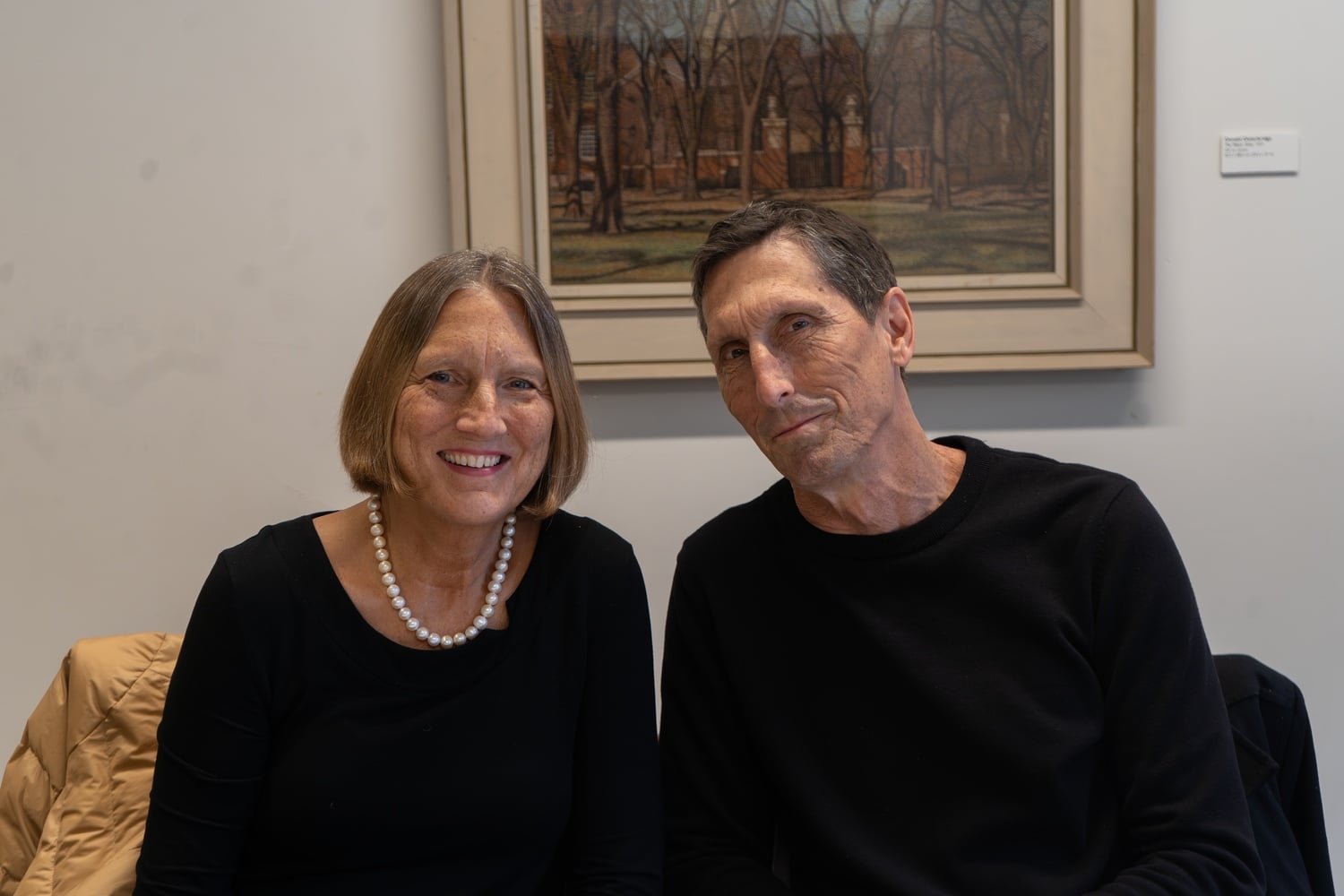
Fifteen Questions: Pat and Tammy McLeod on Faith, Football, and Finding Hope in Ambiguous Loss
The married couple, both Harvard Chaplains, sat down with Fifteen Minutes in the Student Oasis on the ground floor of the Memorial Church to discuss their ministry with athletes, navigating interfaith work at Harvard, and how their son Zach's traumatic brain injury reshaped their understanding of grief.
Partners Pat and Tammy McLeod are Harvard Chaplains for the Christian organization Cru. Tammy is also the president of the Harvard Chaplains. This interview has been edited for length and clarity.
FM: You’re both Harvard chaplains. What does this entail? And how does a typical day look for you?
TM: The Harvard Chaplains is a professional community of over 40 chaplains, and we’re all volunteers, and we’re from every religious and spiritual and ethical background that you could imagine, and then we just serve the needs of the Harvard community.
Personally, I also lead a grief group, and it’s one of my favorite hours of the week. The reason I was even interested in this type of group was because we had a son playing for Buckingham Browne & Nichols high school. He was 16 and became instantly severely disabled for life, and now lives in a group home. Learning about what is ambiguous loss, having a person and not having them the same way — we ended up writing on that topic. We did a book together, but then I decided I think I want to get a grief educator certification, and so I did that, and this will be my 10th year of leading grief groups.
PM: I personally have this opinion that everyone is on a spiritual journey, and some people seem to know where they’re going. Some people don’t. Some people feel lost. Others feel stuck. I just feel like my role is to come alongside people wherever they are, and just walk with them, help them take the next step.
FM: If I’m not mistaken, you went from wanting to coach football to joining Cru in 1984. Was there a specific person or moment when you thought I’d rather do this than coach?
PM: We both really wanted to be teachers and coaches and loved doing it. But on the side, I was coming alongside 0f students who were searching, lost, struggling and spiritually hungry, and I found way more joy in playing that role. I started this little thing — my dad, who was head coach of the school that I was coaching at (he wasn’t a Christian at that time, he called it the God Squad) — this whole team was kind of transformed spiritually. By the end of that, both Tammy and I realized that this is what we want, if we could do this full time, just helping people in their spiritual lives.
I’m glad we had that year, because I don’t have any fantasies of what that life would have been like. There was a lot of glorified babysitting going on that I didn’t really care for in the role as a teacher, but I still think it’s an incredible occupation.
FM: How did you two meet?
PM: It was love at first sight for me, not for her.
TM: We met on a summer outreach project at the Jersey Shore, and I was on his committee, and one night, he asked to talk to me, so I thought maybe I did something wrong.
Why does he want to talk to me? He said, “I just want to tell you that my feelings are different for you than any other girl on this trip,” and I just about fell off the bench. I said I thought I was getting confronted, so I wasn’t ready to engage, but the next morning, I liked him.
FM: What is one trivial thing you will never agree on?
PM: Tammy is so on the go. She doesn’t waste time, she’s super efficient.
TM: I don’t do the space in between very well. I just run things up to the next thing.
My view of this is he’s a P on the Myers-Briggs. It just drives me crazy. Just like, land the plane.
FM: You trace your faith journey to three questions your sorority president asked you: Why are you here? Where are you going? And what makes you happy? Why did these questions crack something open in you, and how would you answer them now?
TM: I sat down trying to write the answers to those questions, and I couldn’t. I listed family, boyfriends, friends, activities, achievements, and I just thought, these don’t answer her questions.
The curiosity about those questions, since I didn’t have the answers, led me to respond yes when someone said, “Do you want to be in a Bible study?” I was just like, what are those words? I’ve never heard those words in my life. I ended up going and I read the scriptures for the first time and fell in love with the scriptures, just kept reading, reading, reading. I went to a retreat so that I could learn more about the scriptures, and there I heard how to have a relationship with God for the first time. That is where I became a Christian, at that retreat.
It was just so freeing and brought so much joy, so her questions totally transformed my life. Now I would just say the answers to my friend’s questions lay in Jesus, as I just studied about Jesus.
FM: How did you celebrate Easter?
TM: In the tradition that we’ve been involved with the past two decades, there’s one continuous service from Thursday night through Sunday. We had Maundy Thursday service at our house.
We had about 15 people at our house, and had communion there. And then Friday, I just spent the day reading the gospels from what would have happened on a Thursday night through Good Friday.
Then at night, we went to a Good Friday service. Sunday morning I was singing in a worship band and a choir at church just celebrating the resurrection. Then we had a family Easter lunch, but then we went to a 200-person Easter dinner for undergrads.
FM: Easter is about new life after death, but a lot of your ministry is helping people live in the Saturday between Good Friday and Easter. How do you guide people stuck on Saturday?
TM: When I lost my son, as I knew him, I couldn’t really go read the healing verses about how Jesus would heal children, because mine wasn’t healed in that way, but I could sit with the psalmists who were crying and screaming out to God for help. I just like to show people who are experiencing Saturday that anything that they’re feeling, they can just say to God, they can be real, authentic. They don’t have to act like they’re fine when they’re not. It’s actually one of my favorite things to do, sit with people on Saturday.
FM: What would you say are the most common forms of ambiguous loss you see among college students?
TM: Pauline Boss coined the term, and her book “Ambiguous Loss” is from Harvard University Press. She said there are two types. The first type is when you do not have the person physically, but they’re still in your mind. That would be like people missing due to war, terrorism, natural disasters, kidnapping, incarceration, but also divorce, adoption, and immigration.
The second type is where we have the person but they’re not the same. Alzheimer’s, dementia. So many students’ grandparents — they’re still connected to them, but they’re not the same anymore. But they didn’t die yet, so they’re dealing with that whole loss. Other people have had traumatic brain injuries. But severe mental illness and addiction, I mean, those two are huge on campus.
Every student has experienced it, but they don’t know what it is. They don’t have a name for it. It took us six years to find the literature. I finally just called the rehab hospital and I said, “Grief books, they don’t help at all. My person didn’t die. My person’s still here.”
With ambiguous loss, there’s no linear process of letting go. There’s rarely acceptance, like you don’t get to acceptance with ambiguous loss. And then there’s never closure. So it just keeps going on and on. But then, dump on top of that, it’s not validated. There are no ceremonies unless someone dies. So we just decided we’re having our own ceremony.
FM: Would you like to talk more about the ceremony?
TM: I kept asking him, do you want to do something on the anniversary? He’s like, “No.”
PM: But then one year, we were away on a planning retreat at the beginning of the year, and she drops this research paper on my lap, and just kind of nonchalantly says, “You might want to look at this.” And I wasn’t surprised when I picked it up and saw that it was about grief.
TM: It was my paper.
And so he said, “Okay, we can have an ambiguous loss ceremony, as long as we have a party for Zach too. We can grieve the Zach he was, but we also have to celebrate the Zach he is.” In ambiguous loss, what happens usually is one person goes off on the having side and the other on the not having. He was the having guy, I was the not having.
PM: The way to properly deal with ambiguous loss is to learn to live well with both. That’s so hard to do, because you usually do one or the other, or neither. And it’s even harder when one is, like she just said, doing one, and the other is not.
TM: It put a lot of pressure on the marriage. So I said, “Okay, we can do both.” Zach was not at the first ceremony. We had slides of Zach before his injury, and music that he used to love. We had our kids get up and speak. We spoke. Other friends got up to speak. Then we handed out blue cards where people could write their losses in relation to Zach. Some stood up and shared those losses. Then people dropped them in a bottle as they exited.
Grieving and community helped me make a turn. It helped our marriage make a turn. It helped our family make a turn. I saw a difference in our kids after that ceremony. The people who said to us, “What are you doing, Zach’s not dead, why are you having this ceremony?” They came up afterwards, tears streaming down their face, and they said, “We didn’t know how much we needed this.”
FM: What’s one thing you expected Harvard students to be like that turned out completely wrong?
TM: I thought the needs of Harvard students would be different than other students, but what I found out is they aren’t — they’re the same.
FM: I know that you advise athletes in action specifically. What is it about athletes versus other students that drew you to focus your energy there? Is it something particular about the athlete experience?
PM: I played football in college, and it was a big part of my life. So I love athletes. I mean, I love college students in general.
TM: I just love working with athletes because they understand commitment, understand teamwork.
I like to make things simple. When I think of athletes, I think of people who have a 40-hour-a-week job on top of being a Harvard student. So, what I try to do is give them things that are not burdensome. They don’t have a lot of time to do a lot of other things. I’ll just encourage them to do like five minutes of slow, meditative reading of scripture in the morning, five minutes of reflection on the day.
FM: What’s your favorite spot on campus?
PM: This place probably has to be it for me, because I realized through the pandemic how important spaces are to me, and when you share that space with people, it locates the memory of real connection with people in a place.
FM: Can you talk about your dinners?
TM: For the first 20 minutes, people are just catching up on how their week was.
Then you have to get up from your table and go meet someone not at your table — like a mixer with a question. That just puts people with all new people.
What I love about it is that anybody can come into that room. You can be of another faith tradition. You can be not anything — no faith at all — and you will be totally loved and welcomed.
FM: You co-founded the Mamelodi Initiative, which facilitates students’ engagement in supporting township communities in South Africa. How do you prepare Harvard students, many from privileged backgrounds, to enter that space thoughtfully and avoid saviorism tourism?
PM: Despite the fact that there’s pretty gross and extreme material poverty in the townships of South Africa, and there’s a lot of brokenness of racism and classism, colonialism — it’s vivid, it’s in your face — you go into a township and there’s a richness of social and relational capital that will put the typical American like me to shame because, in part, they are so in the present. There’s a word in Zulu, Sawubona, and it literally means “I see you.”
Our students just come alive because they’re living in the present. They’re dancing, they’re singing, and they’re seeing these kids who, even though they don’t have access to the educational resources that we have in America, they’re brilliant and creative, and they’re especially good at working together.
I never see Harvard students happier than about the second week they’re in South Africa, because they’re just connected.
They go there, and they’re coaching these kids and just coming alive. So it’s very reciprocal. I think they come back changed. That’s how we prepare them. We tell them from the beginning, that this is a learning experience for you, not a “I’m going to go save South African kids experience.”
FM: How do you foster interfaith initiatives without either compromising your personal beliefs or trying to convert others?
TM: I think the Chaplains are just such a great model for this, because every plenary meeting of the Chaplains — we have Zoroastrians, Baháʼís, secular humanists, all branches of Judaism, Islam, Christianity, Hinduism, Buddhism — we’re having spiritual conversations, and we don’t try to meld, we don’t try to find some lowest common denominator; we just come in exactly as who we are.
PM: It wasn’t always that way, though. When we first got here, for the first probably four years I was here, that was the approach: “let’s try to find the least common denominator.”
That was not working. It was actually a rabbi, Bernie Steinberg, the former head of Hillel, who became a very close friend of mine. Under his leadership, he said, “Let’s validate our distinctiveness and not be ashamed of it.”
—Magazine writer Jolana Kampfová can be reached at Jolana Kampfova [email protected]