
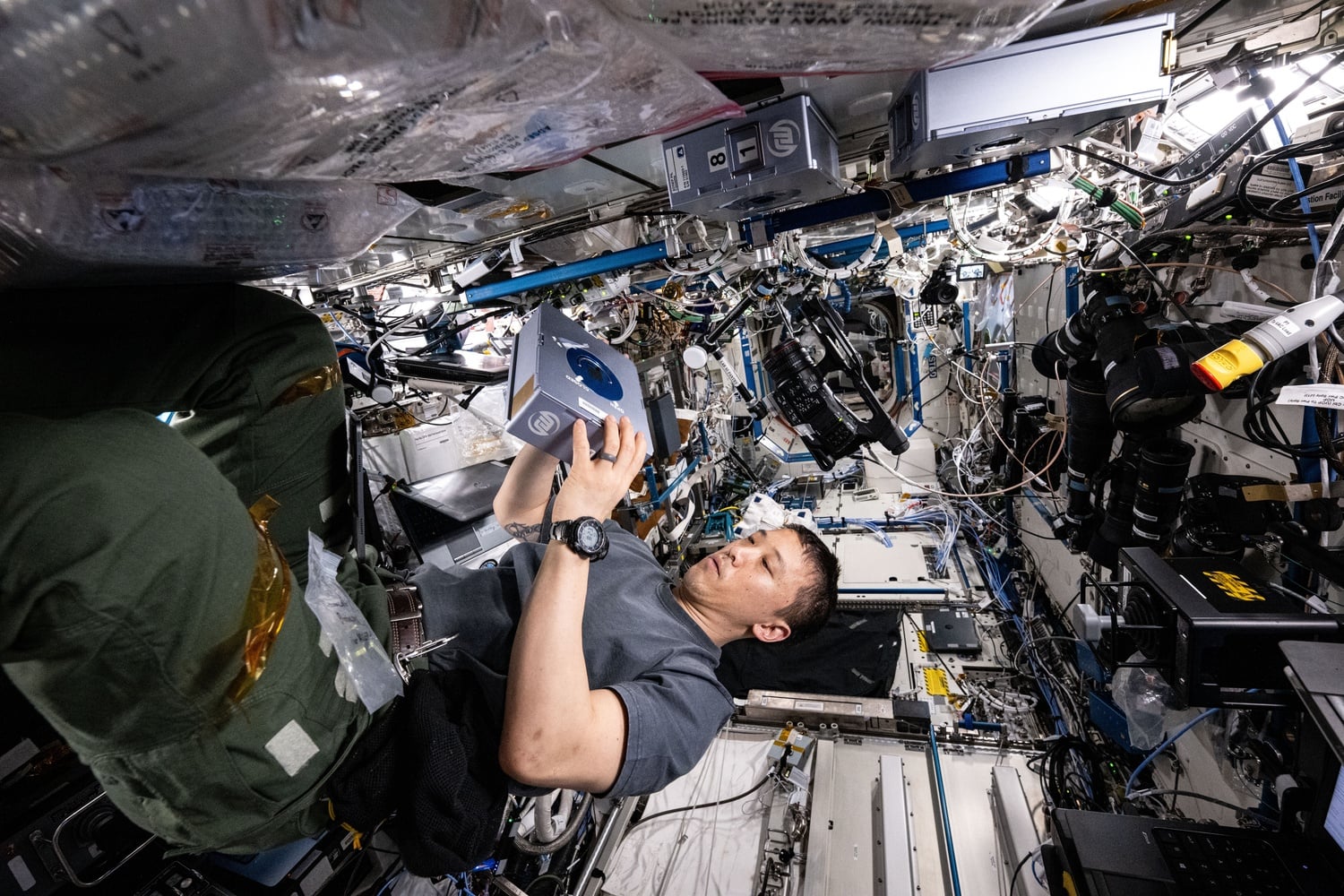
Navy SEAL and Astronaut Jonny Kim on Relearning Empathy and Awe
The Harvard Medical School graduate, who recently finished 245 days aboard the International Space Station, has not always been so fearless.
hen Jonathan Y. “Jonny” Kim was little, he wanted to be an architect — and also a superhero, though that, he says, was “not a real life type of thing.”
Yet at 42 years old, Kim is a Navy SEAL, a Harvard Medical School graduate, and, most recently, an astronaut. In December, Kim finished 245 days aboard the International Space Station, where he conducted scientific experiments, and landed safely back on earth.
But Kim has not always been so fearless.
He grew up in Los Angeles as a second-generation Korean American and describes his younger self as “socially timid.” Though he went to Korean school and played on Korean basketball teams, he felt “a loss of identity.”
“My parents just stopped speaking to me in Korean,” he says. “So, going to Korean school, I wasn’t Korean enough for all the people who went to the Korean churches.”
Even on the basketball team, he was often picked last for his weak athleticism.
“I was not very confident in myself or my athletic abilities and a lot of things,” he says. Instead, he threw himself into video games. He played Mario, The Legend of Zelda, Half-Life: Counter Strike, and more. “I immersed myself in video games because it was a way for me to deal with my apprehension of social situations,” he recalls.
When he was 18, his alcoholic father threatened the family with a gun, and the police shot and killed his father inside their home.
Though Kim prefers not to dwell on his childhood, he acknowledges it helped shape him.
“It was at a time in my life where I really needed an identity to cling to. The Korean American community didn’t give me an identity,” he says. And so, he continues, “I wanted to be a warrior.” Inspired by a childhood friend — “one of the popular kids” and himself an aspiring Navy SEAL — Kim began training for the program.
“I had hard experiences as a kid that really helped me get through it, because I was like, ‘Okay, I’ve been through some really bad stuff. I can get through this,’” he says. “I’m gonna die before I quit, and I just have to get through it.’”
He joined the SEAL Team Three as a sniper and medic. After two tours in Iraq, he received a Silver Star and a Bronze Star Medal for rescuing wounded soldiers.
Kim has been out of combat for more than a decade now, but reminders of war are still imprinted on his body. On his left arm, he has a tattoo of the Navy SEAL Trident with a caduceus — the Greek symbol of medicine — intertwined around it. On right arm, he carries the names of friends he lost in the war.
“I was in my 20s. I had seen and received, and sometimes given, so much trauma — more than a lifetime’s worth, multiple times over,” he recalls. “I’ve taken life. I’ve had friends close to me lose their lives.”
Yet despite all of it, he would do it again in a heartbeat. “Maybe I am a masochist at the end of all this, but having those terrible and beautiful and hard experiences happen to me made me into the person I am today, and I wouldn’t take it away for anything,” Kim says.
While still in the Navy, Kim enrolled in college through the Navy’s Seaman to Admiral-21 program and earned a Bachelor of Arts in Mathematics from the University of San Diego. At the time, he was juggling an 18-unit course load, raising his one-year-old son, and working a part time job handing out parking tickets to make ends meet.
After graduating from USD, Kim enrolled at HMS as part of the Navy’s Health Services College Program for his Doctor of Medicine degree. Since he was “already a trained medic,” he says, medical school “seemed like a natural progression to just continue doing medicine without the combat piece.”
But away from the battlefield, he faced a different set of challenges. In his third year of medical school, the soon-to-be doctors gathered for an hour weekly to discuss their emotions from their clinical experiences.
“I hated it. I didn’t want to talk about it,” he says. “This is the lamest Kumbaya-talk-about-feelings class I’ve ever been a part of.”
But that class ended up being crucial for him.
“It took me a long time to realize, but I had built my heart into a really thick outer layer,” Kim says. “I no longer believed I couldn’t do hard things. In fact, I kind of reveled in it. I reveled in the fact that I could do hard things especially when they were things that other people couldn’t. And it was out of ego.”
His experience at HMS helped him start on a “long journey” to reverse that mentality: “All the trauma I had seen, I had experienced, and sometimes dealt — I was not unfazed from it, I was very damaged from it. I just had to keep up a very, very hard exterior.”
“To do hard and sometimes violent things for the sake of my country or my job or the mission, it required me to turn off my empathy bone for years,” Kim says.
Through these sessions, Kim realized that he “couldn’t actually be an effective doctor if I didn’t have any empathy.” Not only that, he saw that he “couldn’t be an effective human being without empathy” either.
“Empathy, in many ways, is a super weapon. It’s not weakness,” he says.
At Harvard, Kim met physician and former astronaut Scott E. Parazynski, who encouraged Kim to apply to the National Aeronautics and Space Administration. Just a year into medical residency in Boston, Kim left his program to become one of the twelve selected for NASA’s Astronaut Group 22. He thought becoming an astronaut served people “maybe not in a direct way like doctors do, but maybe more through an inspirational way.”
After seven years of training and learning Russian (one of the hardest parts, Kim told the Wall Street Journal last year), he blasted off to space on April 8, 2025 alongside two Russian colleagues. In the 245 days that followed, he conducted scientific experiments, studying how cancer and bone cells react to pharmaceutical drugs in space and testing robots for exploring future planetary surfaces.
Kim says that though the experiments were “cool,” the most life-changing work was showing the “fragility and beauty of our planet” to other humans.
“People are mesmerized by the different colors and beauty of our atmosphere and the planet. And that, to me, is a very powerful way to show people how beautiful our planet can be,” he says.
While in space, he played harmless pranks on mission control in Houston, celebrated the holidays with kimchi and rice as a tiny Christmas tree floated nearby in zero gravity, broadcast his workouts to the world, and commemorated the 25th anniversary of humans on the International Space Station.
He also became an overnight internet sensation.
Social media posts lauded Kim as “nothing short of extraordinary,” with comment sections filled with messages like “Every ASIAN moms dream… I feel bad to be his cousin.” The Wall Street Journal even ran the headline “Navy SEAL. Harvard Doctor. NASA Astronaut. Don’t Tell Mom About This Overachiever.”
Kim, who receives the memes frequently, finds them “cringe worthy” and “a little sad.”
“All of those memes play into Asian tropes that — for better or worse — still label you and stereotype you,” he says. “And I know from firsthand experience it’s never good to be judged — to be labeled anything — and it has an effect.”
But to his three kids, none of that matters.
“All of their friends know,” he says, referring to his occupation. “But here’s the best part: none of them think it’s very cool. They don’t care about it.”
Since returning to Earth in December, he has had more time to play video games with his kids. Kim says he regularly beats his kids in a range of games — legacy games like Castlevania, first-person shooters like Fallout, and role-playing games like Final Fantasy VII. Recently, he has been trying to get them to vibe-code — meaning, code using AI — a Roblox game.
“My wife likes to say, which is very true, is that she has four kids, even though we have three kids together. I’m the fourth kid,” he jokes.
Being a dad hasn’t only been about fun and games, however. Although Kim is now safely back on Earth, he says that leaving his family behind was one of the hardest moments in his life.
To Kim, leaving on an expedition has a level of selfishness.
When his kids asked why he was leaving, he knew they wouldn’t understand his answer. Still, he told them: “I’m leaving because I believe that what I’m doing is the right thing to do and that it will make a difference. I hope one day you will also have the privilege when you’re grown up to do something that you believe in.”
Kim’s days in space are behind him for now. He recently returned to military duty and is in school to become an instructor pilot. On June 5, he’ll be back at Harvard to deliver the keynote address at Harvard Alumni Day.
Kim says he hasn’t ruled out staying at NASA — but he thinks “teaching is a cool gift” and that it’s something he is “really looking forward to.”
But in the long-term, he is unsure what’ll come next. We suggested he could run for office, given his desire for change, but Kim quickly waves it off, saying it’s a “very, very, very hard field.” What about becoming a gamer, we ask? He says it would be tricky to do so as a government-employed astronaut — but if given the chance, he says he would love to play video games on a livestream and donate the proceeds to charity.
But for now, he bids us good night and tells us to “enjoy some video games” as he hits the books for his upcoming aviation exam.
It’s a fitting goodbye for someone who, despite our insistence, still calls himself a “regular guy that has found a lot of different opportunities.”
Correction: May 17, 2026
A previous version of this article incorrectly stated that Kim was 16 when his father was killed and in his final year of medical school when he took a weekly class discussing emotions from clinical experiences with other doctors. In fact, he was 18 when his father was killed and in his third year of medical school when he took the class.
—Staff writer Sunshine Chen can be reached at [email protected]. Follow her on X @sunshine_cxn.