
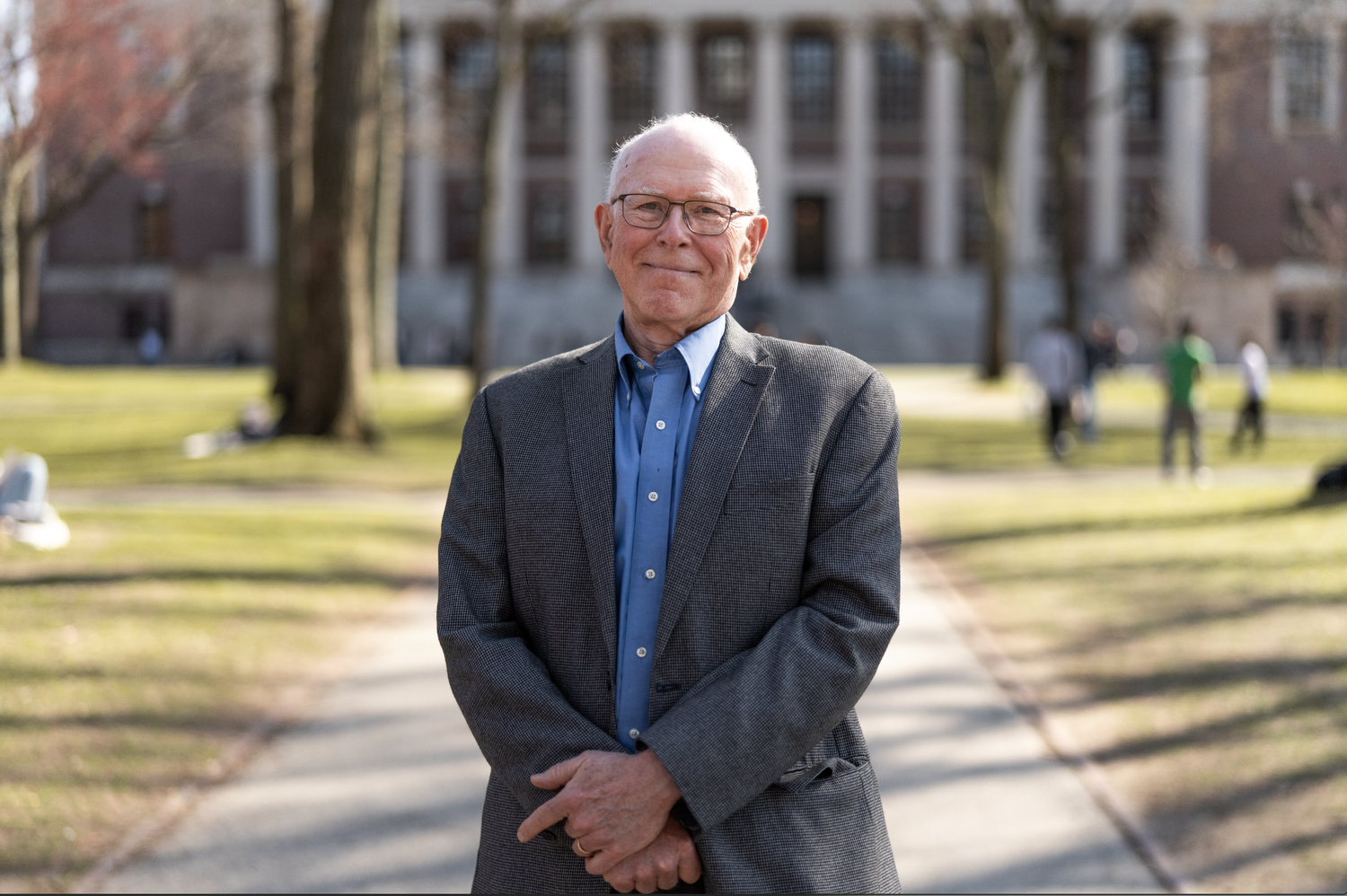
Fifteen Questions: Michael McCormick on the Joys of Curiosity
The medieval history professor sat down with Fifteen Minutes to discuss the marvels of archaeology, history, and the Roman Empire.
Michael McCormick is the Francis Goelet Professor of Medieval History and chairs the Science of the Human Past initiative. This interview has been edited for length and clarity.
FM: So let’s jump straight in. My first set of questions will be a little bit more about Science of the Human Past. What was the question that prompted this creation?
MM: I work in a period — the fall of the Roman Empire —when the documentary, written evidence, contracts. Archeology is just really taking off now because we’ve got better dating systems than we had 40 years ago, 50 years ago. So it’s an evidence-poor area of investigation of our human past. But really important. Roman Empire was a big deal. Its collapse was a big deal. All the new civilizations that came from that are a big deal. So I’m always looking for new kinds of evidence, different places where I can find evidence. And I got into archeology that way in the 1990s. And once you start doing archeology, you realize you have pieces of the material past. And you can turn on these pieces of the material past, whether it’s a pot or a piece of charcoal or a human bone or tooth.
I got interested first in bubonic plague. Not because I was interested in plague, but because I was interested in ship movements. Plague is a disease of rats, yeah, and rats don’t move by themselves. Black rats, the type that carried the plague at Roman times and Middle Ages, they have to be transported passively. So, I wanted to use the outbreaks of plague to date the arrival of ships to be able to chart movements in the Mediterranean when people said there weren’t many. So I started looking for bubonic plague. The next thing I knew, there were scientists claiming they had figured out a way to extract DNA of Yersinia pestis, the bacterium from victims. A colleague in the medical school here in the Department of Pathology, Tom Benjamin, (a wonderful scientist, his kids were in school with my kids in Cambridge Public Schools), I told him, I said “Tom, you could maybe help me?”
He said “Yeah, we can get ancient DNA. We can, let’s try this!”
We tried. It failed completely.
FM: What was the failure?
MM: We couldn’t get Yersinia pestis, we couldn’t get the DNA that the French, that the other team, which claimed to have done it, was able to get from other samples. And I think it’s a good thing, because we didn’t get contamination either. And no one wound up accepting that other group’s results. Another group was able to do it only, I think, in 2010 for the Black Death.
So ever since then, I’ve been looking for ways to multiply the evidence we have for the past, whether it’s ancient DNA of pathogens, because the sufferings of people are a big part of history. They have economic importance. Bubonic plague kills a lot of people. Malaria kills a lot of people. It affects the demography, the overall trend of population growth and contraction.
I got interested in diseases for what they can tell us about human history in general, and that led to the human DNA, and the question of whether human DNA would allow us to track mobility and migrations.
FM: Do you think being trained in Europe has shaped the kind of historian you become and how you view history?
MM: In many ways it has.
The Belgian approach to graduate studies was not to make sure you knew a lot. You had to know a lot, but that wasn’t the emphasis — it was to teach you how to find things out. And so I learned how to find out things about drawings, about excavation.
I learned a lot of tools for finding out new things. That was not an emphasis in American Graduate Education at the time, as far as I could tell. I had these fantastic tools that have allowed me to keep reinventing what I do, because I know how to find out new things. So I teach that to my students as well.
FM: When you come into Harvard freshman year they give you this “perspectives module,” and the one thing that I think the Dean says in there is that an education is not knowledge, it’s a lens to look at the world through.
MM: Absolutely. And it’s to know what tools to use to learn new things. What I love, honestly Anne, is learning new things. And that’s why I love your questions. I love the questions of our students who are constantly asking me things I never thought of, and have to think and go research and come up with an answer and learn something new. To have these wonderful techniques for learning new things, for answering questions, has been a tremendous advantage for me. I also was just lucky. I didn’t know what I was doing. I’m a first generation college student. My high school teachers didn’t have an idea of what was going on, they sent me to a great place, but they couldn’t even know that at that time there was just a tremendous constellation of many great scholars in many different fields.
They were so surprised at this strange hippie with long hair appearing from America, who could barely speak French, but they were also so generous that they devoted immense time to teaching me. Not just in the classroom. After I was a first year, my father lost his job. I didn’t have any money, I didn’t have any food, so two of my professors would take me out to eat every week. And while I ate, they would teach me more things.
I learned so much from them. The last one just died during the pandemic — he was also 90 — but I would go back every year and take them to a nice restaurant and buy oysters for them.
Now they’re gone. So how can I thank them? By reading and studying my student’s work with the care that my professors put into mine.
FM: Because we’re standing in front of Widener, I have read your piece “Research and teaching: Making connections in Widener Library.” I think you say “the professor shifts gears from ‘virtuoso but disciplined performer of a Mozart sonata to pure and provisionalist.’”
MM: Oh, I forgot that!
FM: I thought that was a wonderful line. Once you have all these findings, and you’re presenting them to your students, you have said that students ask you questions that you have never thought about.
MM: The most amazing questions. That’s one of the great rewards for being a Harvard professor — Harvard students. And especially undergraduates, because you guys are very daring in the way the graduate students are not. They’re being very careful to know all the literature and so forth, and they’re very learned. But you guys don’t really care what I think, and you are curious, yes, and you ask great questions.
FM: Do you still remember any specific questions?
MM: Well there are zillions of them. Counterfactual things. So, what would have happened if the Romans had won a big battle? And my initial reaction was, “Well, we don’t deal in counterfactuals.” But the more I thought about it, the more I realized that actually, it could have changed the whole dynamics of history in the later Roman period because of who got killed and who didn’t get killed. And what could have been a catastrophe in the beginning turned out to be something else. That kind of question happens in almost every class.
FM: You had mentioned that you were in this library for a week digging and looking around for records of Arab coins, and that you were basically just chasing this trail. Can you tell me about the thrill of doing that kind of research, hands on? It sounds like you’re being a private investigator.
MM: I knew that there were some Arab coins in the West. A French scholar published that, and I was very interested, but he didn’t document it carefully at all. I was kind of skeptical because everybody said there was no trade, so how the hell did they get there? I tracked down what references I could find. Then I started searching for more. A lot of them were blind alleys. But with this library, every book is there, I mean, “The Bulletin of the Agricultural Society of the Eastern Pyrenees.” That’s where these things were published in the 1890s.
So, you make these little finds. And the beauty of Widener is that you can verify right away. That is to say, you can fail cheaply. Nobody likes to fail. But if you can fail cheaply, you can try lots of different things. You can be that “improvising virtuoso,” and ask lots of questions, some of which are going to go nowhere.
That book — it turned out to be about something I had not expected it to be on. I found all these people traveling who were not supposed to be traveling, and they lined up with the coins. And then I found all these Arab and Byzantine coins in the West. Well, that means that they were bringing silks and spices and drugs back from Constantinople and the Arab world. And they were also bringing money? That meant they were exporting things that were worth more! Because they were running a trade circuit in which whatever they were selling was worth more than the priceless silk. And spice. And medicines. What did they have to sell? Europe had some swords. Some furs. And Europeans. And the slave trade, I was led to conclude, really fueled the origins of the European economy. And that came up with being able to look at all those, and next week, I’m going to Toronto for a conference on slave trading in the early Middle Ages.
FM: When you suddenly realize this pattern, is it like in the movies where the screen of math numbers goes up, your brain is whirling, and you’re like, “Oh my god, Eureka!”?
MM: Something like that happens. I mean, you’re looking at this thing, and it just doesn’t make any sense. And then you try and reconfigure it. It still doesn’t make any sense. And then you say, “Okay, what the heck, but I’ll talk to my wonderful wife.” So patient. So sweet. We have dinner, we’re sitting down and all of the sudden — “BONG!” Pieces fall into place. Or the next morning! I look at it again— “BOOM!” Worse just when I go to sleep. No, no sleep. But that doesn’t happen much anymore. That’s a good thing.
I love your questions — your 15 questions! And the questions of the students, because they’re constantly forcing me to be that virtuoso and tie together all the stuff I’ve had so much fun learning, and continue to learn and to figure out a new answer. And then I want to go learn more to help give a better answer.
FM: There was a popular trend on social media a little while ago, it’s called, what is your Roman Empire?
MM: Oh, yeah!
FM: What is your Roman Empire?
MM: My Roman Empire right now are the people who were the Roman Empire. Not the emperors, not the senators, not the generals. The men, women, children, slaves, the peasants, the working people. Those are the people who we are now discovering, thanks to our skill, thanks to bioarcheology. They left no epitaph. They left no statues. They’re not mentioned in history books. There are thousands of them. If their bones are well preserved, we can discover the ancestry of their mother, their father, their grandfather, their great grandparents. We can find who they’re connected to and buried with, or not buried with. We can look at their bones and see if they’ve been healed from many beatings on the head or the shoulders. So we can know that they probably were enslaved. We can look at their diet and see what kind of things they were eating, what kind of access they had to food. I don’t know if you’ve seen any of our videos on the science community pass website.
FM: Unfortunately, no.
MM: Take a look at them cause they’re kind of fun. There’s one on the Danube, on these Romans from the Danube.
I was preparing the archeological summary, and we had the archeology — there’s a photograph of the guy, young man about your age. Died up on the Danube. He’s buried with a Roman oil lamp with an eagle on it, and then the normal kind of lower class, little wood, middle, lower-middle class wood coffin.
We get his DNA back — he’s from Somalia.
FM: That’s a long way to go.
MM: That’s a long way to go!
His teeth showed that he grew up eating seafood. He was probably born on the beach. He could have had Somalian parents inside the Roman Empire, but it’s more likely that he came from elsewhere.
FM: You’re bringing together all these different kinds of people from very different, very distinct academic fields. Were there any misconceptions that you had about the work that others did? So you were like, “Oh no, we’re so much more similar than I had imagined?”
MM: Not too much, actually. I’ve been blessed to have — I mean, this place is pretty unusual. And before that, I was at Johns Hopkins, and that also is pretty unusual. And the colleagues here and there are pretty tolerant of one another, and we’re all super busy. So the problem is finding time to talk and opportunity to talk. But when you do, I find, for example, that one of the characteristics of my colleagues here is curiosity. They’re all curious, and they’re curious about what they’re working on, but if you can connect what they’re working on with what you’re working on, they get even more curious. “What? You mean, I can help you? How could that be? Tell me.” And then they want to keep talking. So I’ve been struck more by the similarities than the differences. And particularly here, and at Johns Hopkins, by the intellectual generosity of my colleagues.
FM: If you could have a dinner party with anybody in history, past, present, who are the three people that you would invite?
MM: Can I have four?
FM: Okay, you can have four.
MM: Okay. Justinian and Theodora — but I want to take my own bodyguards. Charlemagne, and any one of umpteen wives. And Benjamin Franklin.
— Magazine writer Anne Sun can be reached at [email protected].