
The Universal(ly Replicable) Mind of Bill Evans
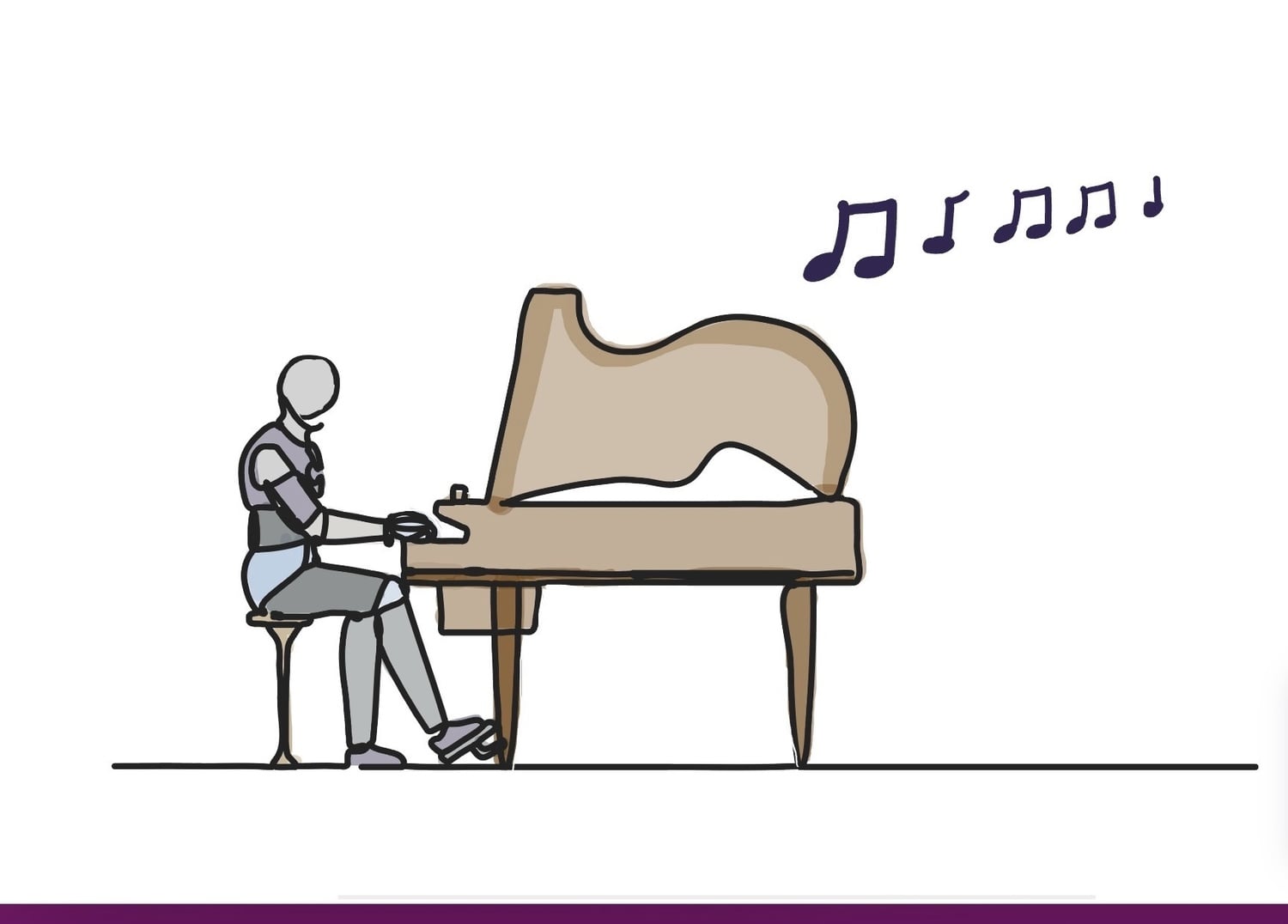
The notion that one could make a generative AI model that sounds like Bill Evans, that an act of such unique human creativity might be automized, is unnerving. To make an AI music generator “play like Bill Evans” is actually a rather strange thing to say, because how exactly does Bill Evans play?
t is not so difficult to imagine that, in the near future, artificial intelligence will be very good at mimicking jazz.
Already, AI-generated (usually smooth) jazz has invaded streaming platforms, slopped out to unsuspecting (or, I suspect, suspecting) listeners that desire a more sophisticated breed of white noise. In its purposeful unobjectionableness and vapidity, it does not distract you from your problem sets.
Jazz can have a certain aura of mysticism. The great improvisational jazz musicians often seem like alchemists, turning leaden standards into a kind of auditory gold, suffusing the air with a vaporous, swirling methamphetamine that invigorates and enlivens its audience.
There is, of course, hiding in the varnished armoires of Thelonious Monk, Bill Evans, and Oscar Peterson, thousands and thousands of hours of practice. In their pockets lie manifold prepared elements — ostinados, scales, arpeggios, voicings, syncopations — tools to be subconsciously wielded to allow what Bill Evans calls “the universal musical mind” to spontaneously channel emotion and intuition into harmony and dissonance.
The notion that one could make a generative AI model that sounds like Bill Evans, that an act of such unique human creativity might be automized, is unnerving. To make an AI music generator “play like Bill Evans” is actually a rather strange thing to say, because how exactly does Bill Evans play?
Heraclitus says we can never step in the same river twice. The stream of jazz that flowed from Bill Evans, then, was also continuously in flux. Does Bill Evans play like he played in 1959 on “Kind of Blue,” or like he played with his trio on the 1961 “Explorations,” or like he did in 1962 with Jim Hall on “Undercurrent?”
It seems probable that you could, with sufficient training data, have a model produce sound that approximates, say, the “average Bill Evans between May 1959 and December 1959” and that this would approximate the “instantaneous Bill Evans” at some point during that time-period.
One might also train a model on, in the parlance of this AI age, the “dataset” Bill Evans himself was trained on: his early love of Stravinsky’s Petrushka, the influence of the Alabaman pianist Nat “King” Cole and the intimidating Miles Davis sextet he joined in New York.
However achieved, we must reckon with the prospect of a mechanical Bill Evans that “plays” so well it could fool a blindfolded critic into believing she had unearthed an undiscovered recording.
Its auditory congruence notwithstanding, most would agree that this prospective Bill Evans is still an automaton, not a reincarnation. The mechanical products, however sophisticated, lack that which actually makes something jazz.
***
Society has long mechanically reproduced individual jazz performances. Indeed, the music critic Ted Gioia argues in his 1987 essay “Jazz: The Aesthetics of Imperfection” that Thomas Edison’s phonograph was critical to the development of improvisational jazz.
New Orleans African Americans had of course played ragtime and the blues long before the proliferation of the phonograph. But as jazz relies primarily on what is not written down, the technology to record solos allowed the proliferation and communication of improvisational styles and techniques, and allowed for jazz students to religiously study the great improvisers.
To Gioia, recording technologies in no small part contributed to the development of the masterful improvisation that came to characterize jazz. That no performance is ever quite the same is much of the appeal of seeing jazz live. You are witnessing, upon the familiar backbone of a standard like “Blue in Green,” an entirely novel sculpture, carved delicately from marble air by practiced fingers.
Gioia argues that the improvisational character of jazz is both its most essential and problematic element. Jazz demands that an artist create something new with each performance; to recite a planned composition instead of an improvised solo is an artistic sin tantamount to cheating. Per Gioia, “were the jazz artist to approach his music in a methodical and calculated manner, he would cease to be an improviser and become a composer.”
The result is that whatever art is produced by the jazz improviser is of inherently lower technical aesthetic quality than something that they had planned out and rehearsed, or to the “meticulously crafted masterpieces of the great composers.” There is no distillation or revision of the same work analogous to poets and playwrights, nor the redrafting of a portraitist or architect. Normal aesthetic criticism, in the view of Gioia, cannot and ought not be applied to jazz.
What Gioia proposes instead is an “aesthetics of imperfection” predicated on the necessary concession that good jazz will inevitably be technically flawed, but that what Monk or Evans can do under the constraints of jazz is eminently interesting. “In short, we are interested in the finished product (the improvisation) not as an autonomous object, but as the creation of a specific person,” Gioia explains.
How does AI fit into such a view? Randomness is inherent in the probabilistic models that generate jazz, but can we really say that this is equivalent to the spontaneity that motivates jazz? AI jazz is far from unrefined; in fact, it is specially designed to be exactly like some kind of asymptotic ideal, as close to the exact vector of Bill Evans at a given moment in time. Is this “improvisational?”
More so than for other art forms, we are drawn to jazz by the jazz artist as much as we are by their music, and indeed, since there is no artist to speak of, under Gioia’s imperfection aesthetic, AI jazz fails to be aesthetically good on the basis of its origin. Gioia says of listening to Charlie Parker that “even his failures interest us because they tell us about the musician who created them.” What such redeeming interest exists in AI jazz?
The early 20th-century German-Jewish culture critic Walter Benjamin can help us understand the qualities of jazz that Gioia is gesturing towards. Benjamin writes in “The Work of Art in the Age of Mechanical Reproduction” of the “cult value” of a work of art — orthogonal to the “exhibition value” — a mystical, ritualistic value granted by the unique existence and authenticity of the artwork.
Cult value is essential to jazz. The true jazz listener cares as much about the aesthetic qualities of her jazz as she does the knowledge that the jazz performer indeed was improvising, that their art is part of the ritualistic enterprise of jazz.
There is something cultish in demanding, as an aesthetic criterion, the knowledge that it’s “real” — that notes flow from a sort of divine inspiration and are not the mere product of logical conception, that a dynamic interplay between the upright bass and the trumpet and the drums and the piano has negotiated the artistic result, that it is all so very human.
Benjamin also writes of the “aura” of a work of art, granted by “its presence in time and space, its unique existence at the place where it happens to be.” If we consider seeing Bill Evans live at The Village Vanguard as the most authentic experience (the one with the most aura), then a recording (a direct mechanical reproduction) is of a second order of aura, and finally, of a tertiary order, must be the automaton Bill Evans — an infinite mechanical reproduction not merely of a single “Waltz for Debby,” but of a man, constituting an unprecedented perversion of aura.
Whereas past innovations in mechanical reproduction enhanced the aura of jazz by cultivating a culture of improvisation and an aesthetic of imperfection, AI has no such effect.
In heathen models, we find the antithesis of aesthetic uniqueness: the sound of Bill Evans, identifiable as a forgery only by careful analysis, stretched out on an endless record. With Evans no longer the sole source of the pattern of sound that we call “Bill Evans,” what does this leave the original Bill Evans as?
Benjamin wrote of film and photography: “By making many reproductions it substitutes a plurality of copies for a unique existence.” Such reproduction pales to the scale of our endless ocean of AI-generated Bill Evans.
Already, recordings are a kind of dilution of the live performance, but in the infinity of auraless music that a model could produce, there is, to borrow Benjamin’s words, a “shattering of tradition”: the Bill Evans sound, no longer finite.
“We enjoy improvisation because we take enormous satisfaction in seeing what a great musical mind can create spontaneously,” Gioia writes. I am not terribly interested in the “spontaneous” jazz creations of a large language model: it only pretends to have aura, and indeed, under Gioia’s aesthetic of imperfection, I do not believe it can be considered jazz at all.
—Magazine writer Andrew W. Shlomchik can be reached at [email protected]. His column, “The Humanist,” explores what it means to be human in an era of unprecedented technological turmoil.