
Fifteen Questions: John Quackenbush on the Art of Film Projection
The AFVS projectionist sat down with Fifteen Minutes to discuss Super 8, movie theaters, Instagram, and the other John Quackenbush.
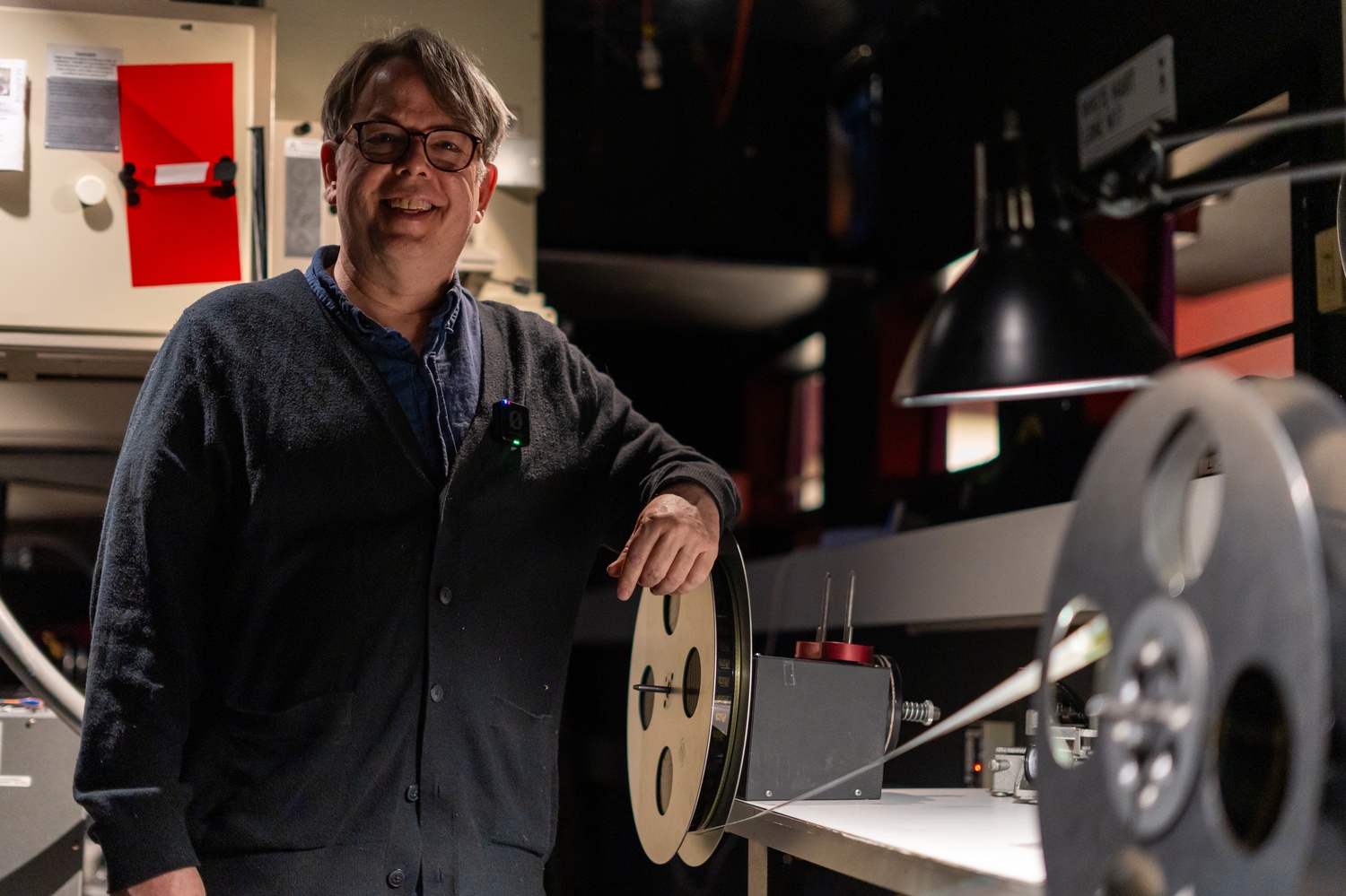
John R. Quackenbush is the projectionist for the Art, Film, and Visual Studies Department and the former head projectionist at the Harvard Film Archive. This interview has been edited for length and clarity.
FM: How did you initially decide you wanted to go into projection? Was it a conscious choice, or did you fall into the career?
JRQ: I’d like to think that I knew all along because I started making films myself as a kid with Super 8 film and projecting them. But really, I probably fell into it. I went to MassArt to study and learned to be a filmmaker — that was the goal — but my first job out of college was for the National Center for Jewish film, where I worked for 12 years in the film archive. Processing prints on the bench was one of my jobs, inspecting, preparing them to be distributed.
The archive was located at Brandeis University, and they installed an archival 35 mm system, and they needed a projectionist. I got trained for that and I was doing that as a side hustle, but I enjoyed it very much, and got involved in doing occasional film festivals. The first Film Festival I did was Nantucket, and then I got offered a job at the IFC Center in New York when they first opened, and I was their head projectionist the first couple years. And then that was it, I was a projectionist. I was a professional projectionist. From that I got involved in film festivals — Sundance and the Dubai Film Festival are probably the ones you’ve heard of — but I’ve worked with many.
FM: You were just at Sundance in February. Is there a difference between working on a film for Sundance or a film festival versus, for the Harvard Film Archive, for example?
JRQ: They’re very much the same. They all require a certain knowledge and experience to present the film as seamlessly as possible. Basically, I want folks to feel that I’m just back here to press and play, and it really isn’t. There’s a lot of preparation that is involved. Sundance is different because there’s a lot of films playing for their first time in front of an audience and many screenings during the day. So it’s a huge operation with projectionists and technicians and people that traffic these films around.
It’s intense. Every film is a premiere, and for the filmmaker, it’s the first time they’ve shown it in front of a large audience, and they usually have their cast and crew there. They have subjects, if it’s a documentary, and of course, the cast is there, so there’s a lot of energy behind it. However, at the Harvard Film Archive, when I worked there and here for the events that happen here, it’s this same idea. There’s a lot of work that’s gone behind the screen. These are like one time events a lot of the time where the filmmaker is showing their screening in the area for the first time. So we work hard to make sure that that is as seamless as possible and the film gets all the way through to the Q&A.
FM: You are a projectionist. You also watch a lot of movies. Do you have a favorite movie theater?
JRQ: I love watching films here. I just love it. I just saw “Clockwork Orange” here. Greg Abrams, the projectionist, did a perfect job.
I just love the bare bones of it: you’re there, there’s an introduction, lights go out, movie starts. There’s no trailers, there’s nothing—it’s the church and we’re there to worship, and everybody’s quiet, there’s no food.
However, I really also like going to the Coolidge, because they have a different type of presentation. A colleague of mine always loved it. The presentation is not just the projection: Is the carpet clean? Does it smell good in the lobby? Is the popcorn good? That’s where it starts, and that’s what the Coolidge gets all A’s on. And their big house is great. They have curtains.
Then the Somerville Theater, which was originally an old Vaudeville theater that was converted to film — their house projectionist has been around Boston for a long time, and he has a sense of style about presentation that goes back before the days of the multiplex. It’s special too, because he’s very knowledgeable about film. If he shows “2001,” for example, he’ll come out and talk to the audience about the print technology, what’s about to happen, point out a few things in the making of the film. And he’ll do that for every screening.
FM: Do you do that for your screenings?
JRQ: Only when asked. I like to be like: you’re not looking at me. You shouldn’t know my name. You should know the director, or the cinematographer or the editor, but not me, even though I feel part of the chain — they made the film. It’s now up to me to show it.
But when I’m running it, it’s my prints, my movie. I have to make sure it’s in focus and it’s not too loud, it’s not too soft.
FM: What do you do when there is a problem with the film? Can you still run it?
JRQ: If it’s minor, like a tear in the sprocket, I’ll repair it here, and just make notes and let the archive know. A lot of these prints don’t just come from the Harvard Film Archive. They come from UCLA’s archive, they come from the Korean archive, just everywhere. These prints are lent to us. We have to be extra careful with them because we’re borrowing them, and we want to borrow more prints from them.
FM: Do you have a favorite film within the Harvard Film Archives collection?
JRQ: That changes daily. Yesterday I showed, for a class, “The Conversation.” And that’s an amazing film by Francis Ford Coppola. Sometimes I think it deserves as much attention as “The Godfather” or “Apocalypse Now.” It’s a smaller film, smaller cast, Gene Hackman’s in it. I really love that film because I’m a bit of a nerd. One part of the story is the technology. Sound technology also shows you the process of filmmaking, and its use of sound and picture is a good way to unravel Coppola’s films and how they’re put together. That’s because I just saw it and it was fresh in my head.
There’s another film. It’s a 16 mm film called “Letters to Jerome” by Nathaniel Dorsky. It is 16 mm, silent images of the fall and spring, and it’s just beautifully shot.
FM: I know a lot of people would argue, “Oh, you have digital formats.” Why do you think it’s still important to preserve a film in its original format?
JRQ: First of all, you could see “The Conversation” on your TV. You could see “The Conversation” on your iPhone. You could see it presented on a big screen in a digital format. But that’s not what Coppola made. He made a film, a print. It had a certain look.
You go to the Museum of Fine Arts and see Van Gogh’s sunflowers, or you can buy the poster, you know, at a record store or whatever, and think that’s the same as looking at the actual painting. And I think we can all agree that it’s not the experience.
Coppola intended and made this film to be presented in a theater, on a big screen. This is what we have. We can recreate that exact, you know, environment that the film was made for. It’s also made to be interactive: an audience, the energy within an audience, reacting to the film. You can’t do that at home.
FM: If you were a film format, what film format do you think best captures your essence?
JRQ: It’s absolutely Super 8 film.
FM: What is Super 8?
JRQ: Okay, quick history here. Film really started with this format, 35 mm. After a while, they made a go of a format that was half the size, 16 mm, and that was primarily made for people making films at home of their family, but also it was used as a way of making educational films and art films, but mainly educational films and home movies. The reason it was great for educational films and documentaries is because it was more affordable, the film was half the size and the cameras were half the size, so they could get their equipment into places a big, 35 mm studio camera could not get into. From there, home movie got popular, and Super 8 came about.
I think I’m Super 8 because I’m accessible, can be a little bit artsy, but mostly should be kept in the home, not out there in the world on the big screen.
FM: As a filmmaker, what’s your approach? When you’re making your own films, are you more of a perfectionist? Are you “go with the flow?” What’s your philosophy about making a film itself?
JRQ: I’m not a perfectionist, and that’s why I appreciate it so much. And it’s been a while since I’ve actually shot film, because Instagram is the only thing I do now. But when I was making films, I would hamfist the material, get my fingerprints on it, scratch it up and let the tape of the splices be revealed.
The film is handled in a way in the professional world where there’s many people working on it, they’re handling the film and doing only one thing. When the film comes from the camera as a negative and is cut, it’s only touched by a negative cutter. Once the information is done from work prints a person just himself, that’s all he does, Careful splices in a room that’s sealed off from dust. He’s probably wearing a hair net and gloves and that’s how these films look. There’s not a scratch, and you’re not distracted by scratches.
But in my work, I like the scratches as part of having the process on the material. I went to an art school, so yeah, I think you get it.
FM: What are your thoughts on Instagram reels or Tiktok content in relation to other video media?
JRQ: I don’t think one’s better than the other in a way. I like guide rails on format. It helps me when I’m making, I like the idea. I think Tiktok has expanded, unfortunately, but I loved it when it was just one minute. You only could do one minute. And then that was interesting, you know, to tell something in one minute.
There’s a class here taught by Lucien Castaing-Taylor, Sensory Ethnography. They give their students a weekly assignment to go out and shoot one minute of video, but not make a one minute video, shoot a subject for one minute.
It’s very interesting, you know, to have something that’s not cutting or anything. I did it myself, just to see what I would get out of it. If you’re interested in filmmaking, it’s an interesting exercise.
FM: What did you end up filming or making?
JRQ: I just filmed stuff around me that I could get away with. I really got a nice shot of somebody. I live in Lynn, and I take the ferry to work.
There’s a ferry that goes from the shore of Lynn to Seaport or to the aquarium. And there’s a time of year where you just get a sunrise in the morning, a sunset at night, and on the ferry — just big, gorgeous orange sunsets. And I had a guy, hand on the rails, back to me, in silhouette with the rays of light. And just watching for a minute, it was interesting. It’s just a different way of looking at the world.
FM: Part of the reason I took on this article is because last semester I interviewed John Quackenbush at the Harvard Public School of Health. Are you aware of this other John Quackenbush? Have you come across any other John Quackenbush or Quackenbi in your life?
JRQ: East Coast Grille is gone now, but there’s a John Quackenbush there that was shucking oysters and we discovered each other when I was paying for oysters with my credit card. The staff thought I grifted his credit card because it’s such a unique name.
I often get emails for the professor Quackenbush and it’s fun to see. I get a window in his life, he gets a window in my life, and we both respond to those emails in the same way, where I’m the evil John Quackenbush. We still haven’t met for coffee yet, and he works a lot in genetics, so I’m surprised he hasn’t decided to use me as a subject to see what went wrong.
I looked him up once and I saw that he did a fundraising boxing match. I think we should box at one point.
FM: The only way to settle the Quackenbush conflict.
JRQ: Yeah, I think we could sell tickets for it and then the loser changes his name.
FM: And then would we put it on at the film archive?
JRQ: Sure, and that would be pay per view.
—Magazine writer Jona P. Liu can be reached at [email protected].