
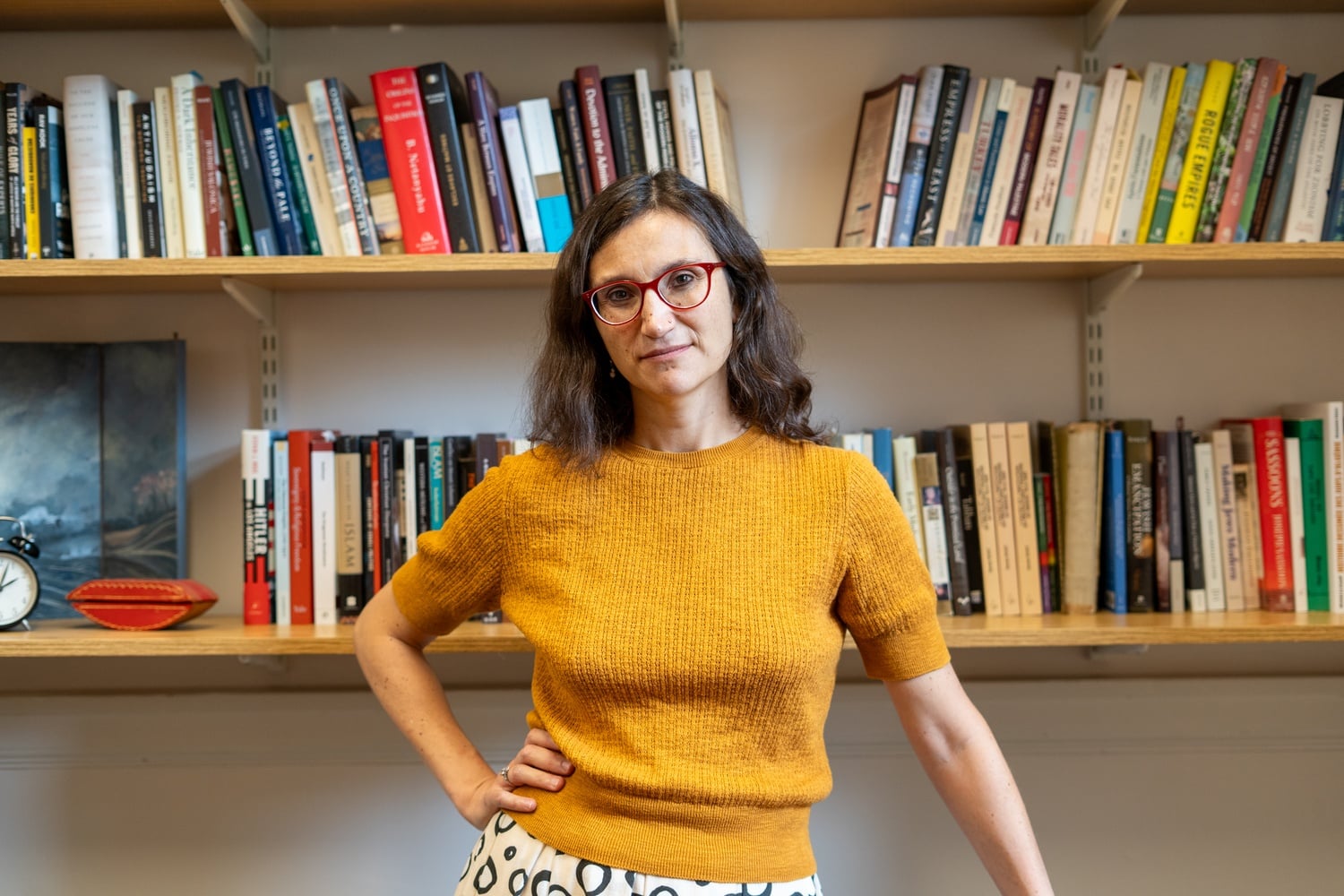
Fifteen Questions: Jessica Marglin on Jewish Studies, the Dudley Co-Op, and Campus Protest Culture
The Near Eastern Languages and Civilizations professor sat down with Fifteen Minutes to discuss what’s changed — and what hasn’t — on her return to the College 20 years after graduating.
Jessica M. Marglin ’06 is the Co-Director of Undergraduate Studies in Near Eastern Languages and Civilizations as well as the Jacob E. Safra Professor of Jewish History and Sephardic Civilization. This interview has been edited for length and clarity.
FM: Let’s talk a little bit about your research. As I understand it, you focus on Jewish groups in the Mediterranean, North Africa. Can you just tell me a little bit about your specific interests in that?
JMM: I would say my bread and butter is Jews in modern North Africa. My two books are both about that. One is about Jews in Morocco, and the other is about a Tunisian Jew who actually kind of lived across between Tunisia and Italy. My angle on it is actually legal history. I’m interested in law — not so much law as it’s written by law professors or jurists, but more law as in how people go to courts, how people make legal arguments in front of judges, how people decide which court to go to or not and which argument to make or not. That’s the way that I usually take in to understanding Jews in North Africa and the broader Middle East and Mediterranean.
Right now, I’m actually writing a book, which is not specifically about Jews. Jews play a very big role, but it’s also about Muslims, Christians, really anybody, and it’s more specifically about this sort of legal history. I’m interested in a legal status that doesn’t exist anymore called extraterritoriality. People who are outside the territory of their home country, so like an American citizen outside of America, but who remains under American jurisdiction. It’s like a little bubble of American law that follows you outside. It was very, very important in the Middle East and North Africa basically through World War I, at which point it kind of went away.
I’m interested in trying to connect Middle Eastern legal history to a broader global history of law and legal change, mainly in the 19th century. I work, I would say, from the early modern period through the 20th century, but my real passion is the 19th century.
FM: Why is law a fruitful way of examining that history?
JMM: This isn’t so new, but for the past 25 years, historians have sort of said, “Actually, you can look at legal change in and of itself as a part of everyday life.” Going to court is a part of people’s daily lives. And that in itself can tell you also about the change of society. I would say one of the kind of basic assumptions that legal historians like me make is that law shapes society and society shapes law. So it’s a kind of ever-evolving cycle, right?
Yes, you have a society that is reflected in its laws, but also laws then shape the way society works, and of course, laws change and societies change, and that kind of interplay is maybe methodologically or analytically one of the stalwarts throughout all of my work. I’m always kind of interested in how that happens: the law and society nexus.
FM: You said that you were a student here, and I’m curious, what’s it like being back now?
JMM: I was here last year as a visiting professor. So my experience of the weirdness of being back as a professor and not a student happened a year ago. But every single time I went into a building, I was flooded with memories of the time I had been in that building as an undergraduate. It took a while to lose those and build new memories.
It was surprising to me how many things hadn’t changed, actually.
A lot of the concentrations are the same, and a lot of the kind of vibe around the concentrations are the same. So I was a social studies concentrator, and that still has a “you’re intense and want to work hard” kind of vibe. So that was pleasing. I was really glad to find that familiarity.
FM: Is there any way that you think Harvard is different now?
JMM: The grade inflation is real. I don’t know if we want to talk about the grading reform, but now I’m co-DUS of the Department. We got a report of the grades in the last 10 years, and I was like, “Oh yeah.” Even in the last 10 years, you could see how many more A’s are being given out across the Department.
FM: That’s interesting. I think something that gets lost in the grade inflation shuffle here is that it’s more nationwide.
JMM: Oh, it’s worldwide. Before coming here, I actually spent two years on leave in France, but I was doing some teaching, and I had a lot of colleagues there. And France is also complaining about terrible grade inflation. They have a lot less than America, but for them, what used to be a good grade is now an okay grade. It’s not just Harvard.
FM: Given your experience in a variety of different places, do you have any thoughts or insights on why that is?
JMM: In the places that I know best, which is France and the United States, I do think the commodification of education. Harvard has always been a private school, but I think — not just at Harvard, but everywhere — there’s a sense of “Well, we’re paying for this, we should get something out of it.”
It’s a tough time to be trying to get a job, and there’s so much anxiety — not that it’s the first time that that’s happened. I think one of the benefits of being an historian is that you see that lots of things have happened before, and many things are cyclical. But it is a moment of extreme uncertainty.
FM: You spent a long time at the University of Southern California and then came from France. I guess I’m curious: why return to Harvard now?
JMM: So many reasons to come. I think, professionally, the kinds of students that I can get here, both at the undergraduate and the graduate level, it’s like a whole different ball game. And I had some very, very good students at USC, but USC is not a school that’s particularly strong in any of my areas.
So part of it is a feeling that I can have a bigger impact on students here, especially graduate students and training the next generation of people who do what I do. Which, hopefully, there will be at least some people who still want to do that.
I think my biggest feeling — and this is more of a vibe than a numbers thing — but coming here, I just have so much of a sense of how many more people are interested in what I do. It just resonates much more.
FM: You mentioned that your daughter is entering ninth grade. As a parent, how has that changed the way you imagine higher education?
JMM: Well, I kind of swallowed the Kool-Aid because I became a professor. I’m all for it, and I’m a humanist, so I’m like, “Do whatever crazy, impractical thing you want to do.” I would say that I’m a little skeptical of the future of the humanities. I’m not encouraging her to become a professor in the humanities. I’m not telling her “Don’t do it,” but I’m not like, “Oh, this is the best thing ever, do what I do.”
You see so many unbelievably talented PhD students who come out at the end and either don’t get a job or take so long to get a job or they get an unstable job or colleagues who had tenure and lost tenure, or their university closed. It’s not a very robust time for professors in the humanities who are seeking employment.
FM: I was doing some research, and when I Googled your name, you came up as one of the signatories on a letter about keeping the Dudley Co-op open.
JMM: Oh, yes.
FM: You were a Dudley co-op alumna, as I understand it.
JMM: I was. I am so sad about this decision. It happened just after I signed and officially started the position. I was like, “Goddamn it, Harvard.” The Dudley Co-op was unbelievably important to my undergraduate experience.
I didn’t know that many people. I was very, very involved in Hillel, the Jewish life on campus. That was a huge part of my world. And it was the Co-op. And that was a huge part of my world. And I moved to the Co-op, I’m proud to say, my second semester, first year.
FM: Whoa. I didn’t even know you could do that.
JMM: Yeah, you can’t technically.
Amazingly, two of the other members of our five-person blocking group — me and one other member, who’s still one of my absolute closest friends in the whole world — and then a woman across the hall from us became close friends and were like, “We want to move to the Co-op. We don’t want to wait.”
I could say so much about the Co-op. First of all, it was exactly the right scale. I really have found in life that scale is very important. Sometimes you can be in something that, on paper, is absolutely the perfect organization or club or whatever, and it’s just too many people, and it’s just not right. This was absolutely a scale at which you actually really did know everybody, and you really felt like you were in community.
We actually had to figure out how to democratically run this place in a way that everybody could live with. It was an unbelievable education in being an adult, being a human.
I know for so many of my fellow Co-opers, especially the ones who were there for many years like me, it made Harvard what it was for them. It was a totally essential part of their Harvard experience, and it just feels so crazy that Harvard can’t keep one fucking co-op open.
(The Dudley Co-op closure will go into effect at the end of this academic year. In an open forum on September 9, Harvard College Dean David J. Deming said that “the kinds of students who would have been in Dudley in years past” will continue to be supported by the College, just through the House system.)
FM: What do you think we as a student body or we as Harvard lose without the Co-op?
JMM: I think it’s just a way of diminishing the incredible diversity that makes Harvard good. What I love about Harvard is that it isn’t all a bunch of corporate people who are gonna go rule the world in finance. That’s fine that those people are there, but that was never my Harvard. And to me, closing down the Co-op is sort of like funneling more energy towards that kind of mainstream.
FM: I do actually have something to show you on the computer. It’s funny that you said you weren’t too involved with The Crimson, because when I was Googling you, you do have two Crimson op-eds to your name. Do you remember them at all?
JMM: One was about economics, EC10, I think. I got involved in something like an offshoot of this Progressive Student Labor Movement, which was sort of advocating for various reforms.
FM: What about this one?
JMM: That was from my PSLM involvement.
I came two years after the occupation of Harvard Hall for a living wage.
A bunch of students occupied the basement of Massachusetts Hall for weeks as part of an ongoing protest to try to make Harvard pay their employees, basically janitorial staff and cafeteria workers, a living wage. It was actually one of the things that made me want to come to Harvard. I visited during the sit-in and so I got very involved in progressive labor politics, and we were doing some organizing.
FM: What are your thoughts on that kind of student protest culture in 2026, with so much of a spotlight on Harvard, whether it’s for dining hall staff or for much bigger geopolitical conflicts?
JMM: This is a delicate issue for Jewish studies professors, and there’s been a huge amount of spotlight on Harvard. I would say the short answer is I think people need to be respectful, and people need to feel safe. I also think protest is mostly a good thing and should be encouraged by universities.
FM: You said earlier you gave the short answer. Is there a longer, more complicated one?
JMM: To the question of how I feel about the protests?
FM: Yeah.
JMM: This is something that affects me a lot because I straddle Middle East studies and Jewish studies, and I feel very deeply engaged in both those fields. I would say the default from the outside assumption is, “Oh, the Jewish studies people are pro-Israel, the Middle East Studies people are pro-Palestine. These are different ends of the political spectrum”’ I think, in fact, the nice thing about universities is that most of the time it’s way more complicated than that, and I like that.
I really see my mission, in part as somebody who does straddle these both fields, as insisting that those two ends of the spectrum are not the only places that we can inhabit. Even if you land on one of those ends of the spectrum politically, that you can then engage in dialogue with people, and that’s part of what we should be doing at universities.
I think also, frankly, the whole difficulty people have in talking about these things and the difficulty people have in holding the complexity of something as difficult as Israel-Palestine, is an excellent argument for the humanities. That’s exactly what humanists do is hold that complexity and refuse to say black or white, good or bad, colonial versus resistance, whatever binary people shouting slogans tend to reduce things to.
— Associate Magazine Editor Wyatt J. Meyer can be reached at [email protected].