
Emphasizing the Creative
Historically, the path to a creative thesis has not always been clear.
uch ink has recently been spilled on the funneling of Harvard students into careers such as finance, consulting, and technology.
But what paths exist for the creatively ambitious students of Harvard?
Under the current honors- or elective-based English concentration, students can count up to two creative writing courses toward their open electives. For aspiring creative writers in the English Department, this means only two workshops can count toward those elective requirements.
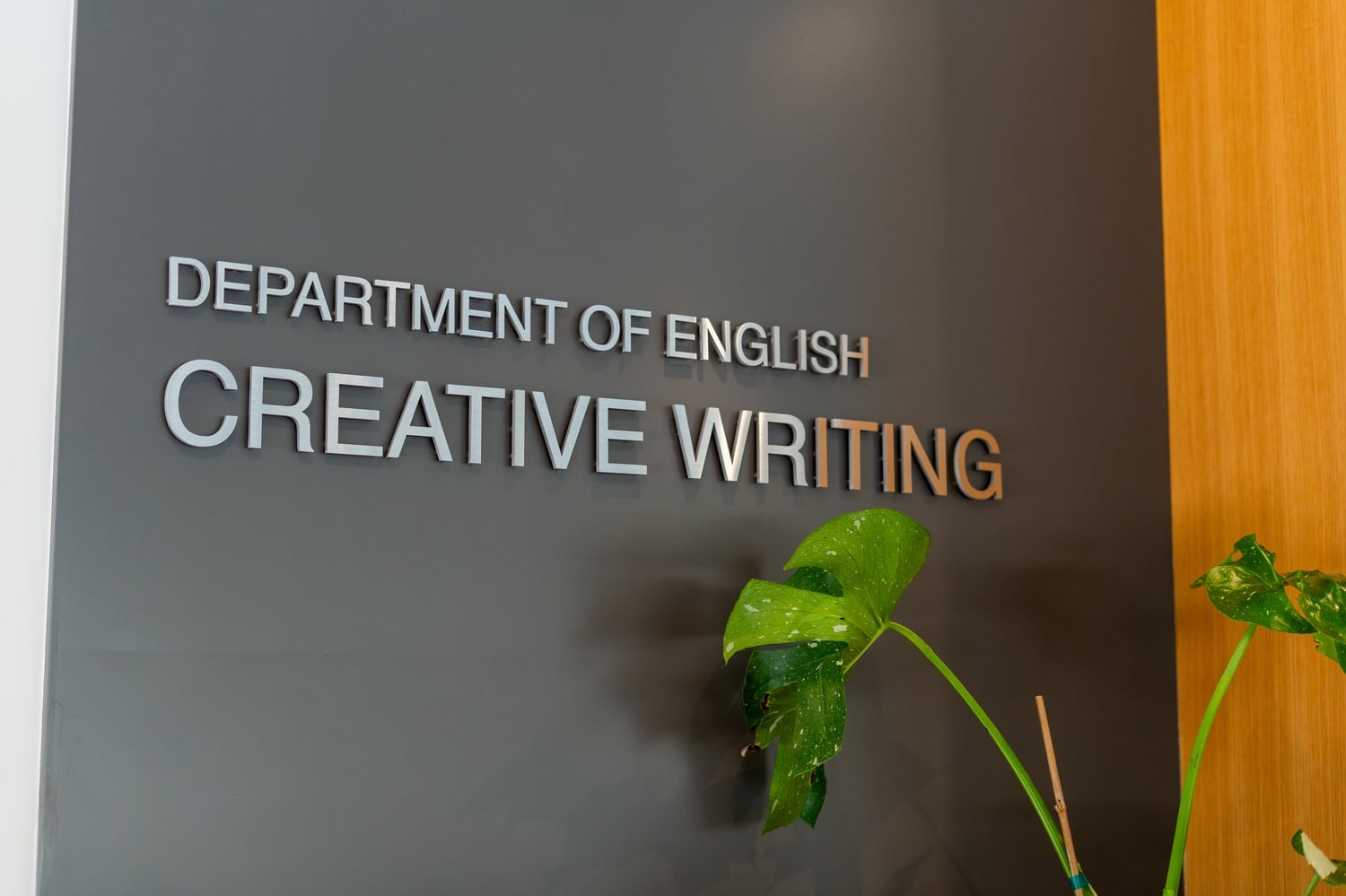
But next academic year, the English Department will introduce a new Emphasis in Creative Writing. In contrast to the concentration’s usual cap at two creative writing workshops among its own open electives, the emphasis will require students to take at least three creative writing courses, at least two of which must be workshops, along with the basic requirements for all English concentrators.
Creative writing has long been established within Harvard’s English Department in the form of workshops and the creative thesis, which gives students the option to spend a year on one creative writing project — a portion of a novel, a play, a collection of poetry.
Historically, however, the path to a creative thesis has not always been clear.
When asked about the need for the emphasis, Laura van der Berg, the department’s creative writing director, lists common questions from students passionate about writing: “What do I do next? What courses should I be taking? What do next steps look like? How do I prepare to write a creative thesis?”
While some students have “been working closely with creative writing faculty” throughout their time at Harvard, and in some sense “doing an unofficial version of a creative writing emphasis,” van der Berg says others may have a “big gap” of a year or more between taking a creative writing workshop and attempting to write a creative thesis.
As of this year, according to van der Berg, about half of theses in the English concentration are creative. As offerings in creative writing have grown to accommodate growing interest, the emphasis is intended to provide a clearer track for interested students towards a creative thesis.
Advising within the creative thesis is both intellectual and practical. Nick White, the department’s assistant director of creative writing, says that even when a thesis advisee has already submitted their writing, they will still meet “because we’re going to talk about MFA programs that she wants to apply to versus internships that she might want to do in publishing and the pros and cons of each.”
According to van der Berg, students frequently ask questions like: “I want to publish my work in a magazine — how do I approach that?” or “How did you publish your first book? What was your path to publication like?”
While creative thesis advising has long aimed to answer such questions about careers in writing, in the past few years, the English Department has been building resources to support students interested in literary careers throughout their undergraduate years. The Literary Careers program has offered information through panels and Q&As throughout the semester and funding through its summer internship fund.
With the new creative writing emphasis track, faculty hope to put students in front of these resources from near the beginning of their time at Harvard.
“By the end, if a student is on the Creative Writing Emphasis, our goal would absolutely be to help them build a toolkit that will support their work as a writer after graduation,” van der Berg says. She hopes in particular that when a student emerges from the emphasis, “they know how to read like a writer.”
Both van der Berg and White say that although the emphasis intends to delineate a clear path for students interested in creative writing that runs alongside the critical work of the English Department; the emphasis will retain the concentration’s common-course and guided-elective requirements while adding creative writing requirements.
“I see all the pathways that the concentration offers as just like different routes through the same forest,” van der Berg says. “We’re all in this space of narrative and language and drama and story and character, but we’’re just taking slightly different pathways through.”
In reference to English faculty, White notes that “all of us, no matter if we do creative or critical work, believe that being a writer means you must first be a reader.”
That relationship between creative and critical writing is reflected in the department’s course offerings, including English 299WC: “Wild Criticism,” taught by Vidyan Ravinthiran, and workshops, such as English CACD: “The Art of Criticism,” taught by Margaret Doherty.
Van der Berg and White highlight the support of non-creative writing faculty in the English Department to help create emphasis, especially Leah Whittington, in her role as the director of undergraduate studies in English and Lauren Bimmler, the undergraduate program administrator.
While the impact of the emphasis will be most felt by future English concentrators, it comes amid a broader push to expand introductory humanities offerings at Harvard. Under Arts and Humanities Dean Sean Kelly, the division has introduced a slate of introductory courses aimed at driving students into humanities fields.
Van der Berg herself is teaching the first iteration of Human 9: “How to Tell a Story” with lecturer Neel Mukherjee this fall as part of that initiative. The open-enrollment course promises to challenge the assumption that to engage in creative writing at Harvard one must have a portfolio full of past experience.
Students may “use the open-enrollment course to learn the foundations of that genre, to write in that genre, and then they emerge from the course with a portfolio of work that they can then use in workshop applications, and they just enter into the workshop with a stronger base and foundation in whatever that genre is,” Van der Berg says.
White hopes that greater accessibility of creative writing may allow for, at least at Harvard, “everyone who is getting a degree in higher education” to “have some experience, whatever that experience looks like, of making art before they leave.”
“I think that is a valuable experience for every person to have, whether that’s making art with words or making art in some other way,” he adds.
Van der Berg agrees.
“I believe so passionately that we all live in story. We all tell stories. We all receive stories, and storytelling,” she says. “Regardless of our field, we use narrative, we use story in some capacity, and so I think any kind of course that works with language, narrative, storytelling has tremendous value for students across all kinds of disciplines.”
—Staff writer Silvia L. Siegel Yousef can be reached at [email protected].