The Future of the Liberal Arts Lies Beyond Harvard’s Gates
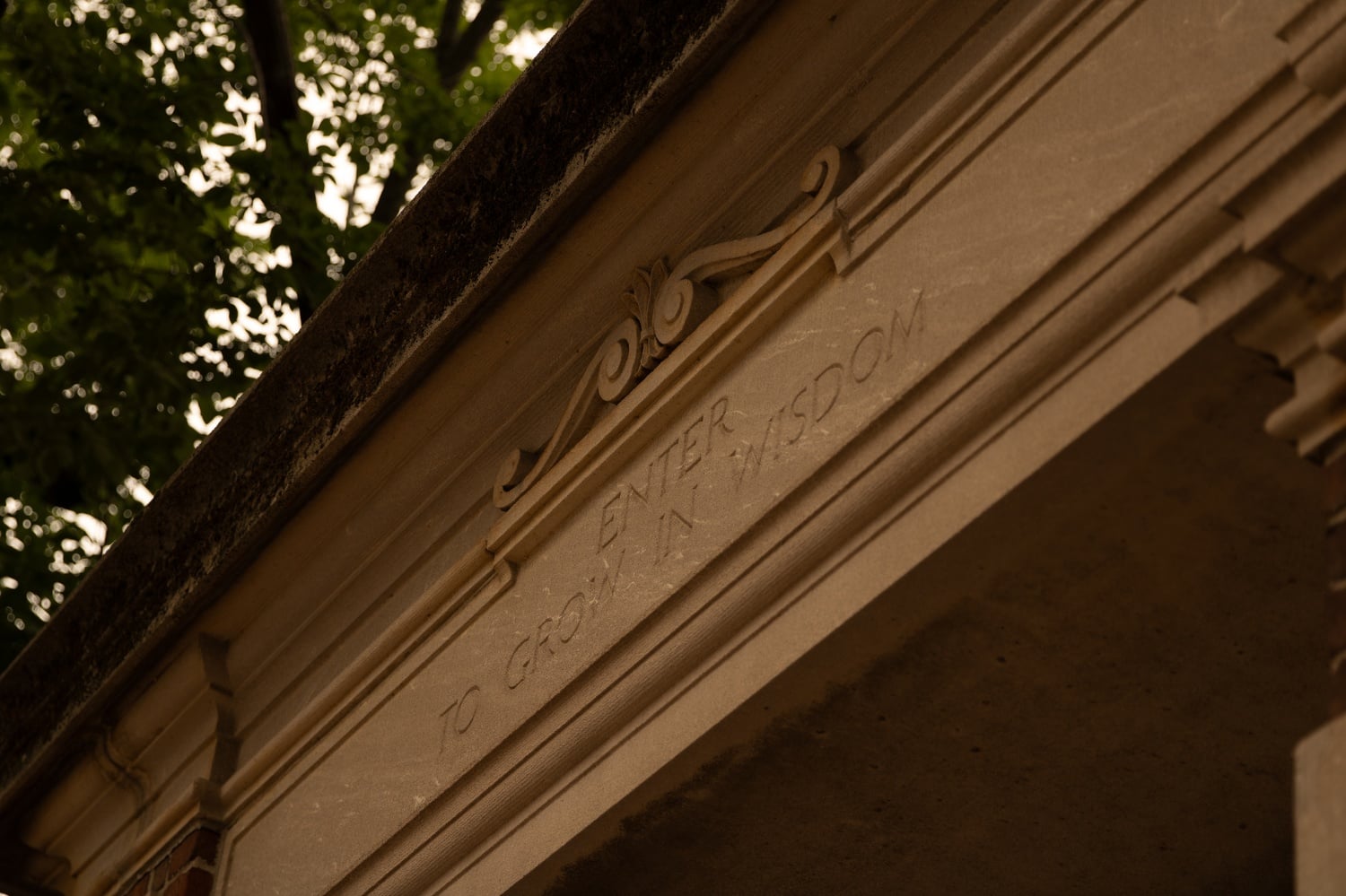
Dexter Gate, my favorite entrance into Harvard Yard, famously bears two missives.
Its invitation, “Enter To Grow in Wisdom,” has been of particular focus lately. The College is facing an inflection point in its history, prompted by public scrutiny, rampant grade inflation, and the proliferation of artificial intelligence.
In response, it has taken marked steps to recenter academics in the student experience — tightening attendance requirements, investing in intellectual vitality, and instituting a controversial 20 percent cap on A grades.
Yet amid all the fanfare, we seem to have forgotten Dexter’s other side: “Depart to Serve Better Thy Country and Thy Kind.”
This summer I set out to cut through the noise and diagnose the state of the liberal arts at Harvard. I spoke with the College’s top administrators and over a dozen undergraduates, and reviewed decades of Harvard’s and The Crimson’s archives.
What I found is not a school in overt crisis, but one overdue for a broader reckoning.
Harvard has begun to think more critically about the role and requirements of its classrooms, but it still needs to grapple with a fundamental moral problem: many of its students appear more interested in making money than doing good with their degrees.
To tackle its careerist culture, the College must refocus on the stated purpose of its liberal arts education and compel its students to contribute to the betterment of the world.
‘The Liberal Arts Are Meant To Serve Society’
Harvard has treated the public good as an important end of its liberal arts education throughout its history — a belief consistently reflected in the College’s academic philosophy.
In the nineteenth century, Harvard President Charles W. Eliot, Class of 1853, shifted the College away from the one-size-fits-all curriculum employed for much of its early history, instead introducing a radical new elective system that allowed students unprecedented agency over their education.
He contended that the elective program would cultivate students with diverse talents, thus better serving the nation. “For the state,” Eliot said, “it is variety, not uniformity, of intellectual product, which is needful.”
Harvard President James B. Conant, Class of 1914, who oversaw the adoption of general education requirements, similarly approached educational reform with service in mind.
The Committee on General Education in a Free Society, commissioned by Conant, argued that the “very prevalence and power of the demand for special training makes doubly clear the need for a concurrent, balancing force in general education.”
“In order to discharge his duties as a citizen adequately, a person must somehow be able to grasp the complexities of life as a whole,” the committee wrote.
These are but two of many similar examples. When a problem in the caliber of Harvard’s undergraduate education was perceived, solutions were often proposed in the name of both student and public good.
The same must happen now.

Today, the College declares that exposure to a diverse range of modes of thinking will “prepare students for leading meaningful lives, with conscientious global citizenship, to enhance the greater good.”
But over the course of my investigation, I found that even while students and administrators largely agree on the importance of working for public betterment, they balk at enforcing such a value.
Dean of Undergraduate Education Amanda Claybaugh traced the College’s conception of the liberal arts back to Conant’s vision for general education.
“Harvard understands, from that moment till now, that the liberal arts are meant to serve society,” Claybaugh said.
Likewise, Harvard College Dean David J. Deming believes the value of a Harvard education should reach beyond its gates.
“Not everyone gets to come to a place like this,” said Deming. “But everyone should benefit from the education that we give here at Harvard.”
While Deming said he hopes students will give back to the world around them, he hesitates to prescribe a specific method of doing so.
“I don’t feel that I should be in the business of telling young people how they should spend their lives,” Deming said.
Dean of Students Thomas G. Dunne identified a pre-professional student culture, but similarly said he wants to respect students’ choices instead of pressuring them towards other paths.
“People have their own reasons to do stuff, and their own motivations and rationales for making particular choices, even in their co-curricular or their career development, that I think are really important to be respectful of,” he said.
But as careerism continues to encroach upon the classroom, this reluctance to more forcefully intervene enables the decay of the College’s nobler goals.
A ‘Funnel’ Into Well-Paid Professions
Students nationwide increasingly conceive of higher education not as a means of intellectual transformation or personal fulfillment, but merely as a ticket to a high-salaried job — and Harvard is no exception. The College has seen a well-documented increase in student pre-professionalism.
The Crimson’s senior survey of the Class of 2026 revealed over half of graduates joining the workforce plan to enter the “Bermuda Triangle” of careers — finance, technology, or consulting. The share of students entering these fields has risen drastically over the past fifteen years, and will likely continue to do so if left unchecked.
“We’re like a funnel into these very well-respected, high-paying jobs,” Zach T. Chen ’28 said. “Most students are using their time here to uplevel their skills and find the best opportunities.”
According to Harvard Undergraduate Association Co-President Zachary D. “Zach” Berg ’28, the culture at the College encourages students to avoid taking academic risks.
“It’s shaped by consulting companies who are now reaching out to people younger and younger, and freshmen worried about recruiting cycles when they never previously were,” Berg said.
A 2025 report released by the Classroom Social Compact Committee supports these ideas. The committee found that students do not prioritize their academics, in part due to overwhelming extracurricular commitments and hunger for pre-professional experience.
If students are drawn to Harvard not for education itself but for what it might add to their resumes, it is no wonder they are disengaged in class, hesitant to discuss controversial topics, and opposed to the prospect of increased academic rigor.

To make matters worse, new AI tools allow already disinterested students to further shortcut their learning — and students are using the technology prolifically.
A survey by the Harvard AI safety group found 88 percent of undergraduates use AI at least weekly. Yet, the College currently has no uniform AI policy, instead allowing individual instructors to guide best practices.
Infractions are difficult to catch and harder to police, meaning student misuse can fly under the radar. In a Crimson survey, nearly 40 percent of students admitted to regularly using AI in ways that may go against course policies.
Five years ago, it may have been true that the College could succeed in its aspirations of cultivating thoughtful public leaders simply by exposing students to ideas that challenge them and encouraging them to think critically about who they are and who they ought to be.
That’s no longer the case. As AI tools proliferate, students are bypassing the very learning intended to instill those values — threatening to accelerate an already troubling digression from public service.
‘We Don’t Insist On It’
Harvard’s career machine is killing its mission.
As its pipeline towards self-serving occupations only grows, the College is overdue for a profound reevaluation of philosophy and policy. But the administration’s apparent wariness to impress specific values upon students stands in its own way.
The Harvard College mission statement expresses a desire for students to learn “how they can best serve the world.” Yet administrators say it’s not a mandate.
“We have a vision of what we would like for our students,” Claybaugh said, “but we don’t insist on it.”
I’d argue that they should.
The privilege bestowed by a Harvard education necessarily instills responsibility. The skills gained through our liberal arts curriculum, coupled with unparalleled access to powerful networks and opportunities, are only on sale to a select group of students each year.
Using the influence of a Harvard degree solely for self-advancement leaves limitless capacity for changemaking on the table — be it through public service, teaching, essential research, or whatever else.
Admittedly, much of the pressure towards pre-professionalism stems from student culture. But the College has worked to amend such issues before. The push to foster intellectual vitality through new funding opportunities and dedicated staff led to notable improvements in student speech culture in only a matter of years.
Unfortunately, the College just threw its strongest pathways to serving the world into disarray.
Recent layoffs overwhelmingly impacted the Center for Public Service and Engaged Scholarship. Hopefully its vital programs will receive more support under the restructuring — not less.
Other efforts could include working through the Mignone Center for Career Success to publicize and fund less traditional vocational pathways with more altruistic goals. Career counselors should encourage students to fully consider their motivations and the responsibilities of their degree before committing to any set path.
Administrators should also consistently remind students of the gravity of a Harvard education and how it ought to influence their future career choices. It is not unreasonable to expect the College to standardize its messaging — on websites, admissions materials, and during high-visibility events like Visitas, Convocation, and Commencement — around more forcefully nudging students toward working for the public good.
Students may not initially be receptive to this campaign. But the institution can’t let that hold it back. Harvard’s liberal arts education seeks to be transformative — and to truly have an impact, it must ask something more concrete of students.
The College seems to be aligned on a common vision: that our graduates emerge with a heart for service, driven into them by a deep awareness of the world around them, the problems it faces, and the duty they owe it as Harvard graduates.
Now it’s time to act.
Victoria L. Dolan ’28, an Associate Editorial Editor, is an English concentrator in Kirkland House.
Want to keep up with breaking news? Subscribe to our email newsletter
Have a tip for The Crimson? Share it confidentially