
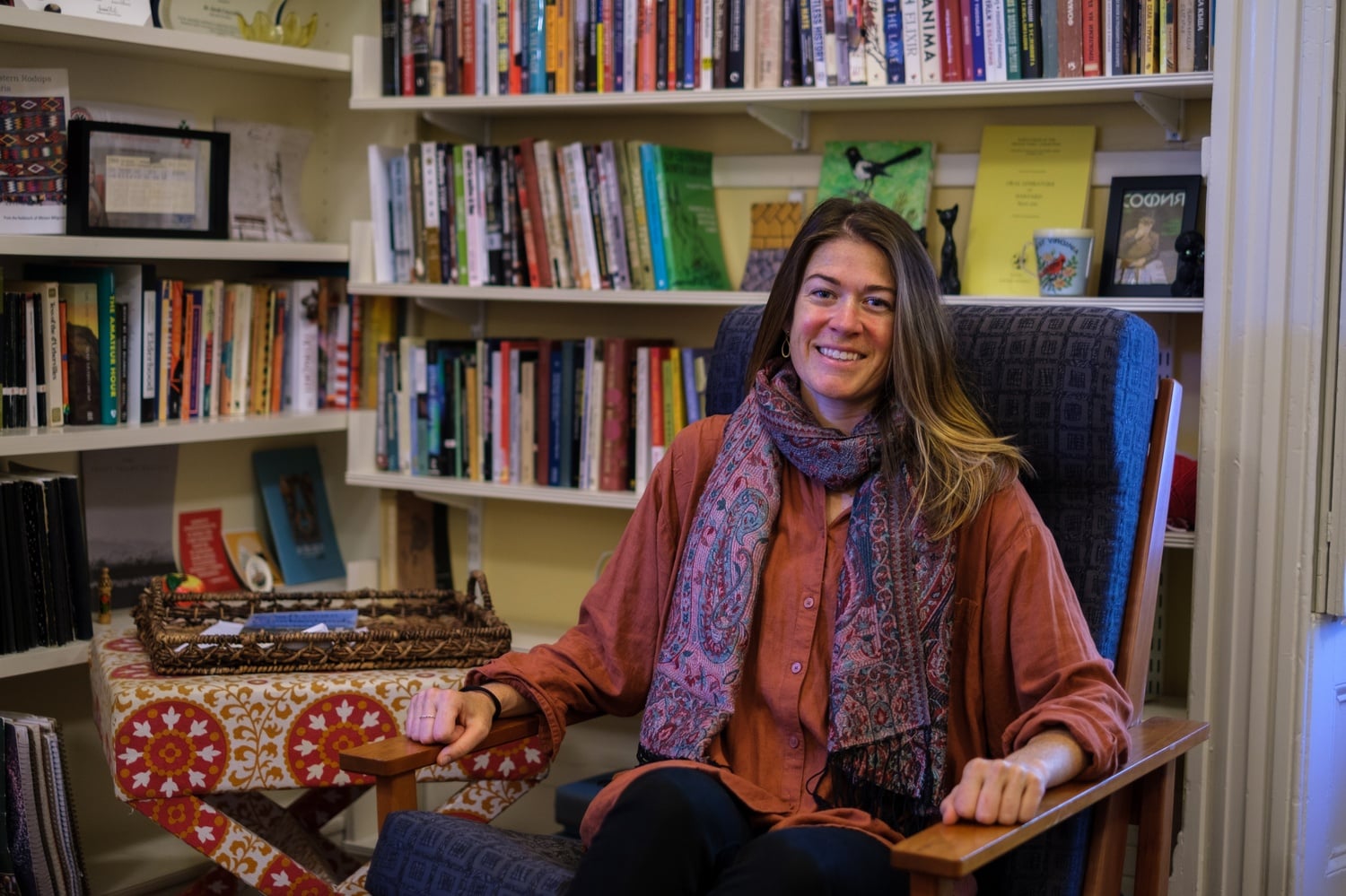
Fifteen Questions: Sarah Craycraft on Granny Witches, the Bulgarian Rural Exodus, and Trad Wives
The Folklore and Mythology Head Tutor Sarah B. Craycraft sat down with Fifteen Minutes to discuss the folkloric role of the grandma figure, how conservative movements interact with tradition, and her experience getting to know Bulgaria.
Sarah B. Craycraft is the head tutor and a lecturer in the Folklore and Mythology department. This interview has been edited for length and clarity.
FM: How did you become interested in folklore as a field of study?
SBC: I had always seen flyers for folklore and felt interested in it, in the English department where I was studying. But I was a first-generation student. I wasn’t going to waste my degree on something silly like folklore.
Then in my senior year, I wanted to write an undergraduate thesis in the English department, and I was just tired of books. I mean, obviously, I love reading. Look around us! But I was like, where are the people?
And I got curious about my little corner of the world — the Appalachian region — and realized there was a whole strong, rich literature about Appalachia, and little by little, I started to understand that there is a focus on folklore in the Appalachian region. So I took a couple of undergraduate folklore classes, specifically so I could write a thesis connected to Appalachia.
FM: Did you have any experience with Appalachian folklore as a kid?
SBC: I guess so, yeah. Not like “gather around the fireplace, y’all! Let’s tell some stories!” That wasn’t my experience, although it is some people’s.
There was a lot of strong ghost lore belief in my family, which I wouldn’t have called ghost lore at the time, but now I look back, and I’m like, okay, maybe this has some regional connections.
FM: Why did you choose to go to Bulgaria?
SBC: It was somewhat of a random choice in some ways. I wanted to apply for the Fulbright program.
I went to the fellowships office, and I said, “I want to apply to this.” And they said, “Do you speak another language?” And I said, “Not other than bad Spanish.” And they said, “Okay, here are five countries where not very many people know the language from.” I don’t remember the other four, but Bulgaria was on there, and they were like, “You have a better chance of getting the grant in a place where there’s not a lot of speakers of this language,” so I applied, looked up Bulgaria, and I was like, “That sounds good.”
FM: What was your first impression of the country?
SBC: I don’t know if I remember my first impression.
All of the Fulbright staff met us at the airport, and they bused us to this resort in the hometown of the former communist leader Todor Zhivkov.
There were just trays and trays of fancy foods and a spa, so it wasn’t like being in Bulgaria. Not to say that Bulgaria is not fancy and luxurious in its own ways, but it was a weird little bubble that we were in.
I thought, “This is beautiful.” It’s a very hilly place, very mountainous.
FM: Did anything break your bubble?
SBC: Actually, when you’re coming out of the Sofia airport — now I’m getting blasts of memory — you drive through one of the Roma neighborhoods, which typically are not serviced by the state. There’s no trash service; often they’re not electrified, or electrification goes off and on. People are living in really difficult circumstances because of systemic injustices. I think that was my first image of Bulgaria: “Oh, there’s a lot of trash. The architecture looks really unstable. Interesting — this is where I have landed.” But later I learned that this is a community that’s really persecuted, so that’s why they don’t have great infrastructure.
FM: From the beginning, were you planning on staying for two years?
SBC: No, absolutely not. I was not planning to go to graduate school. I was going to do my little Fulbright, go back, figure out what job to apply for, and go forward. But my students had very similar stories to me and to young people from my region, which shocked me: “If we want a future, we need to go somewhere else in order to get a good education, get a good job. The future is not here in our hometown. It might not even be in Bulgaria.”
It has a really high depopulation rate — lots of people going to the West, England, Germany, the U.S., Canada for work and study.
Hearing my students say that, which was something that I had been told implicitly and explicitly — “the future is elsewhere; leave to have a future” — that was interesting to me, and it was really what kept me in Bulgaria for that second year, and encouraged me to pursue Bulgarian studies alongside Appalachian studies in folklore. Fun combo.
FM: Is there anything different about Bulgarian folklore compared to other countries around it?
SBC: When we say folklore, we don’t just mean like song, dance, stories. We say it’s the things we say, the things we make, the things we do, and the things we believe. So it can be the material stuff hanging on my wall, things we make. It can be songs, proverbs, jokes, stories, legends, rituals, festivals.
And it’s not just stuff from the past. It’s stuff from the present too — we say that sharing memes is folkloric because it’s the same process of change and transformation as we see with a folk song, which is fun.
What I think is very important to understand about folklore in Bulgaria is that, during the socialist period, folklore was curated by the state. There were some practices, some traditions that the state said, “Yes, this is good. This shows our strong, glorious past. We will allow this. We will stage it.”
FM: You use feminist methods in your research. What does that mean in this context?
SBC: A feminist approach takes into account power dynamics. I’m thinking about how race, class, generations, and gender all impact how people move through the world, and that is a feminist approach. I wouldn’t say that I am a scholar of feminism or gender studies, but in my dissertation research, which became my book research, I was thinking about how some figures are traditionalized or imagined as traditional, particularly the Baba, the grandma, in Bulgaria. I’m interested in this question in Appalachia as well. Why is it that we look at grandmothers as extra folkloric? There are some things that we might imagine particular genders do, which may or may not be reality, and that interests me. That we gender tradition and we gender folklore.
A feminist approach is going to question the expertise of the researchers themselves as having the first and last statement. So I think of myself less as the expert when I’m out in the field, and more like a person trying to understand what these experiences, what these traditions mean to the people that I’m working with. Feminist approaches are always trying to check our understanding, trying to be reflexive about how we, the researchers, the scholars, move through the world. It’s not going, doing a little study and then leaving. It is being in communication with people, trying to understand what my presence there means for them, and trying to let them get to know me, just as I’m asking them to share about their lives for my work.
FM: I thought it was interesting that you mentioned jokes as a part of folklore. Are there any Bulgarian jokes you like?
SBC: I’m thinking of inappropriate jokes that I will not say for The Crimson. I don’t know if I can think of a good one right now.
FM: Any special Bulgarian folk stories?
SBC: I really like all of the stories that are connected to Baba Marta, which means “Grandmother March.”
On the first of March — not just in Bulgaria but in Romania and the Western Balkans too — folks make these red and white bracelets, and they hand them out as a wish for a healthy and happy year. March is personified, like here with Groundhog Day in the U.S.
There are all these stories about what kind of person Baba Marta is, and then there’s this fun calendar custom that’s attached to it. I really like those stories, and anything connected to Cheshma, which is a water fountain that you find all over the roadsides.
FM: You’ve taught a class titled “From Trad Lives to Trad Wives.” What drew you to tradwives as a subject of study?
SBC: Anytime I would tell students that I research — that my book project was about young people going, quote unquote, “back to the land” in Bulgaria, young people tired of city life, or looking for something outside of city life, looking for answers in villages — they would immediately say, “like trad wives?”
Tradwives was given to me as something I should pay attention to by you all, the students. And I found it completely fascinating that in a lot of different places right now, we have people who are supposed to be looking to cities — modern, urban, cosmopolitan — and yet a lot of young people your age — 20s, 30s, my age — are instead interested in what we might think of as traditional ways of life, but with very different politics and ideologies behind it.
My friends who are going to the villages in Bulgaria and the people that I interviewed and worked with, they’re not looking for a traditional heterosexual relationship situation necessarily. Many of them are artists. They’re fascinated with traditional textiles, herbal remedies, just living closer to the land. But then that same kind of draw is also connected with different ideas of what it means to make a family.
FM: What can folklore tell us about conservative movements’ appeal to the past and these values?
SBC: One thing that folklorists try not to do is to stigmatize. We try not to stigmatize what motivates people, and instead to say, “Why are these beliefs — these practices that I may not agree with — why are they meaningful for people around the world?”
A really good example of this is the literature out of folklore on conspiracy theory.
Scholars, primarily of legend, are taking those lessons and looking at the kinds of narratives and the paths of transformation and spread of conspiracy theories, and saying, where do these beliefs come from? How might we understand it as a kind of grassroots sense-making? And then, if we see that these beliefs are becoming dangerous, so they’re isolating people from their families, how can we respond to people without denigrating them, without saying,
“You believe this or that, I think you’re an idiot?” How can we instead approach belief through this understanding that we live in a media and information and news landscape that is very polarized, that is algorithmically controlled, and that is shaping how we live our lives every day?
FM: Are there any other internet trends you’re interested in?
SBC: I’ve been following for some time the different kinds of images of Appalachian grandmas, or mamaw, or meemaws — you’ll hear all three — that are shown on TikTok and Instagram.
She’s normally kind of a white, garbled lady. She’s typically not a woman of color, or if she is, she’s marked a little bit differently. So I’m interested in the kinds of bodies that travel with the ideas attached to them. I’m also interested in the grannies from that region who themselves are on TikTok and Instagram, and what kinds of content they’re making.
And then in Bulgaria, I’ve become very interested in young people moving to Bulgaria and the Balkans to live in villages specifically. Have you heard of Justus Reid? My 5000 euro house?
FM: I don’t think I have.
SBC: Look it up. It’s an American who bought a house in, I think it’s Croatia, very cheap, and made an entire YouTube series or internet series, with sponsors and everything, of him renovating it. Very dramatic, interesting. Ties to some questions I have about rural gentrification. I’ve been interested in all of the social media content around reviving villages, or exploring them as these haunted, abandoned ruins of the past.
FM: You’ve long played ultimate frisbee, but now you’re also learning Bulgarian horo. How are you learning horo?
SBC: I go to dance classes every Friday in Arlington. I have a wonderful teacher. His name is
Petre Petrov. He goes by Pepe.
It’s a work in progress. I know some dances I can do them quite well without any leaders, but the others I have to wait until I see them.
FM: You’re unfortunately leaving Harvard at the end of this year. What are you looking forward to in the next stage of your life?
SBC: I’m starting a position in January at Louisiana State University in their English department. I’ll be an incoming assistant professor of folklore, and that’s a tenure track job, which is very exciting. So I’m looking forward to having stability. I’m starting some new research projects about this grandma figure in Appalachia, but also water lore in Bulgaria and the Balkans. So I’m looking forward to having a little more time to dedicate to that research. I’m very excited to get to learn about the different communities and cultures in Southern Louisiana.
—Magazine writer Maria Borrell Ferrero can be reached at [email protected]