How To: Cambridge Construction
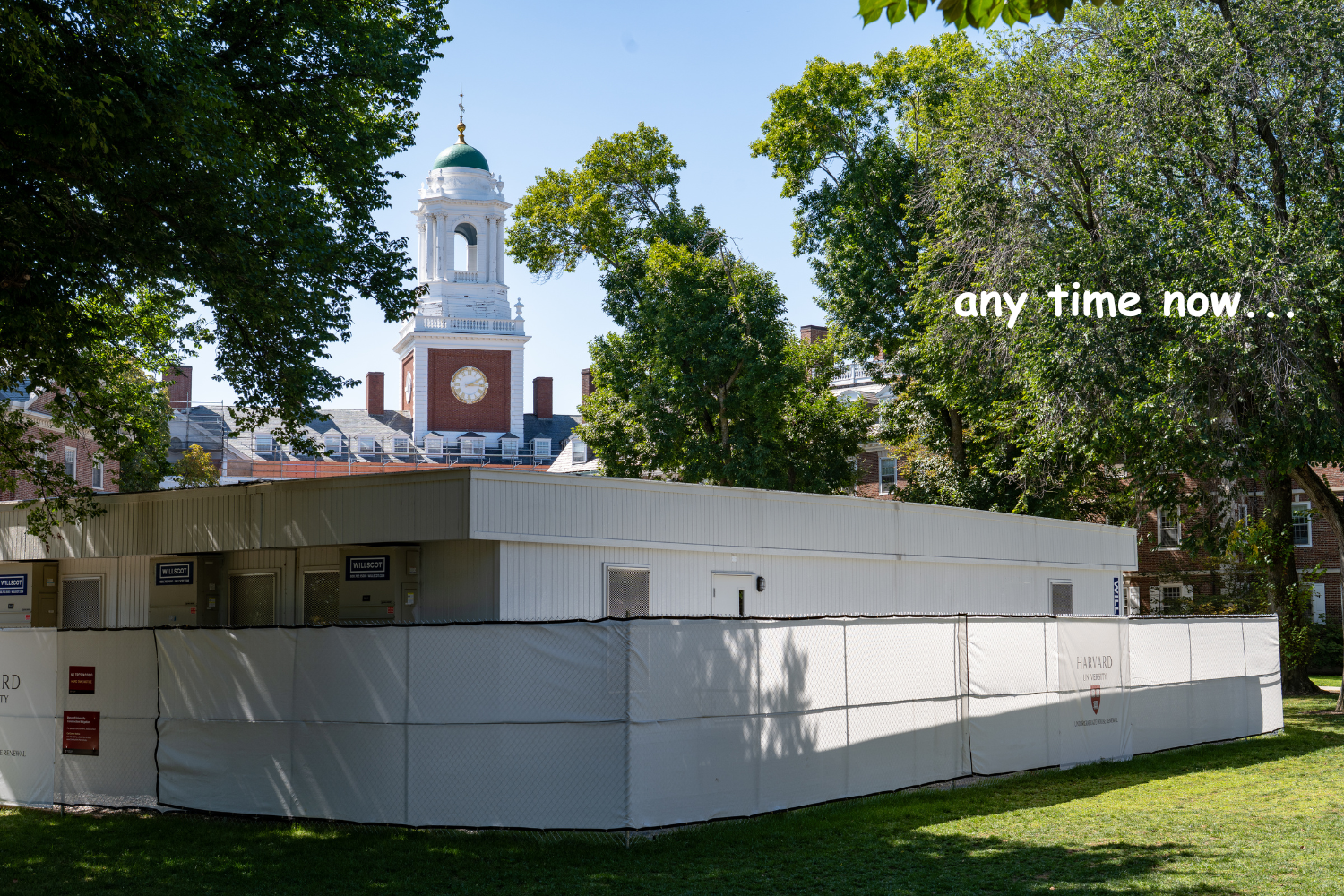
With Eliot House, Eliot Bridge, and everything else I can think of with Eliot in its name (exactly zero things, to be clear) under repair, construction has been the name of the game in Cambridge lately.
A humble writer without a scooter who spends quite a bit of time looking at Cambridge construction projects, I’ve picked up on a few common threads. As an unsolicited service to aspiring developers, I have taken the liberty of creating a blueprint, if you will, for a prototypical Cambridge construction project. My credentials? Virtually none, though I did run past MIT the other day, and their mascot is an engineer. So, there’s that.
Step 1: Set a deadline you cannot meet.
This step is critical. Without it, you run the risk of finishing on time. Ideally, of course, your project stalls indefinitely. But if you do plan on finishing at a finite point in time, it’s best to set an arbitrary finish date strictly before expected completion in order to maximize the community’s hopes for the project. One historically effective strategy for this is the dart-the-chart approach, where you blindfold yourself and launch a dart in the general direction of a calendar to determine an end date. Another tried-and-true approach, which potentially avoids miscalibrated dart-related injuries, is to offer a range: “2-7 years; subject to change.”
Remember: prepare to fail; don’t fail to prepare. Set those deadlines, folks.
Step 2: Only block convenient walkways.
It’s important to consider how your project affects students and commuters in the community. If folks seem to be able to circumvent your project site with relative ease, you’re doing something wrong. To avoid this, try to obstruct as much of the surrounding sidewalks, streets, and trails as possible. In the interest of resource conservation, it’s best not to block any lesser-used walkways; obstructing those is unlikely to have a significant impact on quality of life.
Optimizing for inconvenience, be sure to include a confusing detour around your site for any parties affected by the obstruction. Ideal detour length depends on the size of the project, though as a general rule of thumb, it should range from about a quarter mile to the size of the Atlanta Aquarium. Some shapes to look at for detour inspiration include: circles, spirals, and möbius strips.
A well-designed detour holds many understated benefits for commuters, including increased average daily step counts and greater appreciation for local geography.
Step 3: Never let anyone know your next move.
If the community has any idea what you’re constructing, your project is as good as over. To avoid this unwanted scrutiny, be sure to make it maximally unclear what is going on at any given point in time. Some strategies are: make no visible progress in the project’s first sixteen months; keep construction workers as far from the site as possible; and throw up some abnormally high, quasi-opaque fences around a dug-up dirt patch. (Clarification: the dug-up dirt patch does not have to be the construction site itself for this strategy to be effective.)
Step 4: Optimize for study times.
Harvard students work tirelessly around the clock — it’s important to be considerate of their “fun” time. To best meet this goal, align your construction schedule with peak study times. Concretely, this might look like continuous jackhammering from 7 a.m. to 6 p.m. on weekdays, extended bulldozing hours during midterm season, or a second location closer to libraries and houses. (Again, said satellite location does not have to be a construction site itself for this strategy to be effective.)
If you’ve followed the above four steps, all that remains is —
Step 5: Let it rip.
Hopefully, by following this guide, you, too, will be empowered to construct something few asked for, all while carefully considering how your construction affects the community. Cheers to road shutdowns, noise ordinance violations, and all the progress setbacks one can dream of.