
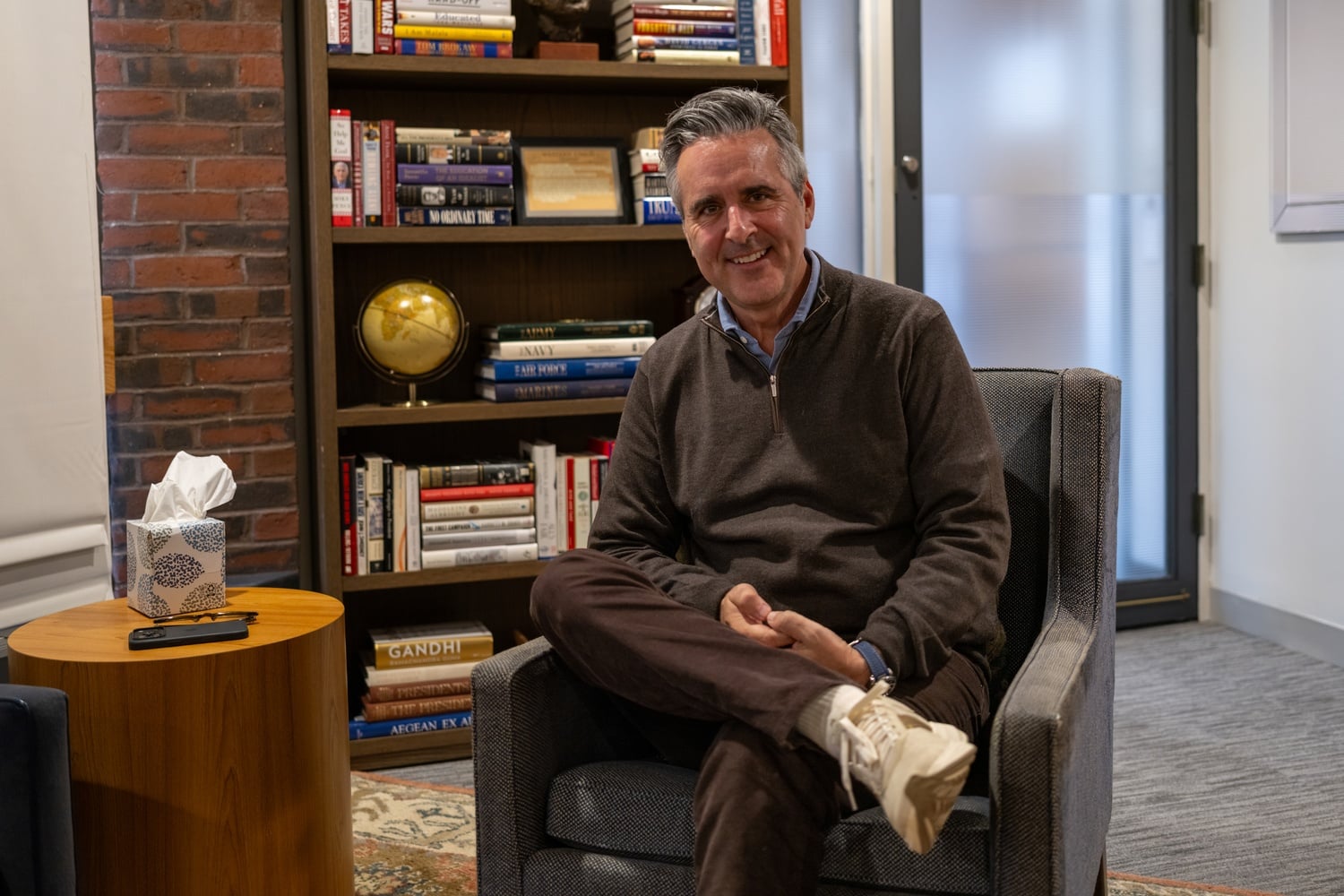
John Della Volpe on Public Opinion Research, the Democratic Party, and Being the ‘Gen Z Whisperer’
The IOP’s director of polling sat down with Fifteen Minutes to discuss Gen Z, AI, and the future of the IOP.
John Della Volpe is the director of polling at the Harvard Kennedy School’s Institute of Politics. He oversees the Harvard Public Opinion Project, which administers the largest nationwide poll on the political opinions of those between the ages 18 and 29. This interview has been edited for length and clarity.
FM: You’ve been the Director of Polling here at the Harvard Institute of Politics for about 26 years now. What motivates you to keep doing this work?
JDV: Every semester, spending time with students gives me so much energy, and I never really know or can anticipate the kinds of questions that they’’re interested in learning the answers to, or to more deeply understand. And I think, from my perspective, that is an incredibly fortunate position to be in, because I can — through the eyes of students — stay in touch with your generation, their generation, and a generation of Americans.
FM: What is it like working with Harvard students through HPOP to run the Harvard Youth Poll each year?
JDV: I love it. Every semester is new. What I really like about this is how diverse the students are that I engage with, and how serious they take their responsibility.
I can’t think of anything that’s more important than spending time with younger people, trying to mentor them a little bit, teach them a skill or two, but ultimately, share their voice and the voice of their generation. It keeps me curious every single day.
FM: Have you found that Americans in the past few decades have become more or less trusting of polls?
JDV: Americans have become less trusting of virtually everything over the last decades, and probably polls as well. But, when we talk about polling, the way in which we think about that is different, perhaps, than the way the general public might think about that.
The general public might think about polling from what they see on a RealClearPolling average on a Nate Silver blog or post in terms of who’s winning or who’s losing a particular race at a particular moment in time. The way in which we apply polling and public opinion and survey research at the Institute of Politics isn’t to predict something in the future, it’s to better understand the lives of 18 to 29 year olds. And that’s a very different approach than the simple horse race polling that I think a lot of the general public might think is representative of our industry.
FM: Politico called you the “Gen Z Whisperer.” What do you think older folks get wrong about Gen Z today?
JDV: I think it’s hard to generalize.
People of other generations often don’t appreciate the fact that younger Americans, Gen Z, have grown up in a culture largely of chaos.
Younger people tell me, regardless of where I am, that largely they don’t remember a time when America felt connected, or where they could feel real proud to be American.
I always say that one of the ways in which I distinguish between Gen Zers and Millennials is: does an individual have a living memory of 9/11? And if they do, that also means they remember September 12 and 13th, when, regardless of whether we were in Cambridge, Massachusetts, or Davenport, Iowa, people, by and large, were patriotic. They hung flags, and we were joined together under a common identity. Gen Zers don’t have those memories. Instead, they would tell me that growing up there was a lot of anxiety around the house, often because of financial reasons, in the aftermath of 9/11, and then of course the financial crisis. Still today, I meet Gen Zers who have nightmares because some of their first memories in elementary school were perhaps hiding under a desk or in a closet for what we call “red alert” school shooting drills. By the time many Gen Zers were in middle school or high school, sadly, they would tell me that they attend wakes or funerals for classmates,whether it was because of deaths by suicide — which increased when Gen Zers turned age 13 about double digit increases across every state — or through opioids or some other drug-induced death. And that’s before Covid, and that’s before Parkland and concerns about climate
When we put that into context for older people, they begin to understand and have a little bit more empathy, specifically on the impact of all that trauma and chaos has had on someone’s life and their maturity.
I think the third group of things that a lot of older people don’t fully appreciate is the fact that millions and millions of young Americans were told that if you work hard, you go to school, you prepare yourself for life after that — that the version of the American dream that we had as Gen Xers would still be available, and that’s clearly not the case anymore.
Those are the three buckets: the era in which they’ve grown, and the disconnect from institutions that are supposed to protect them, one. The second is how that has led to mental health. The third, the very direct impact of the cost of education, healthcare, and a job market that seems to be getting more challenging rather than easier to find its place in.
FM: As the Gen Z Whisperer, do you keep up with Gen Z slang?
JDV: It’s harder and harder every year. I find myself getting more disconnected, but I try.
FM: What’s your favorite slang?
JDV: You know, there are the obvious ones: “rizz” and “mid.” Uh, “slaps” — is that already passé?
My favorite? I think “mid.” The reason I say that is because I think Gen Z has a high standard, right? And I think they’re pretty clear when something doesn’t meet that. So I think they feel free to share their direct opinion.
FM: In 2020, you stepped away from the IOP briefly to work on the Biden-Harris campaign. What did you learn from that experience?
JDV: I learned so much. From a polling perspective, what I learned was that I think that was the first campaign where the polling unit was set up with subject matter experts as well as presidential battleground state pollsters.
What I appreciated about that approach was that younger people from my lens, Hispanic Americans, African Americans, and women were essentially that data was shared, you know, and was a part of every strategic decision that the campaign made. So, I appreciated being one member of that broader team.
When one of our fellow pollsters was reporting on something from Arizona, Georgia, Carolina, Michigan, what have you — they would have what was happening in the state, but we could overlay that with a deeper understanding.
Through that we learned things that otherwise would have been missed because most polls, whether it’s at the presidential level or otherwise, would only have maybe 100, a couple hundred younger people in there. So I give a lot of credit to President Biden and his campaign team to ensure that younger people had a virtual seat at the table.
FM: Why do you think the Democrats lost in 2024?
JDV: The Harris campaign didn’t make the economic message central to their campaign with young people, specifically in the final weeks. I spend a lot of time on this campus, on other campuses, speaking with younger people. The young women I spoke to, who were independent-minded in the final days, would say things like: “I care deeply about reproductive health. I care deeply about climate, environment, and other things. But I also appreciate the fact that even if Kamala Harris wins, it’s not going to change my access to abortion or anything else because that’s a Supreme Court decision, and I just wish you spent more time talking about the economy.”
So I think an overreliance on issues other than the economy is probably the central reason why she lost. In fact, I just last week gave a presentation of some of our focus groups to HPOP here, and one of the clips I showed was from the spring of 2024, where a young woman said, “I’m just trying every single day to keep my head above water, to tread water. I care about guns, I care about reproductive health, but I just need to focus on the economy,” and ultimately, I think that is the reason why.
FM: During the 2024 election, you wrote a NYT op-ed about how Trump’s focus on young men might cost Democrats the election. Now, two years down the line, with upcoming elections, how does that thesis hold today?
JDV: Well, I think it was accurate. Two years later, we’ve got a greater understanding in terms of why.
I think that the Democratic Party has had a history of taking younger people for granted — taking lots of groups for granted, particularly younger people — and not making an effort to stay relevant and to give them a voice.
But in hindsight, when we look at those young men who either voted for the first time for Republicans or switched from Independent or Democrats to Republicans, the lesson was — I feel confident about that — it’s not because of some major ideological shift. I don’t think we see spikes in the number of young men becoming self-identify as more conservative or even Republican. This was a moment when Donald Trump was in many ways forced to find ways to expand the electorate because he lost last time. He needed to find more votes. The second thing is there’s an opportunity to find votes from people who hadn’t voted before.
Virtually every young man that I’ve interviewed talks about the importance of being a provider and protector for the folks that they care about, in their lives or the community. Donald Trump understood that it’s hard to be a provider and protect or feel good about yourself as a young person or as a young man if you can’t provide and protect for yourself because of economics, right?
So he spoke to young men. His campaign spent tens of millions of dollars offering a narrative that would give young people, young men in particular, strength — strength that would be driven from an economy that would work for them, and a focus on domestic and not foreign policy issues like wars. That was a major driver of the messaging and why so many young men chose to vote Republican in 2024.
FM: Do you think the Democratic Party has learned its lesson?
JDV: I don’t know if the Democratic Party writ large has learned its lesson.
What I do know is that there are a lot of candidates associated with or aligned with the Democratic Party that seem to be speaking more directly to youth concerns.
I think Mayor Mamdani fits that. I think Talarico fits that. El-Sayed in Michigan. I think that the governors of New Jersey and Virginia speak to that. So, I do think that the individual candidates understand the importance of youth vote, the importance of speaking to their day-to-day lived experience and not taking them for granted.
I think, largely, the rank-and-file members of the Democratic Party understand that. The apparatus itself, I don’t know.
FM: How do you think the rise of AI is shaping how young Americans interact or don’t interact with the political system?
JDV: Largely, I hear in my conversations and focus groups where it makes it more challenging to identify what’s real and what’s not real through deep fakes and other things, so that’s a question that further weakens trust in institutions and communications and campaigns. That’s not helpful.
Let me tell you how I’m using it.
Outside of Harvard, I’ve been working with a team to essentially develop a digital twin of myself, which means that it’s trained on a lot of my interviewing style, kinds of questions I’ve asked, the approach to the order of those questions, et cetera.
Every single night we are interviewing dozens, if not hundreds, of people around the country. Through this AI conversational agent, where younger and older Americans are having an open-ended conversation, not unlike this, with a voice that sounds like me.
Eighty-four percent give us permission to share not just their response but their actual interview, their own voice. And when my AI twin asks the participants why, they say “because no one’s ever asked me those questions before. I’ve never had an opportunity to truly tell someone how I believe, or what’s stressing me out, or to explain something in a way that’s not on a Likert scale, and more importantly, to have an honest conversation without feeling judged or shamed.”
So there are plenty of negative consequences surrounding AI. There are obviously some things that make me optimistic around its application to science, but one of the one of the true surprises that I’ve learned from that is the degree to which Americans of all ages feel a need to share their voice in a venue where they feel respected and understood. That can happen on AI. That could also happen in other kinds of offline research, but to me, that’s one of the most interesting and exciting things that I’ve discovered in the last year.
FM: Is using AI conversational tools for polling something you guys are uniquely doing, or is it happening with other polling companies as well?
JDV: There are dozens of AI-related tools that are being used today in market research. There are fewer being applied to public opinion research. I think our technique that we’re developing is unique in the public opinion space. We call it Big Qual.
AI allows us to fill that space between depth and scale. We now have the ability to have hundreds and thousands of conversations — literally around the world — that provide a scale, but also a richness of data that never existed before. So that is, I believe, unique.
We’re creating access to databases that allow leaders and other members of our community, including parents, to never have an opportunity to understand what Gen Z thinks by tapping into this database and resource.
FM: Does it ever weird you out to know that you have an AI twin asking people questions?
JDV: I try not to think about it.
FM: What is the single most important thing young Americans care about right now?
JDV: Having a place to sleep at night. The number of young Americans that I interact with through focus groups who are on the verge of currently or had recently been homeless is staggering, absolutely staggering.
At the end of the day, it’s about the basics, right? Do I have enough resources available to keep a roof over my head? I think that’s essentially it.
FM: The world today is vastly different than it’s ever been, in more ways than one. What do you think it’s going to take for young and old Americans to rally together, or do you think that’s even possible?
JDV: I do think it’s possible. I think that it’s more possible every day. I think it’s happening in other parts of the world that are worth paying attention to. I think that the generation of leaders we have today seem to me to be more interested in understanding younger people than ever before.
I’m still hopeful that my generation will work collectively with your generation to solve some of these challenges.
I recently met a young man who served in the United States Army, and then after retiring from the army, went to work in his parents’ restaurant. But he cut his hand, and needed nine stitches. When he went to the minute clinic, the doctor told him it would cost $500 for the stitches and $800 for anesthesia. In America in 2026, someone who put his life on the line for our country, that young man had to make a decision at that point.
Of course, he paid for rent and took nine stitches without anesthesia.
I’m hopeful that when we can share those stories and our students can elevate their own experiences, older generations — whether they’re in politics or in other forms of civic or private life — will work and find a common agenda and a method of making progress on those issues.
FM: October marks the IOP’s 60th anniversary. What do you see as Harvard’s role in politics in the past, and how do you think it’s going to change in the future?
JDV: I think that the vision of President Kennedy and his family was to create a unique space in American life where younger people could engage directly with political leaders and political community. Whether they enter public service directly, they would certainly understand the importance of engaging in civic life.
I think that role and this Institute will only play an even more important role in the future, especially when we see a decline in trust in institutions. The best way to enhance reputation or to garner more trust is through direct engagement and understanding with the leaders from the Democratic Party, Republican Party, and the institutions that they govern.
So as politics has become more fractious, as the divisions become more contentious, I remain hopeful that the IOP can play an important role as a convener and as an opportunity for younger people to engage directly with members of the political community.
—Associate magazine editor Charan S. Bala can be reached at [email protected].