
Peter Petrov Dances Himself
Peter I. Petrov teaches Bulgarian folk dance in Arlington each week. It’s an art form he “can’t exist” without.
f you find yourself at the Arlington Masonic Temple on a Friday, chances are you’ll hear Bulgarian folk music seeping through the windows of the upper floors. Through the glass, you may even spot people standing in a circle, hand-in-hand, dancing along to the rhythmic tunes.
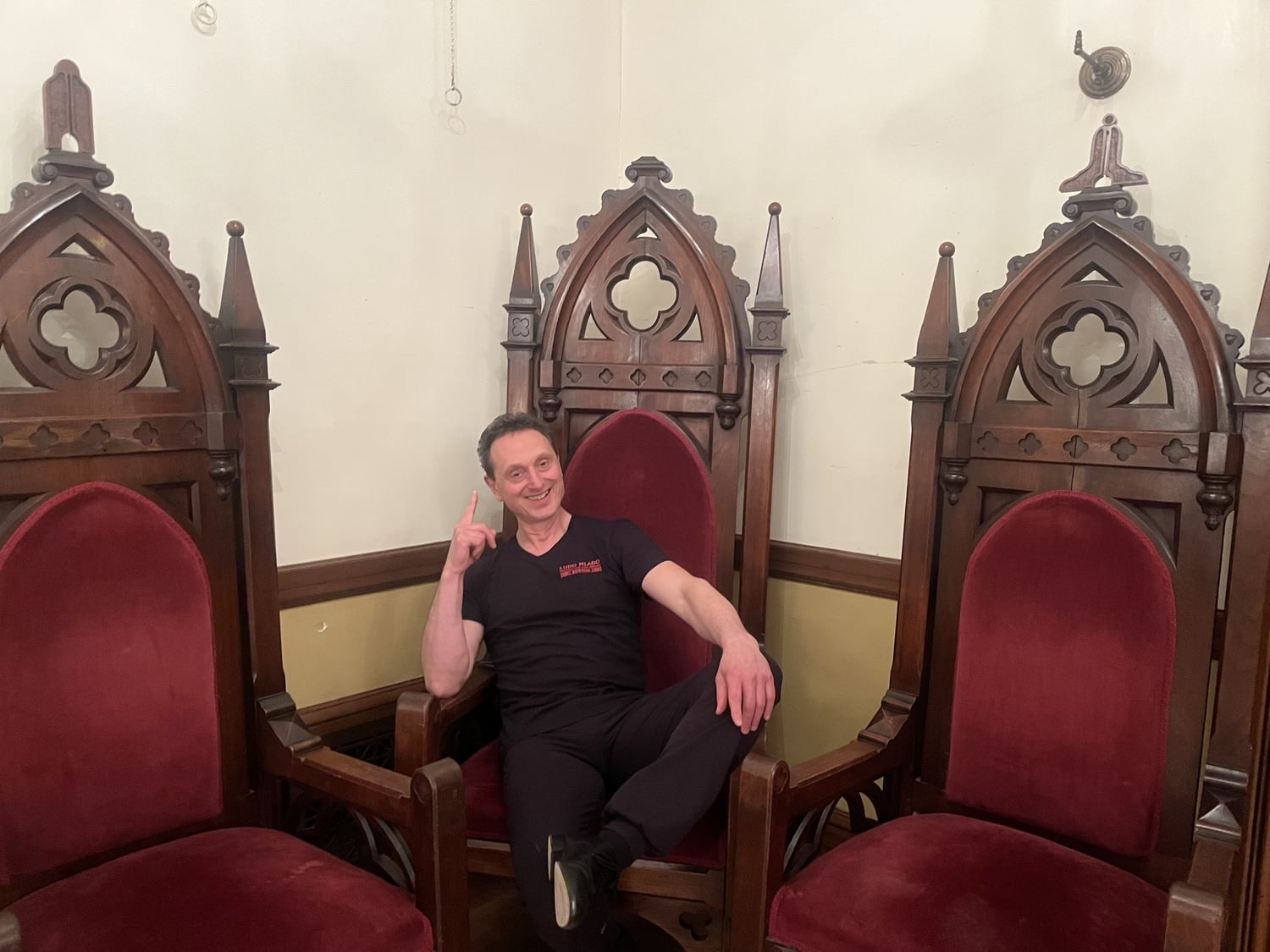
Often found at the center of this circle, instructing one minute and freestyling the next, is Peter I. Petrov. A Bulgarian immigrant, former professional folk dancer, and current instructor, Petrov has enjoyed a long relationship with the art of dance.
It all began at the age of 7, when he was captivated by dance.
“I was living with my grandparents in the village, and every Sunday afternoon in the square of the village, they would have a live music performance,” Petrov says. He recalls being mesmerized by people dancing hand-in-hand in a line, as is common in the Bulgarian tradition.
Unable to resist the allure of dance, he and the other children jumped in. “When I was running around and crossing the lines, something kind of sparked,” he adds, “I wanted to learn how to do it.”
Decades later, this spark has only grown stronger. Retired from his professional dance career, Petrov now teaches folk dance to a wide range of students. He works with the Bulgarian dance ensemble Ludo Mlado, and he offers more casual instruction for recreational dancers on Fridays.
“We’ve been around for 25 years,” Petrov says with pride. “We have traveled a lot over the years, all over the United States and Canada.”
His connection to the Cambridge-area Bulgarian dance scene began in the early 2000s. He was teaching at a studio in Harvard Square when members of a Bulgarian affinity group at Harvard took one of his classes. He remembers them liking it so much that they asked him to bring his workshops to campus. They attracted Bulgarian students and others curious about this art form.
“We had a dance performance at the School of Business on the other side of the Charles River,” Petrov says. “I’m still in touch with some of the former students that used to dance with me there.”
Now, Petrov continues his involvement in the Harvard community through his friendship with Sarah B. Craycraft, a lecturer in the Folklore and Mythology department, and often gives workshops to her students.
For the past few years, Petrov has taught workshops and given demonstrations for students of General Education 1196: “Tradition in Everyday Life” and the Folklore and Mythology sophomore tutorial.
Upon arriving as a guest speaker, Petrov recalls, “Students would ask me questions, then we would move the tables, and we’d dance.”
A notable part of any Petrov-led workshop happens at the very end: once the music has wound down and stretches have ceased, Petrov faces away from the crowd of students. He taps his head and heart with one hand, then bows twice—once to his left, and once to his right. Then, facing his students, he repeats the same movements.
Petrov attributes this ritual to a friend he made early on in his professional dancing career who had a lasting impact on him.
The two met at the beginning of their dancing careers. Though at the time Petrov was already a “very good dancer,” Petrov felt he was still “missing something.” He turned to this friend for advice.
Petrov recalls his friend asking him: “Do you dance yourself or do you dance somebody else?”
Petrov was taken aback by the phrasing. But the more he thought about it, the more he understood the wise words of his friend.
“I would learn the structure and I would dance the structure, and I’d be the best at doing the structure, but my soul wasn’t connecting with it,” Petrov says. “He opened that door for me to get inside of myself and to really put my soul into the dance.”
Petrov’s ritual at the end of every class honors his friend, who died in a car crash in 1995. For Petrov, bowing in every direction reminds him of what he learned from his friend about dancing himself and putting his soul into the steps.
“This is his memory: just connecting with everything,” says Petrov.
Petrov identifies dance as an essential part of life, as inextricable from human existence as breathing.
“My relationship to dance is that I can’t exist without it,” he says. “I cannot be who I am without the dance.”
—Magazine writer Micaela S. Arenas can be reached at [email protected]