
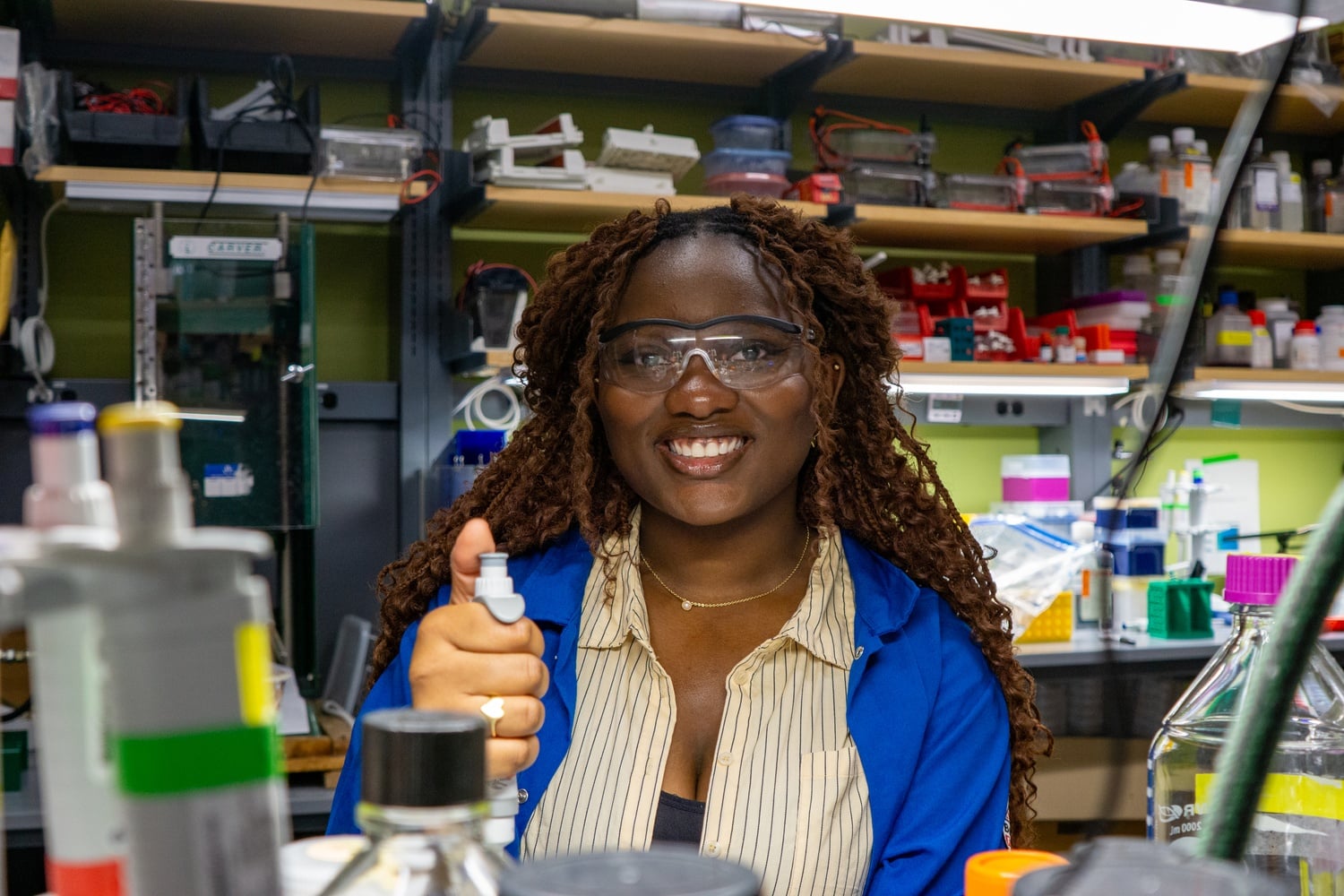
Most Interesting Thesis: Michaela Uloho-Okundaye
Michaela is attacking epilepsy head-on in a two-pronged project.
For Michaela O. Uloho-Okundaye ’27, writing a senior thesis is personal.
When she was 10, Michaela was diagnosed with Rolandic epilepsy, a neurological condition that causes seizures during childhood development. She’d continue to have epileptic seizures through the age of 16.
“I was two years seizure-free when I graduated high school,” she tells me.
Now, the Quincy House resident is attacking epilepsy head-on in a two-pronged project. In neuroscience, she investigates cytotoxic edema — brain swelling — and asks how disruptions in chloride ion gradients play a role in cell death. From a global health perspective, she examines the role of stigma in epilepsy patient education and treatment in Africa.
When we meet for the first time at one of the round tables by the Quincy Grille, I am struck by her warmth. Having grown up in Winnipeg, Manitoba, the Nigerian-Canadian lives up to the Canadian reputation of unabashed friendliness — even after a long day of laboratory work. Michaela estimates she spends around 16 hours each week doing lab work. (I spend at best four hours a week in a lab, yet I’m not nearly as lively and personable.)
Back home, Michela’s own pediatric neurologist served as early inspiration “to look at the scientific perspective” of her condition. The lab she is now working on her thesis with — the Pediatric Epilepsy Research Lab at Massachusetts General Hospital — was on her radar even before she began interning there last year.
“I didn’t actually apply to my lab until my junior year,” she says, “because I knew I wanted to use it for my thesis.”
She jokes that she “came into college with you in mind” — “you” being the lab — as she reenacts her first cold email for me.
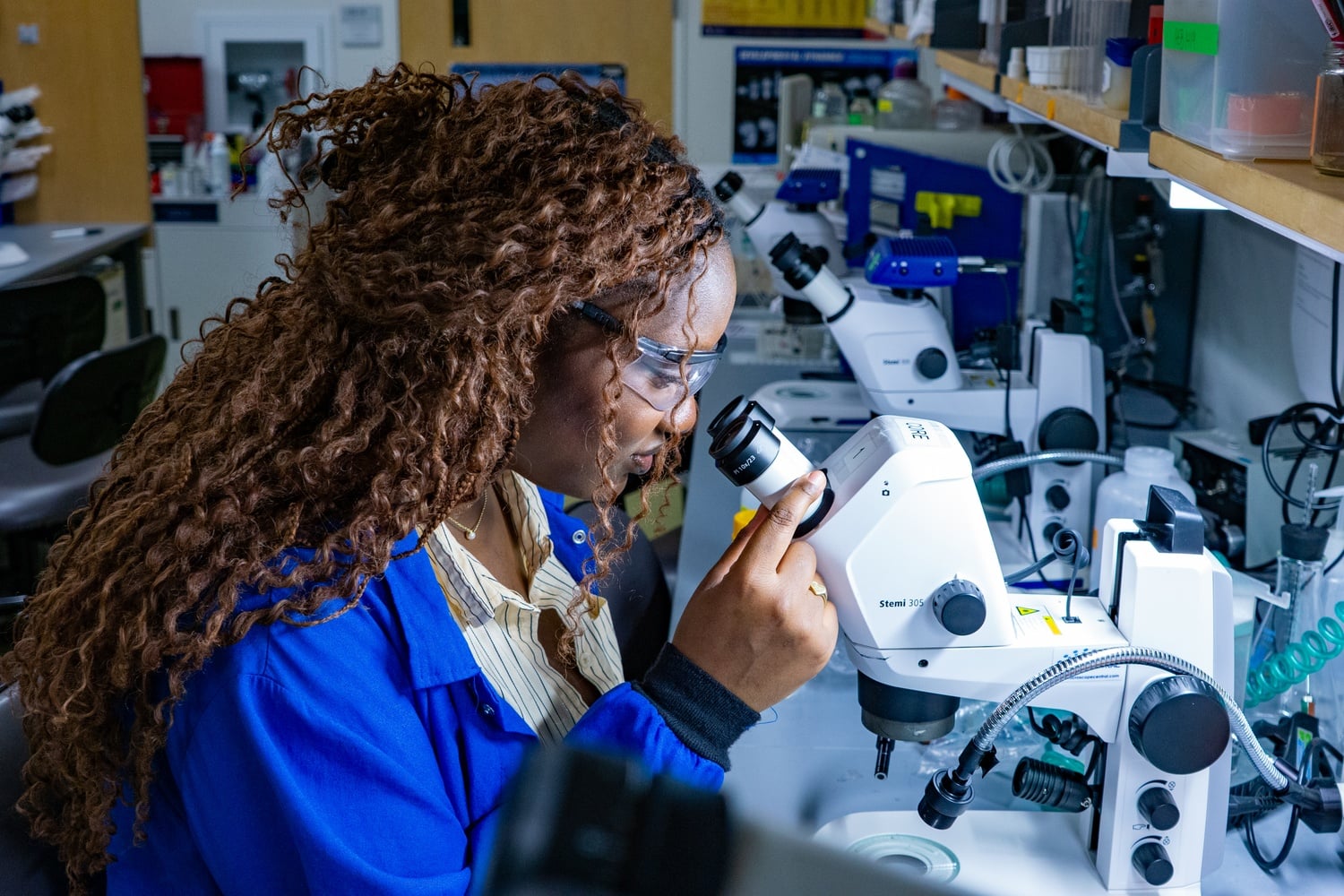
With the help of her research supervisor, Trevor Balena, Michaela has worked on various experiments to “track cells over time.” Thus far, by observing hippocampal cells’ responses to chloride solutions in mice models, she and Balena have found that chloride can cause cells to inflate to double or triple their original size. Furthermore, when washing away the chloride solution, she’s found that cells diverge in their responses: while some return to their original size, many remain inflated — what she calls a “limbo” state.
Now, her current task is assessing commonalities between these cells’ respective fates.
“It’s a rather laborious, meticulous process,” Balena, a neurology instructor at Harvard Medical School, says on a phone call a couple days after Michaela and I met. He explains how tracking those fates requires manually tracing the perimeter of each cell. “But she’s very good at it.”
As she walks me through her procedures, Michaela proves a master science communicator. She uses her hands effortlessly to model timepoints, or to explain laboratory instruments. I’ve never worked with the ImageJ software, but with her help, I’d say I’m pretty confident I know what I’d be looking for.
And we both laugh as she, like a young Neil deGrasse Tyson or Bill Nye, sympathetically tells me, “I’m trying to science this down.”
“If we can understand how this disruption of the ion gradients leads to the outcome of swelling and apoptosis — cell death — then we can, in the future, start thinking about how we can fix this and reduce some of the symptoms that come from head trauma and that leads to the swelling,” she says.
The results of her research could someday impact epilepsy patients directly. Balena explains the stakes: “A pediatric patient that comes into the hospital having sustained some head injury could be given a certain drug clinically immediately, or could be given something intravenously.”
Epilepsy, of course, is about more than just what’s happening in the laboratory: it is lived. Cultural values, access to care, and proximity to resources can all shape the way epilepsy is treated, medicated, and received by others.
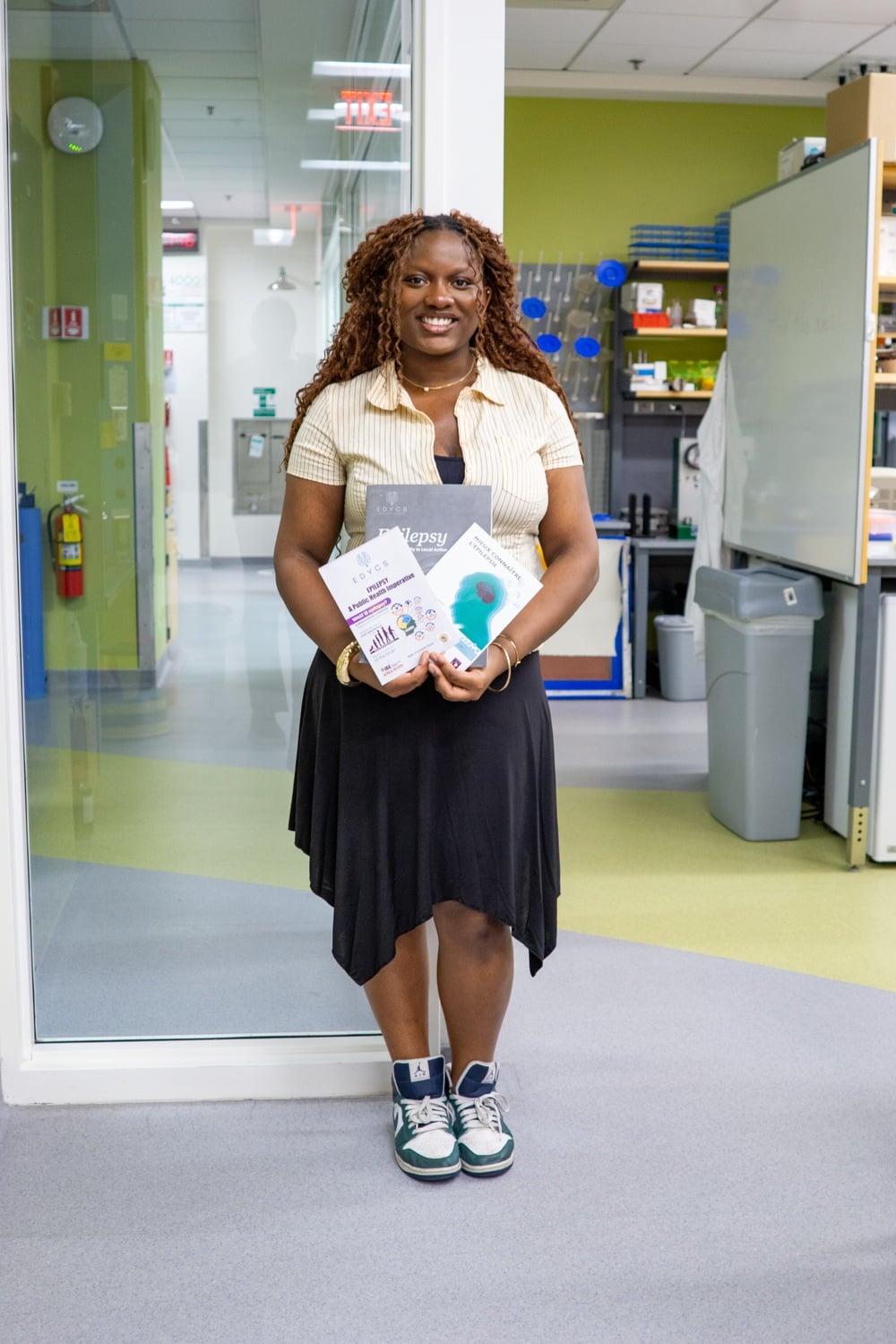
That’s why, for the second chapter of her thesis, Michaela travelled abroad. She spent two months in Mauritius and South Africa, traveling with organizations Epilepsy South Africa and Edycs Epilepsy Group, local branches of the International Bureau for Epilepsy, to better understand regional “epilepsy stigma gaps.”
“I went with them to schools, and we talked to students and to teachers about epilepsy and about the misconceptions and the misunderstandings behind the disease,” she explains.
The globetrotting, if anything, has kept her busy in her senior year: the week before our interview, she traveled back home to Canada to speak on a panel for a scholarship committee.
Going in, Michaela knew from her own experiences that reception to epilepsy varies, especially where knowledge about the disorder is sparse.
“I was worried to tell people around me, and I was worried to tell family members because of fear of people having superstitious ideas about epilepsy, which is true for a lot of African countries — and a lot of other countries, not just in Africa,” she says. Understanding how it felt to have people “tiptoe” around her served as her motivation to look at advocacy in the global south.
Travelling showed her the severity of the real-life consequences of epilepsy stigma. “We had some clients that were kicked out of their homes, so we had to find them homeless shelters that could accommodate their disability,” she tells me. Meeting with local policymakers also surfaced issues with education and access.
In one such case, Michaela explains how Epilem — an anti-convulsant medication — has become the catch-all treatment for epileptic seizures in many parts of Africa, even though there are specialized drugs for different forms of the disorder. “If you’re treating them all under the same cause,” she tells me, “not everybody is going to be treated, and it’s not going to work for everybody.”
Such discoveries come from Michaela’s self-directed field work. Throughout the summer, she conducted 100 interviews, collecting patient and caretaker insights detailing illness narrative and stigma. She asked her participants — including patients, educators, and health practitioners — about their experiences with epilepsy before and after diagnoses. She also looked for qualitative measures, such as whether or not they felt the disease was understood, and the specific role spiritual belief and allopathic medicine played in providing care.
Her findings show, broadly, “that people just don’t know a lot about epilepsy.” For example, to treat seizures, Michaela found that some communities attempted to intervene in seizing patients by shoving a wooden spoon or sock in the mouth. This, she notes, is contrary to a key principle of seizure first aid: to “keep the airway as open as possible.”
Misinformation, Michaela emphasizes, works at varying scales. It can affect communities thousands of miles away, from Mauritius and South Africa, to those much closer to home — in and around Harvard and in grade school classrooms.
Pressing her hands flat on the table, she tells me how a lack of familiarity with epilepsy in Canada led to humorous, albeit empathetic, considerations.
“My classmates, they knew nothing about epilepsy, and I had a family member ask me whether I could watch Incredibles 2, or whether that was going to cause me to have a seizure,” recalls, laughing.
I find her laughter contagious. As folks walk by, they wave, many stopping to say hello. One, perhaps in jest, inquires if I’m her advisor, and we indulge in a conversation about how one is chosen for a senior superlative in the first place. Everyone who stops to see Michaela leaves with a smile on their face.
Juliet E. Poole ’27 and Michaela grew close while grinding away at pre-med courses their sophomore year. Now, they’re best friends, and recently finished their term as co-presidents of the Harvard Undergraduate Black Health Advocates. Her work at HUBHA reminds me just how busy she is. On top of her thesis, Michaela works four jobs (or five, Michaela and I both lose count) while taking five classes.
“She’s a super vibrant person,” Juliet says over the phone. “It’s crazy to see someone so academically-focused, but also such a people-person as well.”
If one thing is true of Michaela’s work, it’s that science and the everyday intermix.
“Our body works with so much else,” she emphasizes. “It’s not just like the biological stuff.”
She adds, “Having four sisters, coming from a low income background, being the daughter of a single parent, and being Nigerian and growing up Nigerian — those are things I can’t separate from myself. So implicitly, I just apply it to my understanding of the world and my understanding of my career.”
Her advocacy — in the lab, in the clinic, and even thousands of miles from campus — crystallizes a life-long commitment to serving those with epilepsy.
“I’d love to work in epileptology and really continue working with kids that have epilepsy,” she says, later adding, “so that people don’t go through the things that I’ve been through.”
—Associate magazine editor Christopher Schwarting can be reached at [email protected].