
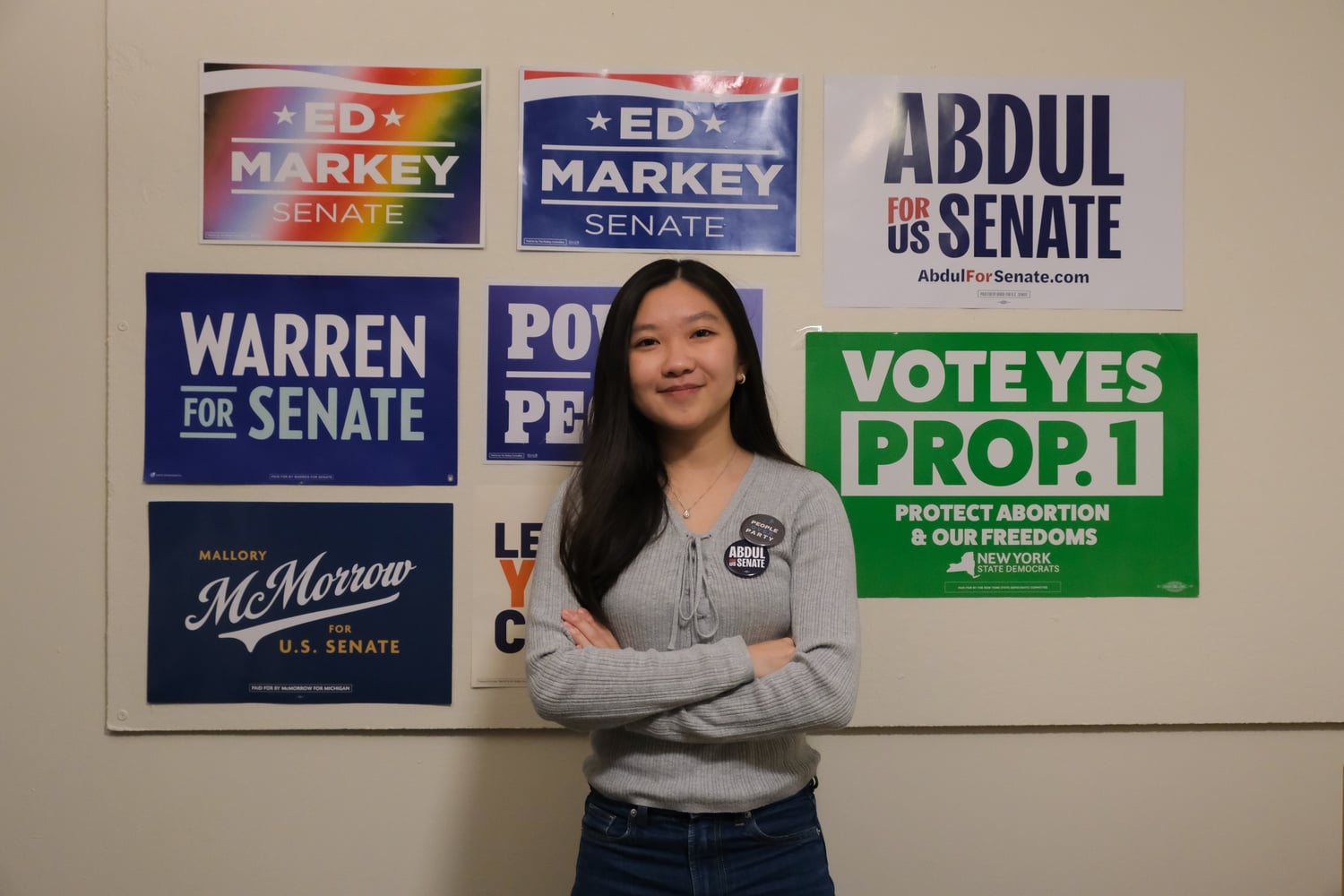
Most Likely to be President: Mandy Zhang
Mandy worked on three Senate campaigns in this year’s midterms. She led the Harvard College Democrats as president and ran the Massachusetts Coalition of Young Democrats as its chair. While her work in politics now seems like a natural given to those who know her, it was never inevitable.
Mandy Zhang ’27 was 16 when she first learned about book banning.
Her district, New York’s Dutchess County, had just banned “Gender Queer: A Memoir,” an autobiographical comic about nonbinary identity. She discovered the decision in a virtual school board meeting and felt unsettled. “Something just doesn’t sit right,” she says. “I had no idea what I was doing.” Confused and upset, Mandy dove into the internet and found that her district was one of many U.S. counties that prohibited “Gender Queer,” among other contested literature, in their libraries and schools.
Virtual school board meetings were not well-attended, and Mandy wanted people to know what happened. She wasn’t sure where this movement would go or what the political significance of book banning was, but she “just felt like it wasn’t right.” Determined, Mandy started a petition on Change.org and began publicly speaking out about the ban in her district.
Her activism quickly caught the attention of local and national news. At 16, Mandy was asked to speak at universities, news cables, and political campaigns about her work. Beyond her book-banning activism, however, Mandy did not know much about advocacy or the American political system: “At that point, I didn’t really know anything about politics. I did not know what it meant to be a Democrat or a Republican.”
At some point, she felt overwhelmed by the attention and online criticism directed at her. “I think 16-year-old me was crying on a school bus because I was like, oh my god, there’s so much hate. There’s so much hate. And I had really thin skin.” She says this with a matter-of-factness: she didn’t have thick skin then, but she has it now. Since then, Mandy worked on three Senate campaigns in this year’s midterms. She led the Harvard College Democrats as president and ran the Massachusetts Coalition of Young Democrats as its chair.
While her work in politics now seems like a given to those who know her, it was never inevitable. Mandy was born in New York to immigrant parents: her parents ran a restaurant, and her dad also worked at a sushi restaurant and repaired air conditioners. Growing up, she helped pack delivery bags and make crab rangoons. She competed in Science Olympiad and thought that she would eventually become a doctor. Politics was an afterthought. Her parents’ philosophy was to study, get good grades, go to a great school and gain a professional degree: “keep it down low, don’t cause a ruckus, just keep your head down.” Mandy was well down this path in high school, until the school board meeting pulled her in a new direction.
Mandy joined the Young Dems as a freshman at Harvard. “I don’t know anything about politics,” she recalls telling them at the activities fair. But she was interested in their work and thought she’d try nevertheless.
Upon attending the first meeting, Mandy felt completely overwhelmed. “I genuinely felt like I was the dumbest person in the room. That I feel like, I don’t belong here,” she says. Mandy kept showing up anyways, attending meetings and jamborees — events where the Young Dems endorsed a candidate.
Mandy now riffs on the names of politicians and campaigns easily and speaks about them fondly, even referring to some as friends. She has also adopted much of the populist mindset of the Democratic party: “I think Washington is corrupt,” she says. “I think we should elect more candidates who are actually standing with working people instead of elites,” and “we want to bring Democrats back to the working people instead of for elite billionaires.”
When I ask her about her position in this question of elitism — as the daughter of immigrants, a first-generation low-income student now at an elite institution — she takes a moment to think. “I do criticize the fact that people are being harmed by those same people who are in Wall Street and especially private equity, and how they’re taking over many different areas and boosting up prices for regular working people,” Mandy responds.
Still, she has some experience in finance herself — a few stints in Wall Street prep workshops and a Goldman Sachs preparatory program. She’s also a 2025 Girls Who Invest scholar.
I ask her about this paradox, and she attributes her decision to venture into finance, at least in part, to peer pressure at Harvard — and also the possibility of making a generous income as a FGLI student. Her sophomore year, she participated in the recruitment process with finance and consulting companies. When interviewers, puzzled by her political experience, asked why she wanted to work at their companies, Mandy was at a loss.
She stopped recruiting in the middle of the process. “I felt like I was trying to mold myself into someone that I wasn’t,” she says. “I just felt like a number.”
Now, Mandy is fully devoted to campaign work. She hopes to work on the 2028 presidential race after graduating and has an impressive resume of political work to boot — serving as a Youth Advisor on Ed Markey’s Senate campaign, working as a digital strategist on Troy Jackson’s Senate Campaign, moving to Michigan for a summer to work on Mallory McMorrow’s campaign, and popularizing Jackson’s viral Senate campaign slogan.
It was after the first of four debates between Maine Senate candidates, incumbent Susan Collins and Jackson. Collins boasted about getting road salt off the tariff list, and Jackson responded with, “We can’t eat road salt.” Mandy thought this slogan would stick: “I was like, ‘That’s gonna go viral.’” She designed signs, stickers, shirts, and buttons emblazoned with the slogan. And it worked — the slogan took off.
“I can’t believe we elected a logger to the U.S. Senate,” she says. “Troy Jackson. He’s a working class champion.”
All the people I speak to who know Mandy — professors, principals, and friends — mention her passion and work ethic. It’s a hard balance to strike. Mandy sheepishly admits that leading up to election day, she often sat in the back of her classes, making designs and posters for a campaign.
Emefa Dake ’27 says that Mandy regularly sacrificed sleep as Election Day neared. Dake texted her friend to encourage her to take care of herself, and recalls that Mandy wrote back saying, “I’m not going to do that until I know that no matter what, everybody, no matter who they are, is able to afford food.”
“I kid you not,” Emefa says.
Mandy admits to sleeping fewer than three hours each day during the final weeks of the campaign, running on adrenaline, Vita chrysanthemum tea, and power naps. (Coffee makes her sleepy.) She didn’t seem to mind, however, convinced that her work was the most important. “I feel like I can outwork them,” she says, referring to the “billionaires who were trying to elect Susan Collins.”
“I can sleep when I’m dead,” Mandy adds.
Hearing Mandy describe her work makes campaigning sound like a small world. McMorrow’s deputy communications director asked Mandy whether she wanted to drop out of school to work full-time on the campaign before McMorrow suspended her bid in July. Mandy herself likens the political world to the fast-paced entrepreneurial world: “It’s like political nerds coming around and launching a startup, and you’re raising millions of dollars in such a short time, and then organizing people to elect someone you truly care about.”
But Mandy doesn’t know if she’ll stay in the campaign world forever. The first time I ask about her envisioned future, she says she doesn’t know. “Maybe I’ll run for office one day. Maybe not,” she says. But a few minutes later, she tells me she wants to work on campaigns in her early 20s, then run for Congress in her own district.
“Maybe I’ll be totally wrong, and I’ll still be running campaigns when I’m 60 years old,” she says. “I don’t know.”
As we leave Mather, Mandy confides that she was “really surprised” to be named Most Likely to be President. To her friends, however, the nomination is no shock: “Words can’t really stress how amazing of a person that she is and how hardworking a person that she is,” Emefa says.
Mirika Jambudi ’27, the Crimson Blog Chair, is similarly effusive about Mandy. “She is just so committed to the things that she does, and innovative, and definitely will be like a future president or government official making change,” Mirika says.
A few hours before I finish writing this piece, Mandy posts on her Instagram:
“Everyone, meet SENATOR-ELECT @troyjackson207! 🦞🪵🌲 WE JUST ELECTED MAINE’S FIRST DEMOCRATIC U.S. SENATOR IN OVER 30 YEARS!!! So much love for Team Troy! What a campaign, what a team, and what a historic win 🥹 the MANY will always beat the MONEY! and sorry to my professor for making @troyjackson207 and @berniesanders’ graphics during class lol #maine #portland #college #politics”
—Associate Magazine Editor Claire Jiang can be reached at [email protected]