
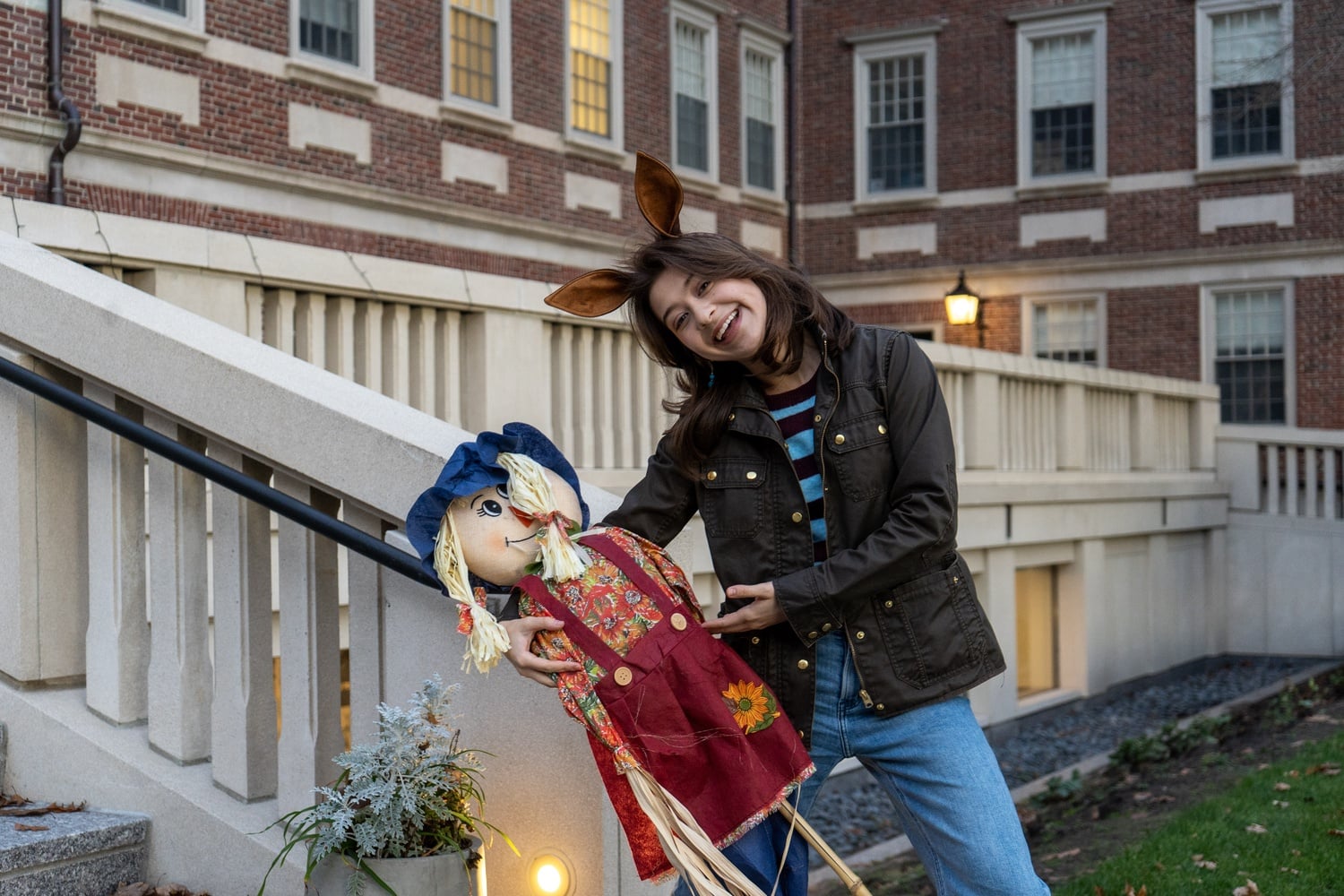
Most Whimsical: Clara Shapiro
One might consider whimsy to be an airy quality, but to Clara, it is “quite earthy.” Whimsy is a way of grounding yourself in your own view of the world, however different it might appear to others.
Having stepped into the picturesque lobby of Gore Hall, I announce my arrival over iMessage to Clara E. Shapiro ’27, a former Crimson Magazine editor.
“I will come SEIZE you,” she immediately texts back, and seized I am — first into a bounding hug, and then into the colors and textures of her cozy Winthrop dorm.
Inside the common room hangs a poster that reads, in loud block letters, “WHAT HAPPENS IN THE MOM CAVE OFTEN GOES UNDER APPRECIATED.” It is a relic from her freshman year in Lionel A, when her room served as the entryway’s unofficial snack depot. True to form, Clara offers me a chunk snapped off from a giant bar of Trader Joe’s chocolate.
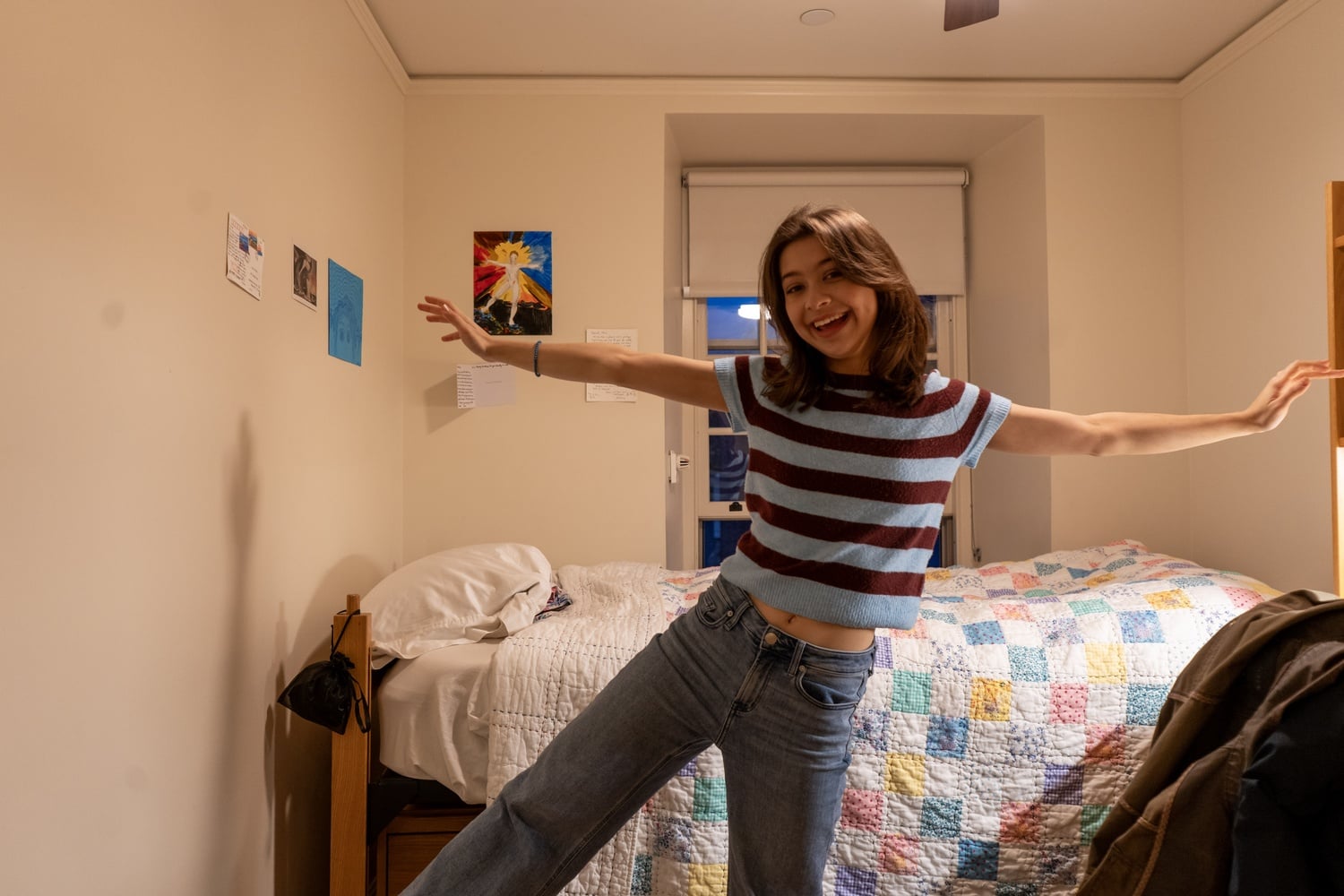
Chocolate slowly melting in our hands, we move to her bedroom. Hanging directly across her pillow is “Blue Guy,” a drawing with an indescribably manic expression, penned by one of her suitemates. “He was originally a resident of the common room, but he was so disturbing that he had to be moved to stare directly at me,” Clara says. “He watches me when I sleep.”
Blue Guy makes uncomfortable eye contact with both of us.
Her room, she tells me, is “in some ways a shrine” to the 18th-century English poet and artist William Blake. His texts line the shelves while postcards of his paintings pepper the walls.
Most notable is a rendering of Blake’s painting “The Dance of Albion,” recreated by another one of her suitemates. In it, the primeval man Albion bursts free of what Blake called “mind-forg’d manacles,” depicted in the painting as an explosion of light.
“That can mean so many things in the modern day,” Clara says, leaning forward. “Conformity is a mind-forged manacle. In some ways, rationality, when taken too far, he argues, can be a mind-forged manacle, and this is when he bursts free from that, and he restores himself to a natural state of creativity and joy.”
Clara’s appreciation for Blake began during the pandemic, when she rediscovered her grandfather’s old, annotated copy of Blake’s poems.
She was, like many first-time readers, confused. “He’s a really weird guy,” she admits. But she kept reading, until Blake became “an element of my personal Bible.” Now, every November 28, his birthday, she writes a quote on the back of a card and sticks it to the doors of her neighbors, so that each person receives “a personal love letter from William.”
What she loves most is what Blake termed “fourfold vision”: being able to see the world through several planes at once. As a boy, Blake once told his parents he had seen a tree filled with sparkling angels. Sternly, they told him not to lie.
“But to him, of course, it wasn’t a lie,” Clara says. “It was simultaneously just a tree, but also, in the mind’s eye, it was filled with angels.”
When I ask what she sees when looking at a tree, Clara quotes Blake himself: “The tree which moves some to tears of joy is in the eyes of others only a green thing which stands in the way.” That tension, she says, is one she lives with. “To view things as purely physical and in some ways, finite, and then also to see the twofold sight of the infinite,” she says.
Seeing fourfold the title of Most Whimsical bestowed upon her was initially baffling. “What the heck is whimsy anyway?” Clara reads from a journal entry she wrote upon learning of her nomination.
“We’re living in a world that wants us to become fixated with categories: success versus failure, young versus old, beautiful versus ugly,” she reads. “Whimsy to me means accepting things and creations, and that includes people, as something unique and irreplicable.”
One might consider whimsy to be an airy quality, but to Clara, it is “quite earthy.” Whimsy is a way of grounding yourself in your own view of the world, however different it might appear to others.
“It’s so easy to let society put you on autopilot, and to suck in all of these ideas as if they’re your own for how to live your life, what constitutes a good life,” she says. “As Emily Dickinson says, ‘Much Madness is divinest Sense / To a discerning Eye / Much Sense - the starkest Madness.’”
Beyond Blake and Dickinson, Clara admires the Irish poet Seamus Heaney, whose writing she describes as healing without being sentimental. She is particularly fond of Heaney’s poem “The Gravel Walks,” which begins with imagery of the literal production of gravel before transforming into a traditional Irish fiddle tune. The poem’s final lines include an invitation to the reader: “Walk on air against your better judgment.”
For Clara, Heaney is ultimately a poet of hope rather than naïveté, a distinction that is significant to her as a half-Jewish, half-Korean writer who grew up under the shadow of historical atrocity. How, she wonders, can anyone confidently promise that things will turn out all right?
“Because we don’t know the plot of the world, we can still hope,” she says. Clara hopes “to walk on air against my better judgment, no matter what happens.”
This act of toeing the boundary between earth and air endures in other aspects of her life, too. An English concentrator, Clara is writing her thesis, a work of narrative nonfiction, about industrial farming and what she sees as its sickness, through the story of Tom Brazie, a small-scale farmer based in New Marlborough, Mass. She met him when she “forced him” to employ her one summer as a farmhand in high school.
Whimsy lives everywhere. At Harvard, Clara has found a particularly high concentration of it in On Thin Ice, the improv troupe she has performed with since freshman year.
“You don’t get into improv by being sane,” she says. “I like to think that improv is like a collective dream.” Because it is so spontaneous, she explains, it can feel as though people’s subconscious minds are speaking to one another. For Clara, that kind of play is not confined to the stage. “Everybody has a part inside of them that wants to play.”
It is also a trait that runs in her family, who she says is “simultaneously very serious and very goofy.” Her grandfather, for example, enjoys serenading her with songs about Chinese soups. Clara offers a taste of his greatest hit, which begins as follows: “Have a drop of egg drop, and you’ll be glad you did.”
Whimsy can even be found in the most mundane of places, including in G400BA3, the all-gender hallway bathroom, which she and fellow Winthropian Christian Ogata ’29 have immortalized with an Instagram account, @gore4bathroomcore. The account documents minor flooding emergencies allegedly caused by students’ misuse of the shower curtain (“If God agreed in the Book of Genesis not to flood the earth anymore, why should we flood Gore4BathroomCore?”), as well as the time she dropped her toothbrush on the checkered ground (“At 1 am I dropped my toothbrush on the wet shower floor, 2nd stall. But my tragedy was soon replaced with strategy. #CVS #24hours”).

In an emphatic Instagram reel, Clara notes that she was not brushing her teeth in the shower: “I believe in the separation of church and state, shower and tooth brushing.”
The account is perhaps an unlikely extension of Clara’s larger philosophy: that there is room for imagination and community even in the most unremarkable places. On October 11, @gore4bathroomcore posted an iMovie-edited masterclass for the showering student body writ large (“A step-by-step shower curtain tutorial by expert showerers ÈBÙN and LIAM”).
As we peek inside the bathroom, the floor is, true to the Instagram page, flooded.
When asked how a person might live more whimsically, Clara objects to what she sees as the gatekeeping of creativity. “Everybody has the right and the potential to create,” she says.
She cites a friend from her semester studying abroad at Worcester College, Oxford, who calls it “the romance of the attempt,” or the belief that there is nobility in trying, always. “It’s not meant to be perfect,” she says. “It’s meant to be free.”
Clara offers me a theory she has held since middle school. “The only thing, in my view, to ever be ashamed of is hurting other people,” she says. “But being weird? That’s not a crime. Who are you damaging by being yourself? Who is personally harmed by you singing to subway poles, or pretending that your feet are puppets, or whatever the hell you are called to do?”
Before I leave her room and the tender embrace of William Blake, Clara offers me another bite of chocolate from the giant bar — a little snack for the road.
I take the opportunity to sneak a glance at Blue Guy one last time. From the corner of my eye, I can see angels sparkling everywhere.
— Magazine writer Elane M. Kim can be reached at [email protected]