
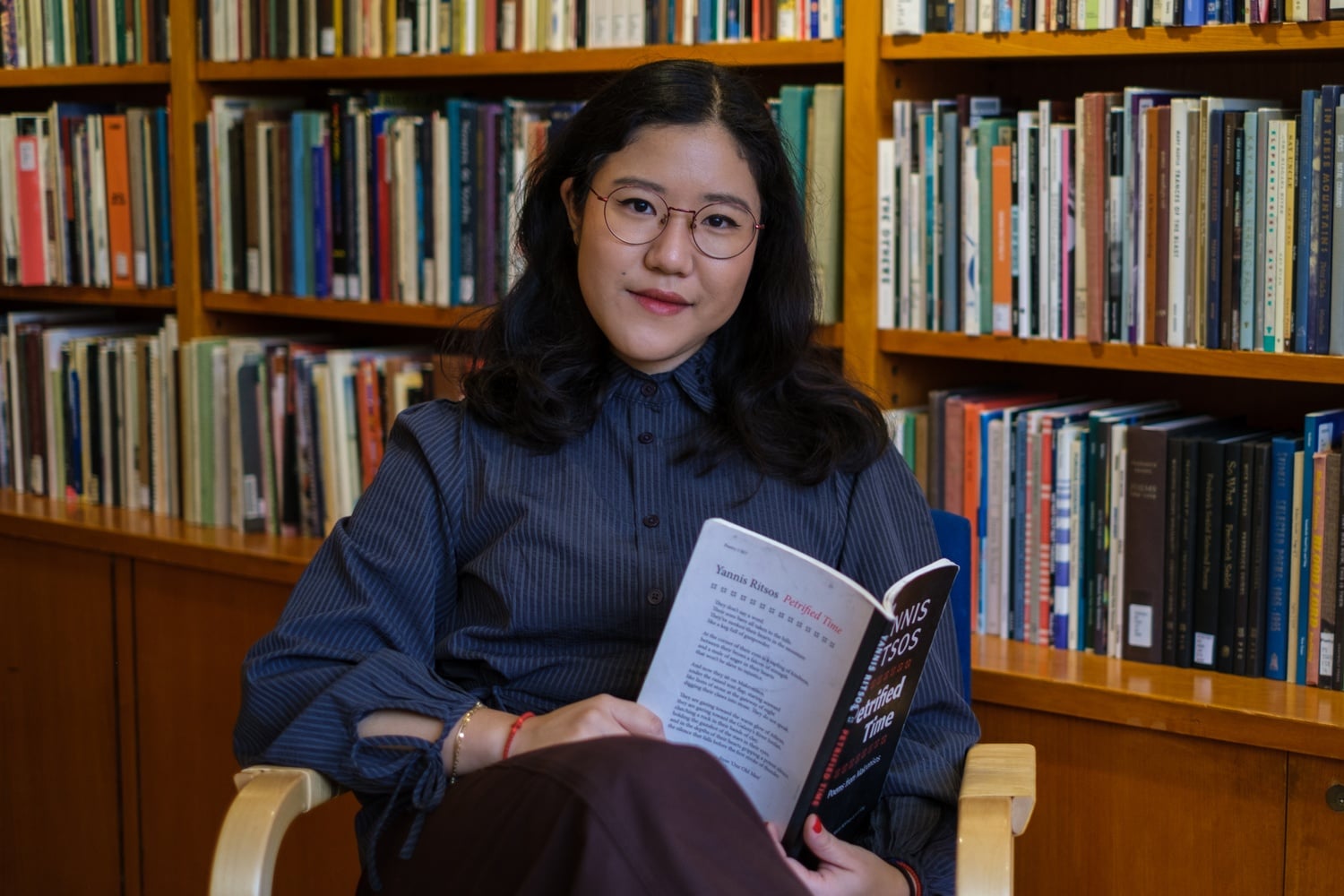
Renaissance Person: Louise Kim
In Louise’s telling, nothing on her list of interests is evidence of separate lives.
Last March, Louise S. Kim ’27 flew to Athens to look through the personal archives of 20th century Greek poet Yiannis Ritsos. With permission from his daughter, now 71, Louise began reviewing his papers. Among them was a collection of poems that, she says, had never been discovered before.
Ritsos had written them on Makronisos, an island that served as a political prisoner camp in the Greek Civil War, waking at 5 a.m. in his tent to write under the fragile dawn light. The poems were later smuggled off the island. “What does that tell us about the role of art?” Louise says. “The role that art can serve in sustaining a person, and sustaining a people, and sustaining stories?”
At the time of her visit, Louise had been learning Greek for just two months — now, she is revising English translations of two of the poet’s collections, with hopes to eventually bring them to publication.
The pursuit is one of the more unlikely ambitions on Louise’s long list. She is a double concentrator in Sociology and English, with a secondary in Economics. She revived a campus literary magazine, passed a wine certification exam, and will start consulting at Mastercard after graduating in May. When asked what she studies, Louise named her fields, but quipped that she is pursuing “a double concentration in experiential learning and culture, and a secondary in risk and taking risks.”
Louise says being named this year’s Renaissance Person is something she is proud of, but says it may come with the connotation of someone who is a collector of disconnected interests. In Louise’s telling, nothing on her list is evidence of separate lives. Each pursuit is a way of getting closer to people — a new language that allows her to converse with a stranger, a magazine that gathers storytellers, a glass of wine that links a winemaker to consumers half a world away. “I love people,” she says. “I’m fascinated by people and how they organize, express themselves, and determine what they value.”
Her method is as consistent as her motive. Louise values dropping herself into a new language or industry and learning its every kink and quirk from the inside out.
She picked up the habit in northern Italy, enrolling in a Harvard study abroad program that included beginner Italian classes the summer after her freshman year. Three weeks later, Louise was encouraged to move up to the intermediate-advanced section. By the end of the nine-week program, she was comfortable speaking with everyone from the owner of a wine store in Montepulciano to children playing in a park in Siena. Knowing the language, she realized, would let her “bear witness” to others’ lives.
The study abroad program also wove winemaking and sommelier culture into its curriculum and immersed students in the medieval traditions of Siena, which revolve around a horse race Louise calls the city’s “heartbeat.” She returned to Siena the following year and received permission to join the city’s 2,000 residents in their ceremonial games. That year, the team she joined won the race for its first time in more than a decade.
Italy also taught Louise something about herself — exploring the city streets on her own, she says, helped her realize that she found unfamiliar cultures both “intellectually incredibly energizing” and “socially energizing.”
“If I can put my mind to it, I can do it,” she says.
Greece, she says, was a bigger gamble. The summer after her sophomore year, Louise spent a little more than two months in Athens at an international democracy nonprofit, and returned the next October to assist with a conference she helped organize. On her first day, she did not know a word of Greek. And so, she set out on her own, equipped with Google Maps and Google Translate, to track down traditional dance performances and jazz ensembles made up of Greeks from all over the archipelago country. What she took from this, she says, was an exposure to “the common people and the common culture.”
Back on campus in the fall, Louise decided that her final two years of college would be the best place to learn Greek — a language she otherwise had no connection to — and she started classes that January. Her interest in translation, she says, was an accident. While reading English translations of the work of a poet she had first read in Humanities 10a: “A Humanities Colloquium: From Homer to Morrison,” Louise noticed what she took to be errors and began retranslating for her own “intellectual enjoyment”. Now, with a grant from the Harvard College Research Program, she has expanded this project to officially retranslate two poetry collections.
Louise is not writing a thesis. Her interests, she says, could not be properly captured by either Sociology or English, so she has reallocated time to her “intellectual and literary and qualitative and historical project” of translation which also has a different public-facing goal of publication.
Though she has only studied Greek for a few months, Louise points to 11 years of writing poetry, four years of tutoring creative writing and other subjects, and the languages she already speaks — English, Korean, French, and the Italian she learned studying abroad — as aids in her translating endeavor.
The project has also brought her close to Ritsos’s family. Louise is now close friends with his daughter, and has visited her on the Greek island Samos, listening to stories about her father and talking about “everything from religion to poetry.” She has begun learning the bouzouki, a Greek stringed instrument she says connects her to “the past century of Greek culture and resistance,” and she hopes to take an official Greek proficiency exam at the C1 level — which represents advanced proficiency in the language — this May.
Wherever Louise’s interests lead, they tend to end with a group of people. In 2025, she revived Tuesday Magazine, which she describes as Harvard’s only literary magazine devoted to publishing writing and art from students across the College and all of its graduate schools. She heard about the opening when the publication’s last leader, from several years earlier, shared it in the English department newsletter.
Louise also previously co-directed the Hum 10 mentorship program, has answered emails for the Phillips Brooks House Association’s Small Claims Advisory Service since freshman fall, and sits on the board of the Harvard Undergraduate Symphony Society —which brings students, many of whom have never attended a classical concert, to Symphony Hall in Boston to hear the Boston Symphony Orchestra play. Through the Undergraduate Hellenic Society, she practices her Greek and helps organize gatherings themed on conversation about literature and politics. Last year, she also served as a research assistant to sociology professor Michèle Lamont to study trends around democracy and social recognition.
Wine was a rare interest Louise didn’t see a ready-made community for — so she made one herself. Italy had introduced her to winemaking, then in her sophomore year, Louise took a two-week trip to Georgia with Harvard’s Davis Center for Russian and Eurasian Studies, which put her in touch with the wine industry, from commercial vineyards to family-run shops.
Soon after that trip, Louise studied for and passed the WSET Level 1 certification, an international wine exam, and started talking to dozens of people in the food and wine world, many of them Harvard alumni. She quickly landed a summer internship with a Manhattan wine distributor for the summer after her junior year, where she worked on business strategy and operations. “It was such a risk,” she recalls, because she did not know any other undergraduates pursuing work in the wine and spirits industry.
What interests her, she says, is that wine differs so much based on the land where it is made. In Georgia and Greece, she encountered traditions that stretched back thousands of years, and picked up on the ways sellers have adapted them over centuries. On the business side, it pulls in geopolitics and data tracking. The thing she loves most, though, is the fact that a grape grown thousands of miles away can end up in a strangers’ glass.
“It’s a sector in which you have to be thinking about many different things and factors at once,” she says, “and that’s generally the kind of environment that I love.”
Now, Louise is part of the Harvard Undergraduate Wine Society, and expects to be “forever interested” in the industry.
She took up consulting, she says, on a whim freshman year. Louise joined Harvard Undergraduate Consulting on Business and the Environment without knowing much about what consulting was or how to do it. Her projects have since ranged from a national food bank nonprofit to agricultural marketing strategies to legal technology. She loved how quickly she was forced to learn, and says it was also an exercise in understanding what other people need and then building something to fit those needs.
To Louise, the data that drives her consulting work is not a departure from her interest in literature. “I think of data also as a narrative,” she says. Literary analysis, as she describes it, involves gathering evidence from a text, an author’s history, and a historical context to piece together a puzzle. Consulting, she says, requires a similar method.
Next year, Louise will work at Mastercard’s consulting arm in the Washington, D.C., area, focused on experimental design. When a company runs a promotion across a number of stores, she explains, Mastercard analyzes card data to see which populations were most affected and then recommends next steps. She finds a “sociological premise” in the work, she says, and sees it as an opportunity to advance the quantitative skills that will make her more confident in telling stories numerically.
Is it a stepping stone? “10,000 percent,” she says. She has also considered law school or a Ph.D., but prefers being “a generalist more than a specialist,” and says she is “incredibly open-minded about where that takes me next.” Louise also hopes to publish both Greek translations and to keep writing poetry, as she has been doing for half her life.
Louise’s past and plans for the future are also mediated by her theological commitment, specifically her Catholic faith, which she says has only deepened since she began at Harvard.
“I would say that my faith is the foundational lens through which I see the world,” she says.
Louise explains how her religion relates to the groups she joins and creates. “I, through my faith, have come to see any community or gathering people as like a site of care and love and reciprocity,” she says.
She adds that her theology also explains her pull toward serving populations facing hardship. This connects to her work in poetry, she says. Though the texts Louise discovered were not religious writing, she was moved by the fact that someone facing such oppression still “had such a great capacity for love.”
For Louise, following the miscellaneous connections between her interests was always intuitive. “I’m very kind of unabashed about my multitudinousness, and I am always hopeful that it helps other people embrace their multitudes within them as well,” she says.
—Magazine Editor-at-Large Caroline G. Hennigan can be reached at [email protected]. Follow her on X @cghennigan.